
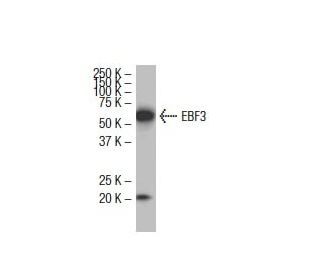

EBF3 Antibody (N7Q): sc-81999
- EBF3 Antibody (N7Q) is a mouse monoclonal IgG1 κ EBF3 antibody provided at 100 µg/ml
- raised against recombinant EBF3 of human origin
- recommended for detection of EBF3 of mouse, rat and human origin by WB, IP and ELISA
- See EBF (C-8): sc-137065 for EBF3 antibody conjugates, including AC, HRP, FITC, PE, Alexa Fluor® 488, 594, 647, 680 and 790.
- At present, we have not yet completed the identification of the preferred secondary detection reagent(s) for EBF3 Antibody (N7Q). This work is in progress.

QUICK LINKS
EBF3 Antibody (N7Q) is a mouse monoclonal IgG1 kappa light chain antibody that detects EBF3 protein of mouse, rat, and human origin by western blotting (WB), immunoprecipitation (IP), and enzyme-linked immunosorbent assay (ELISA). Anti-EBF3 antibody (N7Q) is available as the non-conjugated form. EBF3 plays a crucial role in B lymphocyte maturation, a process essential for adaptive immune response. As a transcription factor, EBF3 regulates gene expression necessary for B cell development, including components of B cell receptor and B lymphoid kinase, which are vital for initiating immunoglobulin light chain gene recombination and signaling pathways. EBF3 is predominantly localized in the nucleus and can form homodimers or heterodimers with other family members, enhancing regulatory capabilities. EBF3′s ability to bind specific DNA sequences, particularly the core sequence CCCNNGGG, through a zinc-coordination motif in DNA-recognition domain underscores importance in transcriptional activation. Additionally, EBF3 exists in two isoforms due to alternative splicing, which may contribute to functional diversity in various cellular contexts.
Alexa Fluor® is a trademark of Molecular Probes Inc., OR., USA
LI-COR® and Odyssey® are registered trademarks of LI-COR Biosciences
EBF3 Antibody (N7Q) References:
- Early B cell factor is an activator of the B lymphoid kinase promoter in early B cell development. | Akerblad, P. and Sigvardsson, M. 1999. J Immunol. 163: 5453-61. PMID: 10553071
- Overlapping expression of early B-cell factor and basic helix-loop-helix proteins as a mechanism to dictate B-lineage-specific activity of the lambda5 promoter. | Sigvardsson, M. 2000. Mol Cell Biol. 20: 3640-54. PMID: 10779354
- EBF3 reactivation by inhibiting the EGR1/EZH2/HDAC9 complex promotes metastasis via transcriptionally enhancing vimentin in nasopharyngeal carcinoma. | Ding, S., et al. 2022. Cancer Lett. 527: 49-65. PMID: 34906623
- Duplication/triplication mosaicism of EBF3 and expansion of the EBF3 neurodevelopmental disorder phenotype. | Ignatius, E., et al. 2022. Eur J Paediatr Neurol. 37: 1-7. PMID: 34999443
- Neurologic, Neuropsychologic, and Neuroradiologic Features of EBF3-Related Syndrome. | Ciaccio, C., et al. 2023. Neurol Genet. 9: e200049. PMID: 37090941
- Circadian clock protein Bmal1 accelerates acute myeloid leukemia by inhibiting ferroptosis through the EBF3/ALOX15 axis. | Wang, D., et al. 2023. Cancer Sci. 114: 3446-3460. PMID: 37271497
- Ebf3+ niche-derived CXCL12 is required for the localization and maintenance of hematopoietic stem cells. | Nakatani, T., et al. 2023. Nat Commun. 14: 6402. PMID: 37880234
- Failure of B-cell differentiation in mice lacking the transcription factor EBF. | Lin, H. and Grosschedl, R. 1995. Nature. 376: 263-7. PMID: 7542362
- EBF contains a novel zinc coordination motif and multiple dimerization and transcriptional activation domains. | Hagman, J., et al. 1995. EMBO J. 14: 2907-16. PMID: 7796816
- Molecular cloning of the olfactory neuronal transcription factor Olf-1 by genetic selection in yeast. | Wang, MM. and Reed, RR. 1993. Nature. 364: 121-6. PMID: 8321284
- EBF and E47 collaborate to induce expression of the endogenous immunoglobulin surrogate light chain genes. | Sigvardsson, M., et al. 1997. Immunity. 7: 25-36. PMID: 9252117
- The B29 (immunoglobulin beta-chain) gene is a genetic target for early B-cell factor. | Akerblad, P., et al. 1999. Mol Cell Biol. 19: 392-401. PMID: 9858563
Ordering Information
| Product Name | Catalog # | UNIT | Price | Qty | FAVORITES | |
EBF3 Antibody (N7Q) | sc-81999 | 100 µg/ml | $339.00 |