
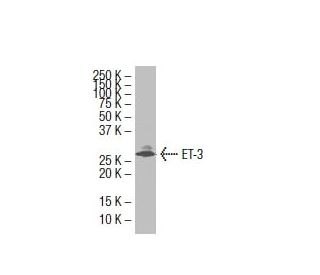

Endothelin-3/EDN3/ET-3 Anticorpo (5E8): sc-81944
- Endothelin-3/EDN3/ET-3 Anticorpo 5E8é um anticorpo monoclonal produzido em camundongo IgG1 (kappa light chain) Endothelin-3/EDN3/ET-3 anticorpo fornecido em 100 µg/ml
- ativado contra recombinante ET-3 de comprimento total de origem human
- recomendado para a detecção de ET-3 of human origin by WB, IP and ELISA
- Atualmente, ainda não concluímos a identificação do(s) reagente(s) de deteção secundário(s) preferido(s) para Endothelin-3/EDN3/ET-3 Anticorpo (5E8). Este trabalho está em curso.

O anticorpo ET-3 (5E8) é um anticorpo monoclonal ET-3 IgG1 κ de camundongo (também designado anticorpo EDN3, anticorpo Endotelina 3 ou anticorpo ET3) que detecta a proteína ET-3 de origem humana por WB, IP e ELISA. O anticorpo ET-3 (5E8) está disponível como anticorpo anti-ET-3 não conjugado. A família de proteínas da endotelina (ET) são péptidos vasoactivos que estão envolvidos em várias funções em todo o corpo. A ET-3 (endotelina 3), também conhecida como EDN3, é uma proteína segregada com 238 aminoácidos que pertence à família das endotelinas e é essencial para o desenvolvimento neuronal adequado. Expressa nos vasos das vilosidades da placenta e nos trofoblastos, a ET-3 funciona como um ligando para o recetor da endotelina tipo B (ETBR) e, através desta interação, medeia a maturação dos neurónios entéricos e dos melanócitos. Embora a ET-3 seja expressa como um péptido de 238 aminoácidos, é modificada pós-tradução para produzir uma isoforma ativa curta e uma isoforma inativa longa. Os defeitos no gene que codifica a ET-3 são a causa de uma série de doenças, incluindo a doença de Hirschsprung tipo 1 (HSCR1), a síndrome de hipoventilação central congénita (CCHS) e a síndrome de Waardenburg tipo IV (WS4).
Alexa Fluor® é uma marca comercial da Molecular Probes Inc., OR., EUA
LI-COR® e Odyssey® são marcas registadas da LI-COR Biosciences
Referencias do Endothelin-3/EDN3/ET-3 Anticorpo (5E8):
- A endotelina 3 induz a reversão de melanócitos para glia através de um progenitor glial-melanocítico derivado da crista neural. | Dupin, E., et al. 2000. Proc Natl Acad Sci U S A. 97: 7882-7. PMID: 10884419
- Uma mutação heterozigótica da endotelina 3 na doença de Waardenburg-Hirschsprung: existe um efeito de dosagem das mutações dos genes EDN3/EDNRB nos fenótipos de neurocristopatia? | Pingault, V., et al. 2001. J Med Genet. 38: 205-9. PMID: 11303518
- A endotelina-3 induz a contração da vesícula biliar humana e do gambá, mediada principalmente pelo subtipo de recetor da endotelina-B in vitro. | Al-Jiffry, BO., et al. 2002. J Gastroenterol Hepatol. 17: 324-31. PMID: 11982704
- Relação clínica entre o gene EDN-3, o gene EDNRB e a doença de Hirschsprung. | Duan, XL., et al. 2003. World J Gastroenterol. 9: 2839-42. PMID: 14669347
- Atividade da enzima de conversão da endotelina-3 nos fenótipos KEL1 e KEL6 do sistema do grupo sanguíneo Kell. | Sha, Q., et al. 2006. J Biol Chem. 281: 7180-2. PMID: 16423827
- A endotelina (ET)-1 e a ET-3 promovem a expressão de c-fos e c-jun no coriocarcinoma humano através das vias G(i)- e G(q)- mediadas pelo recetor ET(B) e da ativação da MAP quinase. | Rauh, A., et al. 2008. Br J Pharmacol. 154: 13-24. PMID: 18362896
- Inativação epigenética da endotelina-2 e da endotelina-3 no cancro do cólon. | Wang, R., et al. 2013. Int J Cancer. 132: 1004-12. PMID: 22865632
- Mecanismo comum na função dos receptores de endotelina-3 e PAF para respostas anti-inflamatórias. | Sato, A. and Ebina, K. 2013. Eur J Pharmacol. 718: 30-3. PMID: 24055926
- A sinalização da endotelina 3/EDNRB induz a diferenciação termogénica do tecido adiposo branco. | Wang, CH., et al. 2024. Nat Commun. 15: 7215. PMID: 39174539
- Uma mutação homozigótica no gene da endotelina-3 associada a um fenótipo combinado de Waardenburg tipo 2 e Hirschsprung (síndrome de Shah-Waardenburg). | Hofstra, RM., et al. 1996. Nat Genet. 12: 445-7. PMID: 8630503
- Mutação frameshift da endotelina-3 na síndrome de hipoventilação central congénita. | Bolk, S., et al. 1996. Nat Genet. 13: 395-6. PMID: 8696331
- Mutações no gene da endotelina-3 na doença de Hirschsprung isolada e sindrómica. | Bidaud, C., et al. 1997. Eur J Hum Genet. 5: 247-51. PMID: 9359047
Informacoes sobre ordens
| Nome do Produto | Numero de Catalogo | UNID | Preco | Qde | FAVORITOS | |
Endothelin-3/EDN3/ET-3 Anticorpo (5E8) | sc-81944 | 100 µg/ml | $339.00 |