
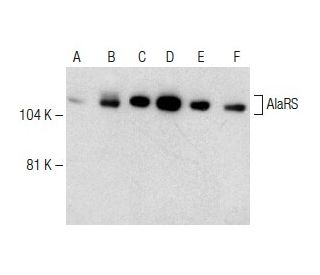
AlaRS Antibody (M6-P2E5): sc-81712
- AlaRS Antibody (M6-P2E5) is a mouse monoclonal IgG1 κ, cited in 1 publications, provided at 200 µg/ml
- raised against a synthetic peptide corresponding to amino acids 956-965 of AlaRS of human origin
- recommended for detection of AlaRS of mouse, rat and human origin by WB and IP
- m-IgG Fc BP-HRP, m-IgG1 BP-HRP and m-IgGκ BP-HRP are the preferred secondary detection reagents for AlaRS Antibody (M6-P2E5) for WB applications. These reagents are now offered in bundles with AlaRS Antibody (M6-P2E5) (see ordering information below).

QUICK LINKS
SEE ALSO...
AlaRS Antibody (M6-P2E5) is a mouse monoclonal IgG1 antibody that detects alanyl-tRNA synthetase (AlaRS) in mouse, rat, and human samples through applications such as western blotting (WB) and immunoprecipitation (IP). AlaRS, a 968 amino acid cytoplasmic protein, plays a crucial role in protein synthesis by catalyzing the ATP-dependent attachment of alanine to its corresponding tRNA, resulting in the formation of alanyl-tRNA(Ala). This process is vital for the accurate translation of genetic information into functional proteins, as AlaRS ensures that the correct amino acid is incorporated into the growing polypeptide chain. Proper functioning of AlaRS is essential, as defects in the gene encoding this enzyme can lead to the accumulation of misfolded proteins within the cell, ultimately resulting in cellular stress and potential cell death. Anti-AlaRS antibody (M6-P2E5) serves as an invaluable tool for researchers studying the mechanisms of protein synthesis and the implications of tRNA synthetase dysfunction in various diseases.
Ordering Information
| Product Name | Catalog # | UNIT | Price | Qty | FAVORITES | |
AlaRS Antibody (M6-P2E5) | sc-81712 | 200 µg/ml | $322.00 | |||
AlaRS Antibody (M6-P2E5): m-IgG Fc BP-HRP Bundle | sc-537259 | 200 µg Ab; 10 µg BP | $361.00 | |||
AlaRS Antibody (M6-P2E5): m-IgGκ BP-HRP Bundle | sc-534484 | 200 µg Ab; 40 µg BP | $361.00 | |||
AlaRS Antibody (M6-P2E5): m-IgG1 BP-HRP Bundle | sc-545113 | 200 µg Ab; 20 µg BP | $361.00 |