
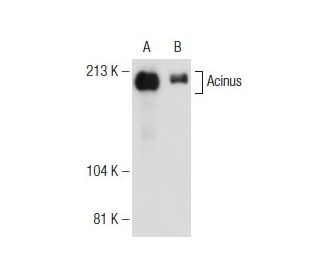


Acinus Antibody (2005C3a): sc-81177
- Acinus Antibody (2005C3a) is a mouse monoclonal IgG1 Acinus antibody, cited in 1 publications, provided at 100 µg/ml
- raised against a recombinant protein corresponding to an internal region of Acinus of human origin
- recommended for detection of Acinus of human origin by WB and IP
- At present, we have not yet completed the identification of the preferred secondary detection reagent(s) for Acinus Antibody (2005C3a). This work is in progress.

QUICK LINKS
SEE ALSO...
Acinus Antibody (2005C3a) is a mouse monoclonal IgG1 antibody that detects Acinus protein of human origin by western blotting (WB) and immunoprecipitation (IP). Anti-Acinus antibody (2005C3a) is available as a non-conjugated monoclonal isotype antibody. Acinus protein plays a crucial role in apoptosis, specifically in chromatin condensation, which is essential for the orderly dismantling of cellular components during programmed cell death. Acinus protein is predominantly localized in the nucleus, where Acinus interacts with both the nuclear membrane and nucleoplasm, facilitating function in apoptosis. Notably, Acinus protein undergoes post-translational modifications, including cleavage by caspase-3, which generates soluble protein p23. This cleavage is vital for inducing chromatin condensation, underscoring Acinus protein′s importance in the apoptotic pathway. Acinus exists in various isoforms, such as AcinusL, AcinusS, and AcinusS′, which arise from alternative splicing and may have distinct functional roles in cellular processes. Acinus protein′s ability to mediate chromatin condensation highlights significance in maintaining cellular integrity and regulating apoptosis, making Acinus (2005C3a) antibody an essential tool for researchers studying these critical biological processes.
Alexa Fluor® is a trademark of Molecular Probes Inc., OR., USA
LI-COR® and Odyssey® are registered trademarks of LI-COR Biosciences
Acinus Antibody (2005C3a) References:
- Emerging roles of caspase-3 in apoptosis. | Porter, AG. and Jänicke, RU. 1999. Cell Death Differ. 6: 99-104. PMID: 10200555
- Apoptotic nuclear morphological change without DNA fragmentation. | Sakahira, H., et al. 1999. Curr Biol. 9: 543-6. PMID: 10339431
- Apoptosis: cell death defined by caspase activation. | Samali, A., et al. 1999. Cell Death Differ. 6: 495-6. PMID: 10381647
- Acinus is a caspase-3-activated protein required for apoptotic chromatin condensation. | Sahara, S., et al. 1999. Nature. 401: 168-73. PMID: 10490026
- ASAP, a novel protein complex involved in RNA processing and apoptosis. | Schwerk, C., et al. 2003. Mol Cell Biol. 23: 2981-90. PMID: 12665594
- Chromatin condensation during apoptosis requires ATP. | Kass, GE., et al. 1996. Biochem J. 318 (Pt 3): 749-52. PMID: 8836114
- Prediction of the coding sequences of unidentified human genes. X. The complete sequences of 100 new cDNA clones from brain which can code for large proteins in vitro. | Ishikawa, K., et al. 1998. DNA Res. 5: 169-76. PMID: 9734811
Ordering Information
| Product Name | Catalog # | UNIT | Price | Qty | FAVORITES | |
Acinus Antibody (2005C3a) | sc-81177 | 100 µg/ml | $339.00 |