
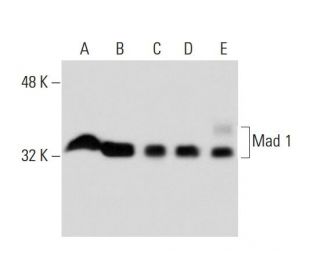
Mad 1 Anticuerpo (F-1): sc-8012
- Mad 1 Anticuerpo (F-1) es un monoclonal de ratón IgG1 λ Mad 1 Anticuerpo, ver las 5 publicaciones, proporcionado como 200 µg/ml
- producido contra los amino ácidos 1-221 representando la proteína completa Mad 1 de origen human
- Mad 1 Anticuerpo (F-1) es recomendado para detectar Mad 1 de mouse, rat y human origen, mediante WB, IP, IF y ELISA
- Mad 1 Anticuerpo (F-1) es disponible conjugado a agarosa para IP; HRP para WB, IHC(P) y ELISA; y tanto a phycoerythrin como a FITC para IF, IHC(P) y FCM
- también disponible conjugado a Alexa Fluor® 488, Alexa Fluor® 546, Alexa Fluor® 594 o Alexa Fluor® 647 para WB (RGB), IF, IHC (P) y FCM
- también disponible conjugado a Alexa Fluor® 680 o Alexa Fluor® 790 para WB (NIR), IF y FCM
- TransCruz reactivo para Gel Supershift y ChIP (sc-8012 X, 200 µg/0.1 ml)
- m-IgG Fc BP-HRP y m-IgG1 BP-HRP son los reactivos de detección secundarios preferidos para Mad 1 Anticuerpo (F-1) for WB applications. Estos reactivos se ofrecen ahora en paquetes con Mad 1 Anticuerpo (F-1)(véase la información de pedido más abajo).

ENLACES RÁPIDOS
El anticuerpo Mad 1 (F-1) es un anticuerpo monoclonal IgG1 de ratón que detecta la proteína Mad 1 de origen humano, de ratón y de rata mediante western blotting (WB), inmunoprecipitación (IP), inmunofluorescencia (IF) y ensayo inmunoenzimático (ELISA). El anticuerpo Mad 1 (F-1) está disponible tanto en forma no conjugada como en varias formas conjugadas, incluyendo agarosa, peroxidasa de rábano picante (HRP), ficoeritrina (PE), isotiocianato de fluoresceína (FITC) y múltiples conjugados Alexa Fluor®. La proteína Mad 1 desempeña un papel crucial en la regulación de la expresión génica como represor transcripcional, especialmente en la diferenciación y proliferación celular. La proteína Mad 1 funciona formando complejos heterodiméricos con Max, que antagonizan la actividad de los heterodímeros Myc-Max, inhibiendo así los genes que promueven el crecimiento y la división celular. El mecanismo regulador de la proteína Mad 1 es vital para mantener la homeostasis celular y evitar la proliferación celular descontrolada, que puede conducir a la oncogénesis. La estabilidad de la proteína Mad 1, en contraste con la altamente regulada proteína Myc, permite una modulación eficaz de la expresión génica en respuesta a diversas señales celulares. Comprender la dinámica de la proteína Mad 1 y sus interacciones con otras proteínas es esencial para dilucidar las complejas redes que rigen el comportamiento celular y desarrollar posibles estrategias terapéuticas dirigidas a estas vías.
Alexa Fluor® es una marca registrada de Molecular Probes Inc., OR., USA
REIVEW LI-COR® y Odyssey® son marcas registradas de LI-COR Biosciences.
Mad 1 Anticuerpo (F-1) Referencias:
- Las oncoproteínas de la familia Myc funcionan a través de una vía común para transformar células normales en cultivo: interferencia cruzada por mutantes dominantes Max y trans. | Mukherjee, B., et al. 1992. Genes Dev. 6: 1480-92. PMID: 1644290
- La asociación de Myn, el homólogo murino de max, con c-Myc estimula la unión al ADN sensible a la metilación y la cotransformación de ras. | Prendergast, GC., et al. 1991. Cell. 65: 395-407. PMID: 1840505
- Las interacciones intracelulares de cremallera de leucina sugieren la hetero-oligomerización de c-Myc. | Dang, CV., et al. 1991. Mol Cell Biol. 11: 954-62. PMID: 1990293
- Max: una proteína cremallera de hélice-bucle-hélice que forma un complejo de unión al ADN específico de secuencia con Myc. | Blackwood, EM. and Eisenman, RN. 1991. Science. 251: 1211-7. PMID: 2006410
- Regulación transcripcional por dimerización: dos caras de una relación incestuosa. | Jones, N. 1990. Cell. 61: 9-11. PMID: 2180585
- La longitud de los telómeros, la expresión de c-myc y mad-1 podrían representar marcadores de pronóstico del síndrome mielodisplásico. | Poloni, A., et al. 2013. Leuk Res. 37: 1538-44. PMID: 24095110
- Una interacción Bub1-Mad1 dirige el complejo Mad1-Mad2 a los cinetocoros desacoplados para iniciar el punto de control del huso. | Moyle, MW., et al. 2014. J Cell Biol. 204: 647-57. PMID: 24567362
- La sobreexpresión de H19 induce resistencia a la 1,25(OH)2D3 al dirigirse a VDR a través de miR-675-5p en células de cáncer de colon. | Chen, S., et al. 2017. Neoplasia. 19: 226-236. PMID: 28189050
- Eficacia de dos tipos de MADS para la terapia de la AOS. | Verburg, FE., et al. 2018. Clin Oral Investig. 22: 1995-2003. PMID: 29214378
- Mad: socio heterodimérico de Max que antagoniza la actividad transcripcional de Myc. | Ayer, DE., et al. 1993. Cell. 72: 211-22. PMID: 8425218
- Mxi1, una proteína que interactúa específicamente con Max para unirse a sitios de reconocimiento de Myc-Max. | Zervos, AS., et al. 1993. Cell. 72: 223-32. PMID: 8425219
- La actividad oncogénica de la proteína c-Myc requiere la dimerización con Max. | Amati, B., et al. 1993. Cell. 72: 233-45. PMID: 8425220
Información sobre pedidos
| Nombre del producto | Número de catálogo | UNIDAD | Precio | CANTIDAD | Favoritos | |
Mad 1 Anticuerpo (F-1) | sc-8012 | 200 µg/ml | $322.00 | |||
Paquete de Mad 1 (F-1): m-IgG Fc BP-HRP | sc-553128 | 200 µg Ab; 10 µg BP | $361.00 | |||
Paquete de Mad 1 (F-1): m-IgG1 BP-HRP | sc-553129 | 200 µg Ab; 20 µg BP | $361.00 | |||
Mad 1 Anticuerpo (F-1) X | sc-8012 X | 200 µg/0.1 ml | $322.00 | |||
Mad 1 Anticuerpo (F-1) AC | sc-8012 AC | 500 µg/ml, 25% agarose | $424.00 | |||
Mad 1 Anticuerpo (F-1) HRP | sc-8012 HRP | 200 µg/ml | $322.00 | |||
Mad 1 Anticuerpo (F-1) FITC | sc-8012 FITC | 200 µg/ml | $336.00 | |||
Mad 1 Anticuerpo (F-1) PE | sc-8012 PE | 200 µg/ml | $349.00 | |||
Mad 1 Anticuerpo (F-1) Alexa Fluor® 488 | sc-8012 AF488 | 200 µg/ml | $364.00 | |||
Mad 1 Anticuerpo (F-1) Alexa Fluor® 546 | sc-8012 AF546 | 200 µg/ml | $364.00 | |||
Mad 1 Anticuerpo (F-1) Alexa Fluor® 594 | sc-8012 AF594 | 200 µg/ml | $364.00 | |||
Mad 1 Anticuerpo (F-1) Alexa Fluor® 647 | sc-8012 AF647 | 200 µg/ml | $364.00 | |||
Mad 1 Anticuerpo (F-1) Alexa Fluor® 680 | sc-8012 AF680 | 200 µg/ml | $364.00 | |||
Mad 1 Anticuerpo (F-1) Alexa Fluor® 790 | sc-8012 AF790 | 200 µg/ml | $364.00 |