
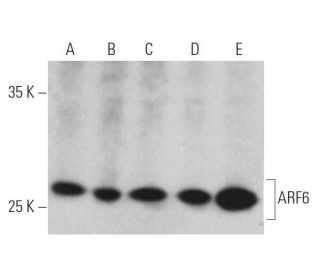
ARF6 Antibody (3A-1): sc-7971
- ARF6 Antibody (3A-1) is a mouse monoclonal IgG2b κ ARF6 antibody, cited in 108 publications, provided at 200 µg/ml
- raised against amino acids 1-174 representing full length of ARF6 of human origin
- ARF6 Antibody (3A-1) is recommended for detection of ARF6 of mouse, rat and human origin by WB, IP, IF, IHC(P) and ELISA
- Anti-ARF6 Antibody (3A-1) is available conjugated to agarose for IP; HRP for WB, IHC(P) and ELISA; and to either phycoerythrin or FITC for IF, IHC(P) and FCM
- also available conjugated to Alexa Fluor® 488, Alexa Fluor® 546, Alexa Fluor® 594 or Alexa Fluor® 647 for WB (RGB), IF, IHC(P) and FCM, and for use with RGB fluorescent imaging systems, such as iBright™ FL1000, FluorChem™, Typhoon, Azure and other comparable systems
- also available conjugated to Alexa Fluor® 680 or Alexa Fluor® 790 for WB (NIR), IF and FCM; for use with Near-Infrared (NIR) detection systems, such as LI-COR®Odyssey®, iBright™ FL1000, FluorChem™, Typhoon, Azure and other comparable systems
- m-IgG Fc BP-HRP, m-IgG2b BP-HRP and m-IgGκ BP-HRP are the preferred secondary detection reagents for ARF6 Antibody (3A-1) for WB and IHC(P) applications. These reagents are now offered in bundles with ARF6 Antibody (3A-1) (see ordering information below).

QUICK LINKS
ARF6 Antibody (3A-1) is a mouse monoclonal IgG2b kappa light chain antibody that detects ARF6 protein of mouse, rat, and human origin by western blotting (WB), immunoprecipitation (IP), immunofluorescence (IF), immunohistochemistry, and enzyme-linked immunosorbent assay (ELISA). ARF6 (3A-1) antibody is available in both non-conjugated and various conjugated forms, including agarose, horseradish peroxidase (HRP), phycoerythrin (PE), fluorescein isothiocyanate (FITC), and multiple Alexa Fluor® conjugates. ARF6, a member of the ADP-ribosylation factor family, plays a crucial role in regulating membrane trafficking and cytoskeletal dynamics, which are essential for maintaining cellular homeostasis and facilitating intracellular communication. ARF6 is localized primarily at the plasma membrane and endosomal compartments, where ARF6 orchestrates the recycling of membrane proteins and lipids, thereby influencing processes such as endocytosis and exocytosis. This localization is vital for the proper functioning of various cellular processes, including cell migration, adhesion, and the formation of membrane protrusions. The human ARF6 gene consists of five exons and four introns, encoding a 175 amino acid protein that is integral to the coordination of vesicle transport and the maintenance of organelle integrity. Anti-ARF6 antibody (3A-1) enables valuable insights into the mechanisms of cellular signaling and trafficking, which are critical for understanding various physiological and pathological conditions.
Alexa Fluor® is a trademark of Molecular Probes Inc., OR., USA
LI-COR® and Odyssey® are registered trademarks of LI-COR Biosciences
ARF6 Antibody (3A-1) References:
- Activated ADP-ribosylation factor assembles distinct pools of actin on golgi membranes. | Fucini, RV., et al. 2000. J Biol Chem. 275: 18824-9. PMID: 10777475
- The gamma-subunit of the coatomer complex binds Cdc42 to mediate transformation. | Wu, WJ., et al. 2000. Nature. 405: 800-4. PMID: 10866202
- Golgi vesicle proteins are linked to the assembly of an actin complex defined by mAbp1. | Fucini, RV., et al. 2002. Mol Biol Cell. 13: 621-31. PMID: 11854417
- ARF6 and Rab11 as intrinsic regulators of axon regeneration. | Nieuwenhuis, B. and Eva, R. 2020. Small GTPases. 11: 392-401. PMID: 29772958
- Arf6 regulates energy metabolism in neutrophils. | Gamara, J., et al. 2021. Free Radic Biol Med. 172: 550-561. PMID: 34245858
- Targeting EGFR-dependent tumors by disrupting an ARF6-mediated sorting system. | Guo, H., et al. 2022. Nat Commun. 13: 6004. PMID: 36224181
- Arf6 as a therapeutic target: Structure, mechanism, and inhibitors. | Sun, D., et al. 2023. Acta Pharm Sin B. 13: 4089-4104. PMID: 37799386
- Platelet-derived extracellular vesicles aggravate septic acute kidney injury via delivering ARF6. | Lu, X., et al. 2023. Int J Biol Sci. 19: 5055-5073. PMID: 37928258
- The amino terminus of ADP-ribosylation factor (ARF) 1 is essential for interaction with Gs and ARF GTPase-activating protein. | Randazzo, PA., et al. 1994. J Biol Chem. 269: 29490-4. PMID: 7961931
- Structure of the human ADP-ribosylation factor 1 complexed with GDP. | Amor, JC., et al. 1994. Nature. 372: 704-8. PMID: 7990966
- Mammalian Cdc42 is a brefeldin A-sensitive component of the Golgi apparatus. | Erickson, JW., et al. 1996. J Biol Chem. 271: 26850-4. PMID: 8900167
- ADP ribosylation factor regulates spectrin binding to the Golgi complex. | Godi, A., et al. 1998. Proc Natl Acad Sci U S A. 95: 8607-12. PMID: 9671725
Ordering Information
| Product Name | Catalog # | UNIT | Price | Qty | FAVORITES | |
ARF6 Antibody (3A-1) | sc-7971 | 200 µg/ml | $322.00 | |||
ARF6 Antibody (3A-1): m-IgG Fc BP-HRP Bundle | sc-528192 | 200 µg Ab; 10 µg BP | $361.00 | |||
ARF6 Antibody (3A-1): m-IgGκ BP-HRP Bundle | sc-520514 | 200 µg Ab, 40 µg BP | $361.00 | |||
ARF6 Antibody (3A-1): m-IgG2b BP-HRP Bundle | sc-550006 | 200 µg Ab; 10 µg BP | $361.00 | |||
ARF6 Antibody (3A-1) AC | sc-7971 AC | 500 µg/ml, 25% agarose | $424.00 | |||
ARF6 Antibody (3A-1) HRP | sc-7971 HRP | 200 µg/ml | $322.00 | |||
ARF6 Antibody (3A-1) FITC | sc-7971 FITC | 200 µg/ml | $336.00 | |||
ARF6 Antibody (3A-1) PE | sc-7971 PE | 200 µg/ml | $349.00 | |||
ARF6 Antibody (3A-1) Alexa Fluor® 488 | sc-7971 AF488 | 200 µg/ml | $364.00 | |||
ARF6 Antibody (3A-1) Alexa Fluor® 546 | sc-7971 AF546 | 200 µg/ml | $364.00 | |||
ARF6 Antibody (3A-1) Alexa Fluor® 594 | sc-7971 AF594 | 200 µg/ml | $364.00 | |||
ARF6 Antibody (3A-1) Alexa Fluor® 647 | sc-7971 AF647 | 200 µg/ml | $364.00 | |||
ARF6 Antibody (3A-1) Alexa Fluor® 680 | sc-7971 AF680 | 200 µg/ml | $364.00 | |||
ARF6 Antibody (3A-1) Alexa Fluor® 790 | sc-7971 AF790 | 200 µg/ml | $364.00 |