
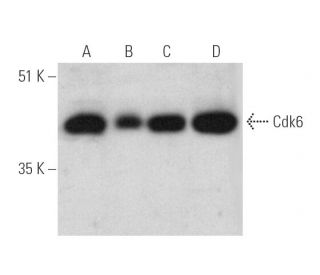
Cdk6 Anticuerpo (B-10): sc-7961
- Cdk6 Anticuerpo B-10 es un monoclonal de ratón IgG1 κ Cdk6 Anticuerpo, ver las 125 publicaciones, proporcionado como 200 µg/ml
- producido contra los amino ácidos 1-326 representando la proteína completa Cdk6 de origen human
- Cdk6 Anticuerpo (B-10) es recomendado para detectar Cdk6 de mouse, rat y human origen, mediante WB, IP, IF, IHC(P) y ELISA
- Cdk6 Anticuerpo (B-10) es disponible conjugado a agarosa para IP; HRP para WB, IHC(P) y ELISA; y tanto a phycoerythrin como a FITC para IF, IHC(P) y FCM
- también disponible conjugado a Alexa Fluor® 488, Alexa Fluor® 546, Alexa Fluor® 594 o Alexa Fluor® 647 para WB (RGB), IF, IHC (P) y FCM
- también disponible conjugado a Alexa Fluor® 680 o Alexa Fluor® 790 para WB (NIR), IF y FCM
- también disponibles conjugados a TRITC para IF, IHC(P) y FCM
- m-IgG Fc BP-HRP, 1 BP-HRP">m-IgG1 BP-HRP y m-IgGκ BP-HRP son los reactivos de detección secundarios preferidos para Cdk6 Anticuerpo (B-10) para aplicaciones WB e IHC(P). Estos reactivos se ofrecen ahora en paquetes con Cdk6 Anticuerpo (B-10)(véase la información de pedido más abajo).

El anticuerpo Cdk6 (B-10) es un anticuerpo monoclonal IgG1 de ratón de cadena ligera kappa que detecta Cdk6 de origen de ratón, rata y humano a través de varias aplicaciones que incluyen la inmunotransferencia occidental, la inmunoprecipitación, la inmunofluorescencia, la inmunohistoquímica y el ensayo inmunoenzimático. El anticuerpo Cdk6 (B-10) se ofrece tanto en forma no conjugada como en múltiples formas conjugadas, como agarosa, peroxidasa de rábano picante, ficoeritrina, isotiocianato de fluoresceína y diversos conjugados Alexa Fluor®. La Cdk6 desempeña un papel crucial en la regulación del ciclo celular, en particular durante la transición G1/S, al asociarse con las ciclinas D1, D2 y D3 para fosforilar sustratos diana esenciales para la progresión del ciclo celular. Esta fosforilación facilita la transición de la fase G1 a la fase S, permitiendo la replicación del ADN y la división celular. La Cdk6 está regulada por inhibidores de la cinasa dependiente de ciclina, como la p18 y la p19, que se unen tanto a las formas libres como a las unidas a ciclina, modulando así la actividad y asegurando un control adecuado del ciclo celular. La interacción de la Cdk6 con estos inhibidores pone de relieve su importancia en el mantenimiento de la homeostasis celular y en la prevención de la proliferación celular descontrolada, que es un rasgo distintivo del cáncer.
Alexa Fluor® es una marca registrada de Molecular Probes Inc., OR., USA
REIVEW LI-COR® y Odyssey® son marcas registradas de LI-COR Biosciences.
Cdk6 Anticuerpo (B-10) Referencias:
- PCTAIRE-1 y PCTAIRE-3, dos miembros de una nueva familia de genes proteína quinasa relacionados con cdc2/CDC28. | Okuda, T., et al. 1992. Oncogene. 7: 2249-58. PMID: 1437147
- Expresión de reguladores del ciclo celular G1 en hígado de rata tras exposición repetida a tioacetamida. | Kim, KT., et al. 2007. Korean J Hepatol. 13: 81-90. PMID: 17380078
- Distintos complejos CDK6 determinan la respuesta de las células tumorales a los inhibidores y degradadores CDK4/6. | Wu, X., et al. 2021. Nat Cancer. 2: 429-443. PMID: 34568836
- Dirigirse a CDK4 y CDK6 en el cáncer. | Goel, S., et al. 2022. Nat Rev Cancer. 22: 356-372. PMID: 35304604
- Isoginkgetin, un inhibidor potencial de CDK6, suprime la actividad potenciadora de SLC2A1/GLUT1 para inducir la autofagia citotóxica mediada por AMPK-ULK1 en el carcinoma hepatocelular. | Yao, J., et al. 2023. Autophagy. 19: 1221-1238. PMID: 36048765
- Las nuevas proteínas INK4, p19 y p18, son inhibidores específicos de las quinasas dependientes de ciclina D CDK4 y CDK6. | Hirai, H., et al. 1995. Mol Cell Biol. 15: 2672-81. PMID: 7739547
- Identificación de p19 humano y de ratón, un nuevo inhibidor de CDK4 y CDK6 con homología a p16ink4. | Chan, FK., et al. 1995. Mol Cell Biol. 15: 2682-8. PMID: 7739548
- Regulación de la síntesis y actividad de la proteína PLSTIRE (quinasa dependiente de ciclina 6 (cdk6)), un importante homólogo de cdk4 asociado a ciclina D en linfocitos T humanos normales. | Lucas, JJ., et al. 1995. J Immunol. 154: 6275-84. PMID: 7759865
- Las quinasas del ciclo celular. | Pines, J. 1994. Semin Cancer Biol. 5: 305-13. PMID: 7803767
- Ciclinas, quinasas dependientes de ciclinas e inhibidores de cdk: implicaciones en el control del ciclo celular y el cáncer. | MacLachlan, TK., et al. 1995. Crit Rev Eukaryot Gene Expr. 5: 127-56. PMID: 8845581
- Papel de la familia de genes inhibidores de las quinasas 4 y 6 dependientes de ciclinas p15, p16, p18 y p19 en la leucemia y el linfoma. | Siebert, R., et al. 1996. Leuk Lymphoma. 23: 505-20. PMID: 9031081
- Conceptos actuales en neuro-oncología: el ciclo celular - una revisión. | Dirks, PB. and Rutka, JT. 1997. Neurosurgery. 40: 1000-13; discussion 1013-5. PMID: 9149259
Información sobre pedidos
| Nombre del producto | Número de catálogo | UNIDAD | Precio | CANTIDAD | Favoritos | |
Cdk6 Anticuerpo (B-10) | sc-7961 | 200 µg/ml | $322.00 | |||
Paquete de Cdk6 (B-10): m-IgG Fc BP-HRP | sc-528186 | 200 µg Ab; 10 µg BP | $361.00 | |||
Paquete de Cdk6 (B-10): m-IgGκ BP-HRP | sc-520508 | 200 µg Ab, 40 µg BP | $361.00 | |||
Paquete de Cdk6 (B-10): m-IgG1 BP-HRP | sc-542806 | 200 µg Ab; 20 µg BP | $361.00 | |||
Cdk6 Anticuerpo (B-10) AC | sc-7961 AC | 500 µg/ml, 25% agarose | $424.00 | |||
Cdk6 Anticuerpo (B-10) HRP | sc-7961 HRP | 200 µg/ml | $322.00 | |||
Cdk6 Anticuerpo (B-10) FITC | sc-7961 FITC | 200 µg/ml | $336.00 | |||
Cdk6 Anticuerpo (B-10) PE | sc-7961 PE | 200 µg/ml | $349.00 | |||
Cdk6 Anticuerpo (B-10) Alexa Fluor® 488 | sc-7961 AF488 | 200 µg/ml | $364.00 | |||
Cdk6 Anticuerpo (B-10) Alexa Fluor® 546 | sc-7961 AF546 | 200 µg/ml | $364.00 | |||
Cdk6 Anticuerpo (B-10) Alexa Fluor® 594 | sc-7961 AF594 | 200 µg/ml | $364.00 | |||
Cdk6 Anticuerpo (B-10) Alexa Fluor® 647 | sc-7961 AF647 | 200 µg/ml | $364.00 | |||
Cdk6 Anticuerpo (B-10) Alexa Fluor® 680 | sc-7961 AF680 | 200 µg/ml | $364.00 | |||
Cdk6 Anticuerpo (B-10) Alexa Fluor® 790 | sc-7961 AF790 | 200 µg/ml | $364.00 | |||
Cdk6 Anticuerpo (B-10) TRITC | sc-7961 TRITC | 200 µg/ml | $326.00 |