
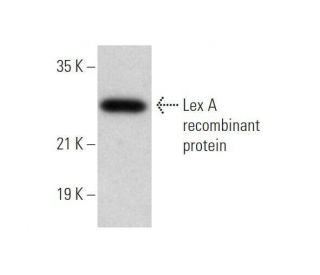


Lex A Antibody (2-12): sc-7544
- Lex A Antibody (2-12) is a mouse monoclonal IgG1 κ, cited in 79 publications, provided at 200 µg/ml
- epitope mapping within the DNA binding domain of Lex A
- Lex A Antibody (2-12) is recommended for detection of Lex A and Lex A fusion proteins by WB, IP and IF
- Anti-Lex A Antibody (2-12) is available conjugated to agarose for IP; HRP for WB, IHC(P) and ELISA; and to either phycoerythrin or FITC for IF, IHC(P) and FCM
- also available conjugated to Alexa Fluor® 488, Alexa Fluor® 546, Alexa Fluor® 594 or Alexa Fluor® 647 for WB (RGB), IF, IHC(P) and FCM, and for use with RGB fluorescent imaging systems, such as iBright™ FL1000, FluorChem™, Typhoon, Azure and other comparable systems
- also available conjugated to Alexa Fluor® 680 or Alexa Fluor® 790 for WB (NIR), IF and FCM; for use with Near-Infrared (NIR) detection systems, such as LI-COR®Odyssey®, iBright™ FL1000, FluorChem™, Typhoon, Azure and other comparable systems
- m-IgG Fc BP-HRP and m-IgG1 BP-HRP are the preferred secondary detection reagents for Lex A Antibody (2-12) for WB applications. These reagents are now offered in bundles with Lex A Antibody (2-12) (see ordering information below).

QUICK LINKS
SEE ALSO...
Lex A Antibody (2-12) is a mouse monoclonal IgG1 kappa light chain antibody that detects Lex A in various applications including western blotting (WB), immunoprecipitation (IP), and immunofluorescence (IF). Anti-Lex A antibody (2-12) is available in both non-conjugated and multiple conjugated forms, such as agarose, horseradish peroxidase (HRP), phycoerythrin (PE), fluorescein isothiocyanate (FITC), and various Alexa Fluor® conjugates, providing versatility for different experimental needs. Lex A, a crucial protein involved in the regulation of gene expression, plays a significant role in the two-hybrid system, a powerful method for studying protein-protein interactions. This system utilizes genetically engineered yeast or bacteria, where a ′bait′ protein is fused to a DNA-binding domain (DBD) and a ′prey′ protein is linked to a transcriptional activation domain (AD). The interaction between these proteins activates reporter genes, allowing researchers to identify and analyze protein interactions effectively. The adaptability of the two-hybrid system, which incorporates DBDs like GAL4 or LexA and ADs from GAL4 or the herpes simplex virus protein VP16, has made this approach a preferred choice for proteomics studies and interactome mapping. The ability to utilize prokaryotic proteins, such as Escherichia coli LexA′s DBD, alongside the N-terminal of GAL4 from Saccharomyces cerevisiae, enhances experimental versatility across various organisms, ensuring specific transcriptional activation and appropriate localization of proteins within the cell.
Alexa Fluor® is a trademark of Molecular Probes Inc., OR., USA
LI-COR® and Odyssey® are registered trademarks of LI-COR Biosciences
Lex A Antibody (2-12) References:
- GAL4 fusion vectors for expression in yeast or mammalian cells. | Sadowski, I., et al. 1992. Gene. 118: 137-41. PMID: 1511877
- The bacterial LexA transcriptional repressor. | Butala, M., et al. 2009. Cell Mol Life Sci. 66: 82-93. PMID: 18726173
- The two-hybrid system: a method to identify and clone genes for proteins that interact with a protein of interest. | Chien, CT., et al. 1991. Proc Natl Acad Sci U S A. 88: 9578-82. PMID: 1946372
- Pheromone-dependent phosphorylation of the yeast STE12 protein correlates with transcriptional activation. | Song, D., et al. 1991. Genes Dev. 5: 741-50. PMID: 2026326
- Activators and targets. | Ptashne, M. and Gann, AA. 1990. Nature. 346: 329-31. PMID: 2142753
- A novel genetic system to detect protein-protein interactions. | Fields, S. and Song, O. 1989. Nature. 340: 245-6. PMID: 2547163
- The Use and Abuse of LexA by Mobile Genetic Elements. | Fornelos, N., et al. 2016. Trends Microbiol. 24: 391-401. PMID: 26970840
- A model fungal gene regulatory mechanism: the GAL genes of Saccharomyces cerevisiae. | Johnston, M. 1987. Microbiol Rev. 51: 458-76. PMID: 2830478
- Deletion analysis of GAL4 defines two transcriptional activating segments. | Ma, J. and Ptashne, M. 1987. Cell. 48: 847-53. PMID: 3028647
- Nanobodies targeting LexA autocleavage disclose a novel suppression strategy of SOS-response pathway. | Maso, L., et al. 2022. Structure. 30: 1479-1493.e9. PMID: 36240773
- Purified lexA protein is a repressor of the recA and lexA genes. | Little, JW., et al. 1981. Proc Natl Acad Sci U S A. 78: 4199-203. PMID: 7027255
- The two-hybrid system: an assay for protein-protein interactions. | Fields, S. and Sternglanz, R. 1994. Trends Genet. 10: 286-92. PMID: 7940758
Ordering Information
| Product Name | Catalog # | UNIT | Price | Qty | FAVORITES | |
Lex A Antibody (2-12) | sc-7544 | 200 µg/ml | $322.00 | |||
Lex A Antibody (2-12): m-IgG Fc BP-HRP Bundle | sc-526502 | 200 µg Ab; 10 µg BP | $361.00 | |||
Lex A Antibody (2-12): m-IgG1 BP-HRP Bundle | sc-531875 | 200 µg Ab; 20 µg BP | $361.00 | |||
Lex A Antibody (2-12) AC | sc-7544 AC | 500 µg/ml, 25% agarose | $424.00 | |||
Lex A Antibody (2-12) HRP | sc-7544 HRP | 200 µg/ml | $322.00 | |||
Lex A Antibody (2-12) FITC | sc-7544 FITC | 200 µg/ml | $336.00 | |||
Lex A Antibody (2-12) PE | sc-7544 PE | 200 µg/ml | $349.00 | |||
Lex A Antibody (2-12) Alexa Fluor® 488 | sc-7544 AF488 | 200 µg/ml | $364.00 | |||
Lex A Antibody (2-12) Alexa Fluor® 546 | sc-7544 AF546 | 200 µg/ml | $364.00 | |||
Lex A Antibody (2-12) Alexa Fluor® 594 | sc-7544 AF594 | 200 µg/ml | $364.00 | |||
Lex A Antibody (2-12) Alexa Fluor® 647 | sc-7544 AF647 | 200 µg/ml | $364.00 | |||
Lex A Antibody (2-12) Alexa Fluor® 680 | sc-7544 AF680 | 200 µg/ml | $364.00 | |||
Lex A Antibody (2-12) Alexa Fluor® 790 | sc-7544 AF790 | 200 µg/ml | $364.00 |