
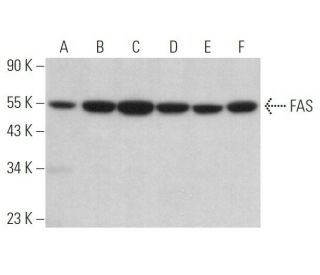
FAS Anticuerpo (G-9): sc-74540
- FAS Anticuerpo (G-9) es un monoclonal de ratón IgG1 κ, ver las 44 publicaciones, proporcionado como 200 µg/ml
- producido contra los amino ácidos 1-335 de la proteina total FAS de origen human
- FAS Anticuerpo (G-9) es recomendado para detectar FAS de mouse, rat y human origen, mediante WB, IP, IF y ELISA
- FAS Anticuerpo (G-9) es disponible conjugado a agarosa para IP; HRP para WB, IHC(P) y ELISA; y tanto a phycoerythrin como a FITC para IF, IHC(P) y FCM
- también disponible conjugado a Alexa Fluor® 488, Alexa Fluor® 546, Alexa Fluor® 594 o Alexa Fluor® 647 para WB (RGB), IF, IHC (P) y FCM
- también disponible conjugado a Alexa Fluor® 680 o Alexa Fluor® 790 para WB (NIR), IF y FCM
- m-IgG Fc BP-HRP y m-IgG1 BP-HRP son los reactivos de detección secundarios preferidos para FAS Anticuerpo (G-9) for WB applications. Estos reactivos se ofrecen ahora en paquetes con FAS Anticuerpo (G-9)(véase la información de pedido más abajo).

ENLACES RÁPIDOS
VER TAMBIÉN ....
El anticuerpo FAS (G-9) es un anticuerpo monoclonal de ratón IgG1 κ (también designado como anticuerpo FAS o anticuerpo CD95) que detecta FAS de origen humano, de ratón y de rata mediante WB, IP, IF y ELISA. El anticuerpo FAS (G-9) está disponible en forma de anticuerpo anti-FAS no conjugado, así como en múltiples formas conjugadas de anticuerpo anti-FAS, incluyendo agarosa, HRP, PE, FITC y múltiples conjugados de Alexa Fluor®. La citotoxicidad mediada por linfocitos T (CTL) constituye un componente importante de los mecanismos efector específicos en la inmunovigilancia contra células infectadas por virus o transformadas. Dos mecanismos parecen dar cuenta de esta actividad, uno de los cuales es el proceso basado en perforina. Independientemente, un mecanismo basado en FAS implica la molécula transductora FAS (también designada como APO-1) y su ligando (FAS-L). La proteína humana FAS es una glicoproteína de superficie celular que pertenece a una familia de receptores que incluye CD40, receptores de factor de crecimiento nervioso y receptores de factor de necrosis tumoral. El antígeno FAS se expresa en una amplia gama de líneas celulares linfoides, algunas de las cuales experimentan apoptosis en respuesta al tratamiento con anticuerpos contra FAS. Estos hallazgos implican fuertemente que la muerte celular dirigida es potencialmente mediada por las interacciones intercelulares de FAS con su ligando o efectores, y que FAS puede estar críticamente involucrado en la citotoxicidad mediada por CTL.
Alexa Fluor® es una marca registrada de Molecular Probes Inc., OR., USA
REIVEW LI-COR® y Odyssey® son marcas registradas de LI-COR Biosciences.
Información sobre pedidos
| Nombre del producto | Número de catálogo | UNIDAD | Precio | CANTIDAD | Favoritos | |
FAS Anticuerpo (G-9) | sc-74540 | 200 µg/ml | $322.00 | |||
Paquete de FAS (G-9): m-IgG Fc BP-HRP | sc-527043 | 200 µg Ab; 10 µg BP | $361.00 | |||
Paquete de FAS (G-9): m-IgG1 BP-HRP | sc-532416 | 200 µg Ab; 20 µg BP | $361.00 | |||
FAS Anticuerpo (G-9) AC | sc-74540 AC | 500 µg/ml, 25% agarose | $424.00 | |||
FAS Anticuerpo (G-9) HRP | sc-74540 HRP | 200 µg/ml | $322.00 | |||
FAS Anticuerpo (G-9) FITC | sc-74540 FITC | 200 µg/ml | $336.00 | |||
FAS Anticuerpo (G-9) PE | sc-74540 PE | 200 µg/ml | $349.00 | |||
FAS Anticuerpo (G-9) Alexa Fluor® 488 | sc-74540 AF488 | 200 µg/ml | $364.00 | |||
FAS Anticuerpo (G-9) Alexa Fluor® 546 | sc-74540 AF546 | 200 µg/ml | $364.00 | |||
FAS Anticuerpo (G-9) Alexa Fluor® 594 | sc-74540 AF594 | 200 µg/ml | $364.00 | |||
FAS Anticuerpo (G-9) Alexa Fluor® 647 | sc-74540 AF647 | 200 µg/ml | $364.00 | |||
FAS Anticuerpo (G-9) Alexa Fluor® 680 | sc-74540 AF680 | 200 µg/ml | $364.00 | |||
FAS Anticuerpo (G-9) Alexa Fluor® 790 | sc-74540 AF790 | 200 µg/ml | $364.00 |