
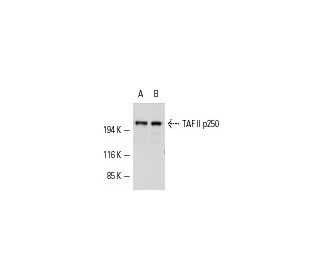
TAF II p250 Antibody (6B3): sc-735
- TAF II p250 Antibody (6B3) is a mouse monoclonal IgG1 κ TAF II p250 antibody, cited in 69 publications, provided at 200 µg/ml
- raised against TAF II p250 isolated from HeLa cells
- TAF II p250 Antibody (6B3) is recommended for detection of TAF II p250 of human origin by WB, IP, IF and IHC(P); non cross-reactive with TAF II p250 of hamster or Drosophila origin
- Anti-TAF II p250 Antibody (6B3) is available conjugated to agarose for IP; HRP for WB, IHC(P) and ELISA; and to either phycoerythrin or FITC for IF, IHC(P) and FCM
- also available conjugated to Alexa Fluor® 488, Alexa Fluor® 546, Alexa Fluor® 594 or Alexa Fluor® 647 for WB (RGB), IF, IHC(P) and FCM, and for use with RGB fluorescent imaging systems, such as iBright™ FL1000, FluorChem™, Typhoon, Azure and other comparable systems
- also available conjugated to Alexa Fluor® 680 or Alexa Fluor® 790 for WB (NIR), IF and FCM; for use with Near-Infrared (NIR) detection systems, such as LI-COR®Odyssey®, iBright™ FL1000, FluorChem™, Typhoon, Azure and other comparable systems
- TransCruz reagent for Gel Supershift and ChIP applications (sc-735 X, 200 µg/0.1 ml)
- m-IgG Fc BP-HRP, m-IgG1 BP-HRP and m-IgGκ BP-HRP are the preferred secondary detection reagents for TAF II p250 Antibody (6B3) for WB and IHC(P) applications. These reagents are now offered in bundles with TAF II p250 Antibody (6B3) (see ordering information below).

QUICK LINKS
SEE ALSO...
TAF II p250 Antibody (6B3) is a mouse monoclonal IgG1 kappa light chain antibody that detects TAF II p250 of human origin by western blotting (WB), immunoprecipitation (IP), immunofluorescence (IF), and immunohistochemistry (IHC). TAF II p250 monoclonal antibody (6B3) is available in both non-conjugated and various conjugated forms, including agarose, horseradish peroxidase, phycoerythrin, fluorescein isothiocyanate, and multiple Alexa Fluor® conjugates. TAF II p250 plays a crucial role in transcriptional regulation of genes, particularly those involved in cell cycle progression, by being a part of the TFIID complex, which is essential for assembly of the pre-initiation complex at the TATA promoter. TAF II p250 structure consists of multiple subunits, including the TATA-binding protein and various TBP-associated factors, which together facilitate both basal and activator-dependent transcription. TAF II p250 has been identified as identical to CCG1, a nuclear DNA-binding protein vital for proper cell cycle regulation. TAF II p250 interaction with specific transcription factors allows for precise activation of genes necessary for cell cycle progression, underscoring importance in cellular function and development.
Alexa Fluor® is a trademark of Molecular Probes Inc., OR., USA
LI-COR® and Odyssey® are registered trademarks of LI-COR Biosciences
TAF II p250 Antibody (6B3) References:
- Identification of human TFIID components and direct interaction between a 250-kDa polypeptide and the TATA box-binding protein (TFIID tau). | Takada, R., et al. 1992. Proc Natl Acad Sci U S A. 89: 11809-13. PMID: 1465404
- Isolation of coactivators associated with the TATA-binding protein that mediate transcriptional activation. | Dynlacht, BD., et al. 1991. Cell. 66: 563-76. PMID: 1907890
- The human CCG1 gene, essential for progression of the G1 phase, encodes a 210-kilodalton nuclear DNA-binding protein. | Sekiguchi, T., et al. 1991. Mol Cell Biol. 11: 3317-25. PMID: 2038334
- Five intermediate complexes in transcription initiation by RNA polymerase II. | Buratowski, S., et al. 1989. Cell. 56: 549-61. PMID: 2917366
- Molecular cloning of the cDNA of human X chromosomal gene (CCG1) which complements the temperature-sensitive G1 mutants, tsBN462 and ts13, of the BHK cell line. | Sekiguchi, T., et al. 1988. EMBO J. 7: 1683-7. PMID: 3169001
- Multiple factors required for accurate initiation of transcription by purified RNA polymerase II. | Matsui, T., et al. 1980. J Biol Chem. 255: 11992-6. PMID: 7440580
- Cloning and expression of human TAFII250: a TBP-associated factor implicated in cell-cycle regulation. | Ruppert, S., et al. 1993. Nature. 362: 175-9. PMID: 7680771
- The p250 subunit of native TATA box-binding factor TFIID is the cell-cycle regulatory protein CCG1. | Hisatake, K., et al. 1993. Nature. 362: 179-81. PMID: 8450888
Ordering Information
| Product Name | Catalog # | UNIT | Price | Qty | FAVORITES | |
TAF II p250 Antibody (6B3) | sc-735 | 200 µg/ml | $322.00 | |||
TAF II p250 Antibody (6B3): m-IgG Fc BP-HRP Bundle | sc-528118 | 200 µg Ab; 10 µg BP | $361.00 | |||
TAF II p250 Antibody (6B3): m-IgGκ BP-HRP Bundle | sc-520420 | 200 µg Ab, 40 µg BP | $361.00 | |||
TAF II p250 Antibody (6B3): m-IgG1 BP-HRP Bundle | sc-542770 | 200 µg Ab; 20 µg BP | $361.00 | |||
TAF II p250 Antibody (6B3) X | sc-735 X | 200 µg/0.1 ml | $322.00 | |||
TAF II p250 Antibody (6B3) AC | sc-735 AC | 500 µg/ml, 25% agarose | $424.00 | |||
TAF II p250 Antibody (6B3) HRP | sc-735 HRP | 200 µg/ml | $322.00 | |||
TAF II p250 Antibody (6B3) FITC | sc-735 FITC | 200 µg/ml | $336.00 | |||
TAF II p250 Antibody (6B3) PE | sc-735 PE | 200 µg/ml | $349.00 | |||
TAF II p250 Antibody (6B3) Alexa Fluor® 488 | sc-735 AF488 | 200 µg/ml | $364.00 | |||
TAF II p250 Antibody (6B3) Alexa Fluor® 546 | sc-735 AF546 | 200 µg/ml | $364.00 | |||
TAF II p250 Antibody (6B3) Alexa Fluor® 594 | sc-735 AF594 | 200 µg/ml | $364.00 | |||
TAF II p250 Antibody (6B3) Alexa Fluor® 647 | sc-735 AF647 | 200 µg/ml | $364.00 | |||
TAF II p250 Antibody (6B3) Alexa Fluor® 680 | sc-735 AF680 | 200 µg/ml | $364.00 | |||
TAF II p250 Antibody (6B3) Alexa Fluor® 790 | sc-735 AF790 | 200 µg/ml | $364.00 |