
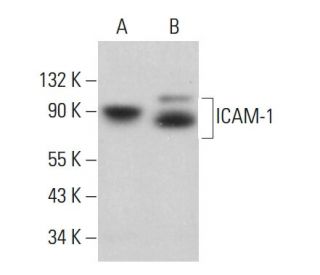


ICAM-1/CD54 Antibody (2Q710): sc-71292
- ICAM-1/CD54 Antibody (2Q710) is a mouse monoclonal IgG1 κ, cited in 4 publications, provided at 200 µg/ml
- raised against an ICAM1-positive cell preparation
- recommended for detection of ICAM-1 of mouse, rat and human origin by WB, IP, IF, IHC(P) and FCM
- See ICAM-1/CD54 (G-5): sc-8439 for ICAM-1/CD54 antibody conjugates, including AC, HRP, FITC, PE, Alexa Fluor® 488, 594, 647, 680 and 790.
- m-IgG Fc BP-HRP is the preferred secondary detection reagent for ICAM-1/CD54 Antibody (2Q710) for WB and IHC(P) applications. This reagent is now offered in a bundle with ICAM-1/CD54 Antibody (2Q710) (see ordering information below).

ICAM-1 Antibody (2Q710) is a mouse monoclonal IgG1 kappa light chain antibody raised against an ICAM-1-positive cell preparation, demonstrating reactivity with mouse, rat, and human species. ICAM-1 monoclonal antibody (2Q710) is suitable for applications such as western blotting (WB), immunoprecipitation (IP), immunofluorescence (IF), immunohistochemistry with paraffin-embedded sections (IHCP), and flow cytometry (FCM). ICAM-1, also known as CD54 or intercellular adhesion molecule-1, is a cell surface glycoprotein belonging to the immunoglobulin superfamily. ICAM-1 plays a crucial role in mediating cell-cell adhesion during immune responses by interacting with specific proteins like leukocyte function-associated antigen-1 (LFA-1, also known as CD11a/CD18) and Mac-1 (CD11b/CD18) integrins on leukocytes. These interactions facilitate leukocyte adhesion and transmigration across the endothelium, essential for immune surveillance and inflammation. ICAM-1 also interacts with fibrinogen and hyaluronan-binding protein 2, influencing cellular signaling pathways and vascular permeability. Understanding these protein-protein interactions is important for research into inflammatory diseases, autoimmune disorders, and cancer metastasis, where altered ICAM-1 expression and function contribute to disease progression. Anti-ICAM-1 antibody (2Q710) provides a valuable tool for studying ICAM-1′s role in physiological and pathological processes.
Ordering Information
| Product Name | Catalog # | UNIT | Price | Qty | FAVORITES | |
ICAM-1/CD54 Antibody (2Q710) | sc-71292 | 200 µg/ml | $322.00 | |||
ICAM-1/CD54 Antibody (2Q710): m-IgG Fc BP-HRP Bundle | sc-539359 | 200 µg Ab; 10 µg BP | $361.00 |