
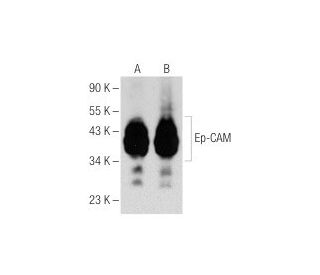
Ep-CAM Antibody (0.N.276): sc-71059
- Ep-CAM Antibody (0.N.276) is a mouse monoclonal IgG1 κ, cited in 7 publications, provided at 200 µg/ml
- raised against small cell lung carcinoma cell line HG9 of human origin
- recommended for detection of Ep-CAM of human origin by WB, IP, IF and FCM
- available conjugated to either phycoerythrin or FITC for IF, IHC(P) and FCM
- See Ep-CAM (C-10): sc-25308 for Ep-CAM antibody conjugates, including AC, HRP, FITC, PE, Alexa Fluor® 488, 594, 647, 680 and 790.
- m-IgG Fc BP-HRP and m-IgG1 BP-HRP are the preferred secondary detection reagents for Ep-CAM Antibody (0.N.276) for WB applications. These reagents are now offered in bundles with Ep-CAM Antibody (0.N.276) (see ordering information below).

QUICK LINKS
SEE ALSO...
Ep-CAM Antibody (0.N.276) is a mouse monoclonal IgG1 antibody that detects Ep-CAM in human samples through applications such as western blotting (WB), immunoprecipitation (IP), immunofluorescence (IF), and flow cytometry (FCM). Ep-CAM, also known as tumor-associated calcium signal transducer 1 and MK-1, is a monomeric membrane glycoprotein predominantly expressed in normal human epithelial tissues and various carcinomas. The human Ep-CAM gene encodes a 314 amino acid protein that exists in two forms, with the major form being more prevalent and the minor form reduced upon treatment with the amino-glycosylation inhibitor tunicamycin. Ep-CAM contains an extracellular domain with two epidermal growth factor-like repeats followed by a cysteine-poor region, which is essential for adhesive properties. Ep-CAM′s overexpression in numerous carcinomas makes anti-Ep-CAM antibody (0.N.276) a promising tool for both visualization and therapeutic strategies in human solid tumors. Ep-CAM′s interactions with specific proteins, such as integrins and cadherins, highlight Ep-CAM′s importance in maintaining cellular integrity and facilitating communication between cells, which is vital for normal tissue function and tumor progression prevention. Ep-CAM monoclonal antibody (0.N.276) serves as an invaluable tool for researchers exploring cancer biology and therapeutic development.
Ordering Information
| Product Name | Catalog # | UNIT | Price | Qty | FAVORITES | |
Ep-CAM Antibody (0.N.276) | sc-71059 | 200 µg/ml | $322.00 | |||
Ep-CAM Antibody (0.N.276): m-IgG Fc BP-HRP Bundle | sc-539340 | 200 µg Ab; 10 µg BP | $361.00 | |||
Ep-CAM Antibody (0.N.276): m-IgG1 BP-HRP Bundle | sc-541423 | 200 µg Ab; 20 µg BP | $361.00 | |||
Ep-CAM Antibody (0.N.276) FITC | sc-71059 FITC | 200 µg/ml | $336.00 | |||
Ep-CAM Antibody (0.N.276) PE | sc-71059 PE | 200 µg/ml | $349.00 |