
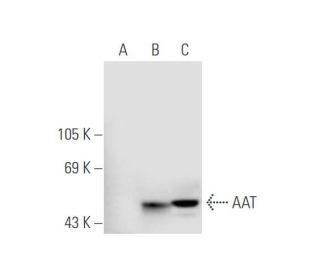

Anticorps AAT (8.F.14): sc-69986
- L'anticorps AAT 8.F.14 est un monoclonal IgG1 de souris fourni en 100 µg/ml
- dirigé contre AAT purifié de sérum d'origine human
- recommandé pour la détection de human serum AAT d'origine mouse, rat et human par WB, IP et ELISA; non cross-reactif avec AACT
- Nous testons actuellement encore nos anticorps secondaires pour trouver la meilleure protéine de liaison pour cet anticorps primaire AAT (8.F.14). Veuillez nous contacter si vous avez des questions concernant les réactifs de détection secondaire appropriés.

ACCÈS RAPIDE AUX LIENS
VOIR ÉGALEMENT...
L'anticorps AAT (8.F.14) est un anticorps monoclonal IgG1 de souris qui détecte l'α1-antitrypsine (AAT) dans des échantillons de souris, de rats et d'humains par des applications telles que le western blotting (WB), l'immunoprécipitation (IP) et l'enzyme-linked immunosorbent assay (ELISA). L'AAT est une protéine hépatique cruciale de la phase aiguë, composée de 394 acides aminés, principalement synthétisée dans le foie, où l'AAT joue un rôle vital dans la protection des tissus pulmonaires contre les dommages causés par l'élastase neutrophile, une sérine protéase impliquée dans le développement de l'emphysème pulmonaire. La localisation de l'AAT dans le foie est importante car elle permet une réponse rapide aux stimuli inflammatoires, garantissant la disponibilité de l'AAT pour inhiber les enzymes protéolytiques qui peuvent conduire à la destruction des tissus. L'AAT est une protéine sérique glycosylée très polymorphe, qui présente des profils de focalisation isoélectrique distincts pour diverses variantes génétiques, ce qui peut influencer la capacité fonctionnelle et le potentiel thérapeutique. Le gène codant pour l'AAT est situé sur le chromosome humain 14, à côté d'un autre gène de serpine qui code pour la globuline liant les corticostéroïdes, ce qui souligne l'interconnexion de ces protéines dans la régulation des réponses inflammatoires. L'oxydation du résidu méthionine 358 dans le site actif de l'AAT réduit considérablement la capacité de l'AAT à inhiber l'élastase, ce qui souligne l'importance des modifications post-traductionnelles dans le maintien de la fonction protectrice. Le déficit en AAT est associé à un risque nettement accru de développer un emphysème pulmonaire précoce, ce qui rend l'étude de l'AAT et de ses interactions essentielle à la compréhension et à l'atténuation potentielle des maladies pulmonaires.
Alexa Fluor® est une marque déposée de Molecular Probes Inc., OR., USA
LI-COR® et Odyssey® sont marques déposées de LI-COR Biosciences
Anticorps AAT (8.F.14) Références:
- L'avantage sélectif du déficit en alpha1-antitrypsine. | Lomas, DA. 2006. Am J Respir Crit Care Med. 173: 1072-7. PMID: 16439713
- Les anomalies de l'alpha-1-antitrypsine (AAT) sont associées à des maladies pulmonaires dues à des mycobactéries à croissance rapide et l'AAT inhibe l'infection des macrophages par Mycobacterium abscessus. | Chan, ED., et al. 2007. Scand J Infect Dis. 39: 690-6. PMID: 17654345
- Stratégies protéostasiques pour restaurer le déficit en alpha1-antitrypsine. | Bouchecareilh, M., et al. 2010. Proc Am Thorac Soc. 7: 415-22. PMID: 21030523
- Propriétés anti-inflammatoires et immunomodulatrices de l'α1-antitrypsine sans inhibition de l'élastase. | Jonigk, D., et al. 2013. Proc Natl Acad Sci U S A. 110: 15007-12. PMID: 23975926
- Distinguer le déficit en alpha1-antitrypsine de l'asthme. | Siri, D., et al. 2013. Ann Allergy Asthma Immunol. 111: 458-64. PMID: 24267358
- Récompenses hors cible de la thérapie d'augmentation avec l'alpha-1-antitrypsine. | Jenne, DE. 2014. Am J Respir Crit Care Med. 190: 1203-4. PMID: 25436777
- L'alpha;1-antitrypsine favorise les métastases de l'adénocarcinome pulmonaire en régulant l'expression de la fibronectine. | Li, Y., et al. 2017. Int J Oncol. 50: 1955-1964. PMID: 28440399
- L'édition du génome in vivo restaure partiellement l'alpha-1-antitrypsine dans un modèle murin de déficit en AAT. | Song, CQ., et al. 2018. Hum Gene Ther. 29: 853-860. PMID: 29597895
- L'alpha-1-antitrypsine provoque la régulation négative du CD8 pendant la différenciation des thymocytes. | Bristow, CL. and Winston, R. 2021. Trends Immunol. 42: 177-178. PMID: 33546997
- Déficit en alpha 1-antitrypsine (AAT) et vascularite systémique ANCA-positive: implications génétiques et cliniques. | Callea, F., et al. 1997. Eur J Clin Invest. 27: 696-702. PMID: 9279535
Informations pour la commande
| Nom du produit | Ref. Catalogue | COND. | Prix HT | QTÉ | Favoris | |
Anticorps AAT (8.F.14) | sc-69986 | 100 µg/ml | $322.00 |