
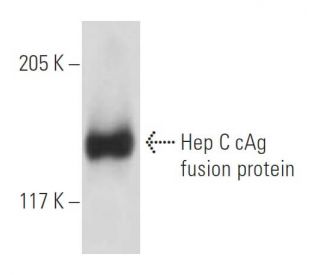

Hep C cAg Anticuerpo (1868): sc-69937
- Hep C cAg Anticuerpo 1868 es un monoclonal de ratón IgG1, ver las 2 publicaciones, proporcionado como 100 µg/ml
- Producido contra Hepatitis C virus
- recomendado para detectar core antigen genotypes 1a, 1b and 2a de Hepatitis C virus origen, mediante WB, IP y IF
- Actualmente, aún no hemos completado la identificación de los reactivos de detección secundaria preferidos para Hep C cAg Anticuerpo (1868). Este trabajo está en progreso.

ENLACES RÁPIDOS
VER TAMBIÉN ....
La Hepatitis C (Hep C) es un virus de ARN de sentido positivo, de cadena sencilla, pequeño y envuelto, perteneciente a la familia Flaviviridae. La transmisión del virus ocurre cuando la sangre de una persona infectada entra en el cuerpo de una persona no infectada. La Hep C se replica principalmente dentro de los hepatocitos en el hígado, y las partículas circulantes de Hep C se unen a receptores en la superficie y entran en estas células. La Hep C se replica rápidamente, produciendo aproximadamente un billón de partículas cada día en personas infectadas. La ARN polimerasa de la Hep C no tiene función de corrección, por lo que el virus tiene una tasa de mutación excepcionalmente alta que puede ayudarlo a eludir el sistema inmunológico del huésped. La infección por Hep C resulta en infecciones crónicas, cirrosis hepática y carcinoma hepatocelular en la mayoría de las personas. La proteína central de la Hep C, conocida como cAg de Hep C, está bien conservada entre los diferentes genotipos virales y puede contribuir a la fibrogénesis hepática al regular al alza el factor de crecimiento del tejido conectivo y TGFβ1.
Alexa Fluor® es una marca registrada de Molecular Probes Inc., OR., USA
REIVEW LI-COR® y Odyssey® son marcas registradas de LI-COR Biosciences.
Hep C cAg Anticuerpo (1868) Referencias:
- La proteína del núcleo del VHC promueve la fibrogénesis hepática a través de la regulación al alza de CTGF con TGF-beta1. | Shin, JY., et al. 2005. Exp Mol Med. 37: 138-45. PMID: 15886528
- La interacción de la proteína del núcleo del VHC con la proteína 14-3-3epsilon libera Bax para activar la apoptosis. | Lee, SK., et al. 2007. Biochem Biophys Res Commun. 352: 756-62. PMID: 17141194
- Los efectos neurotóxicos de la proteína del núcleo del VHC están mediados por la activación sostenida de ERK a través de la señalización TLR2. | Paulino, AD., et al. 2011. J Neurovirol. 17: 327-40. PMID: 21660601
- Inhibición de la proteína del núcleo del VHC en la respuesta inmunitaria al antígeno de superficie del VHB y en la expresión génica y replicación del VHB in vivo. | Zhu, W., et al. 2012. PLoS One. 7: e45146. PMID: 23024803
- Evaluación de la proteína total del núcleo del virus de la hepatitis C (VHC) en la crioglobulinemia mixta relacionada con el VHC. | Russi, S., et al. 2014. Arthritis Res Ther. 16: R73. PMID: 24636026
- Papel de la proteína exógena del núcleo del VHC en la interacción de la proliferación de los hepatocitos humanos y las subpoblaciones de macrófagos. | Yao, Z., et al. 2014. PLoS One. 9: e108278. PMID: 25265479
- El fragmento N-terminal de la proteína del núcleo del VHC disminuye la actividad del proteasoma 20S en presencia de PA28γ. | Zheng, Y., et al. 2019. Biochem Biophys Res Commun. 509: 590-595. PMID: 30602418
- El lncRNA HULC facilita la carga eficiente de la proteína del núcleo del VHC en las gotitas lipídicas y la posterior liberación de las partículas del virus. | Sharma, G., et al. 2019. Cell Microbiol. 21: e13086. PMID: 31290220
- Nanoplataforma plasmónica para el análisis en el punto de atención de trazas de la proteína del núcleo del VHC. | Li, X., et al. 2020. Biosens Bioelectron. 147: 111488. PMID: 31350137
- Impacto de los genotipos de IL28 y modelización de las interacciones de la proteína central del VHC en el tratamiento de la hepatitis C. | Hashempour, T., et al. 2020. Interdiscip Sci. 12: 424-437. PMID: 32656614
Información sobre pedidos
| Nombre del producto | Número de catálogo | UNIDAD | Precio | CANTIDAD | Favoritos | |
Hep C cAg Anticuerpo (1868) | sc-69937 | 100 µg/ml | $322.00 |