
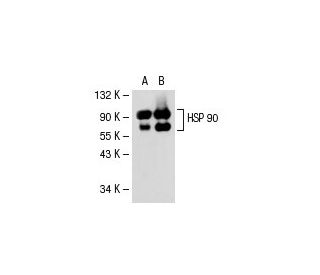


HSP90 Anticorpo (4F10): sc-69703
- HSP90 Anticorpo 4F10é um anticorpo monoclonal produzido em camundongo IgG2b HSP90 anticorpo, citado em 157 publicações, fornecido em 50 µg/0.5 ml
- activada contra HSP 90 recombinante de comprimento total de origem human
- recomendado para a detecção de HSP 90 of human origin by WB, IP and ELISA
- See HSP90 alpha/beta (F-8): sc-13119 for additional antibody conjugates, including AC, HRP, FITC, PE, Alexa Fluor® 488, 594, 647, 680 and 790.
- 2b BP-HRP">m-IgG2b BP-HRP é o reagente de deteção secundário preferido para HSP90 Antibody (4F10) para aplicações WB. Este reagente é agora oferecido num pacote com HSP90 Antibody (4F10)(ver informações para encomenda abaixo).

O Anticorpo HSP 90 (4F10) é um anticorpo HSP 90 monoclonal de camundongo IgG2b (também designado anticorpo HSP90, anticorpo HSP90AA1 ou anticorpo HSP90AB1) que detecta a proteína HSP 90 de origem humana por WB, IP e ELISA. O anticorpo HSP 90 (4F10) está disponível como anticorpo anti-HSP 90 não conjugado. A resposta ao choque térmico foi descrita pela primeira vez para as células das glândulas salivares de Drosophila e, morfologicamente, consiste em uma mudança nos padrões de inchaço dos cromossomos politênicos que envolve a síntese de novo de algumas proteínas. Proteínas de choque térmico semelhantes foram descobertas posteriormente em galinhas bacterianas e células de mamíferos, e foram estudadas posteriormente em outros organismos. Uma série de proteínas, incluindo HSP 90, HSP 70, HSP 20-30 e ubiquitina, é induzida por insultos como choque térmico, produtos químicos e outros estresses ambientais. Uma das principais funções da HSP 90 e de outras HSPs é atuar como chaperonas moleculares. A HSP 90 forma um complexo com o receptor de glicocorticoide (GR), tornando o receptor não ligado ao ligante transcritivamente inativo. A HSP 90 se liga ao GR como um heterocomplexo composto pela HSP 56 ou pela ciclofilina D, formando um complexo aporeceptor. A HSP 90 também existe como um dímero com outras proteínas, como p60/STI1 e p23, formando um complexo aporeceptor com receptores de estrogênio e androgênio.
Alexa Fluor® é uma marca comercial da Molecular Probes Inc., OR., EUA
LI-COR® e Odyssey® são marcas registadas da LI-COR Biosciences
Referencias do HSP90 Anticorpo (4F10):
- PKC epsilon é um regulador único para o gene hsp90 beta na resposta ao choque térmico. | Wu, JM., et al. 2003. J Biol Chem. 278: 51143-9. PMID: 14532285
- HSP90 e o chaperoning do cancro. | Whitesell, L. and Lindquist, SL. 2005. Nat Rev Cancer. 5: 761-72. PMID: 16175177
- A Hsp90 potencia a rápida evolução de novas características: resistência a fármacos em diversos fungos. | Cowen, LE. and Lindquist, S. 2005. Science. 309: 2185-9. PMID: 16195452
- Modulação das funções da chaperona molecular Hsp90 através de acetilação reversível. | Aoyagi, S. and Archer, TK. 2005. Trends Cell Biol. 15: 565-7. PMID: 16199163
- A família de genes HSP90 no genoma humano: uma visão sobre a sua divergência e evolução. | Chen, B., et al. 2005. Genomics. 86: 627-37. PMID: 16269234
- Hsp90: uma chaperona para a dobragem de proteínas e regulação de genes. | Zhao, R. and Houry, WA. 2005. Biochem Cell Biol. 83: 703-10. PMID: 16333321
- A Hsp90 regula a ativação do fator regulador do interferão 3 e a estabilização da TBK-1 em células infectadas com o vírus Sendai. | Yang, K., et al. 2006. Mol Biol Cell. 17: 1461-71. PMID: 16394098
- Transferência de substrato da chaperona Hsp70 para a Hsp90. | Wegele, H., et al. 2006. J Mol Biol. 356: 802-11. PMID: 16403523
- Modulação da função da chaperona e da interação da cochaperona pela novobiocina no domínio C-terminal da Hsp90: provas de que os antibióticos cumarínicos perturbam a dimerização da Hsp90. | Allan, RK., et al. 2006. J Biol Chem. 281: 7161-71. PMID: 16421106
Informacoes sobre ordens
| Nome do Produto | Numero de Catalogo | UNID | Preco | Qde | FAVORITOS | |
HSP90 Anticorpo (4F10) | sc-69703 | 50 µg/0.5 ml | $322.00 | |||
Pacote do HSP90 (4F10): m-IgG2b BP-HRP | sc-548446 | 50 µg Ab; 10 µg BP | $361.00 |