
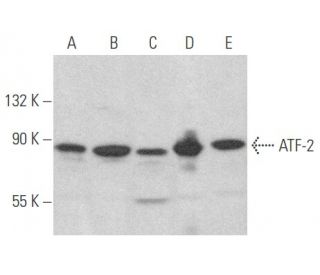

This polyclonal antibody has been discontinued. See our recommended ATF-2 (F2BR-1) monoclonal antibody (sample data shown).
ATF-2 Antibody (N-96): sc-6233
- ATF-2 Antibody (N-96) is a rabbit polyclonal IgG; 200 µg/ml
- epitope corresponding to amino acids 1-96 mapping at the N-terminus of ATF-2 of human origin
- Discontinued polyclonal antibody

For Research Use Only. Not Intended for Diagnostic or Therapeutic Use.
Alexa Fluor® is a trademark of Molecular Probes Inc., OR., USA
Ordering Information
ATF-2 (F2BR-1): sc-242 [ Recommended monoclonal replacement for ATF-2 (N-96) ]
| Product Name | Catalog # | UNIT | Price | Qty | FAVORITES | |
ATF-2 Antibody (F2BR-1) | sc-242 | 200 µg/ml | $322.00 | |||
ATF-2 Antibody (F2BR-1): m-IgG Fc BP-HRP Bundle | sc-528101 | 200 µg Ab; 10 µg BP | $361.00 | |||
ATF-2 Antibody (F2BR-1): m-IgGκ BP-HRP Bundle | sc-520399 | 200 µg Ab, 40 µg BP | $361.00 | |||
ATF-2 Antibody (F2BR-1): m-IgG1 BP-HRP Bundle | sc-542759 | 200 µg Ab; 20 µg BP | $361.00 | |||
ATF-2 Antibody (F2BR-1) X | sc-242 X | 200 µg/0.1 ml | $322.00 | |||
ATF-2 Antibody (F2BR-1) AC | sc-242 AC | 500 µg/ml, 25% agarose | $424.00 | |||
ATF-2 Antibody (F2BR-1) HRP | sc-242 HRP | 200 µg/ml | $322.00 | |||
ATF-2 Antibody (F2BR-1) FITC | sc-242 FITC | 200 µg/ml | $336.00 | |||
ATF-2 Antibody (F2BR-1) PE | sc-242 PE | 200 µg/ml | $349.00 | |||
ATF-2 Antibody (F2BR-1) Alexa Fluor® 488 | sc-242 AF488 | 200 µg/ml | $364.00 | |||
ATF-2 Antibody (F2BR-1) Alexa Fluor® 546 | sc-242 AF546 | 200 µg/ml | $364.00 | |||
ATF-2 Antibody (F2BR-1) Alexa Fluor® 594 | sc-242 AF594 | 200 µg/ml | $364.00 | |||
ATF-2 Antibody (F2BR-1) Alexa Fluor® 647 | sc-242 AF647 | 200 µg/ml | $364.00 | |||
ATF-2 Antibody (F2BR-1) Alexa Fluor® 680 | sc-242 AF680 | 200 µg/ml | $364.00 | |||
ATF-2 Antibody (F2BR-1) Alexa Fluor® 790 | sc-242 AF790 | 200 µg/ml | $364.00 |