
Subscrever / Inscrever-se Conta
Corrinho de compra (0)
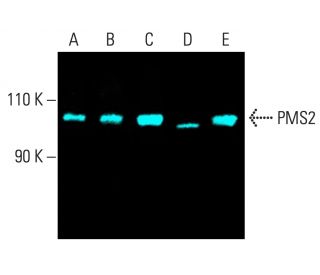

Este anticorpo policlonal foi descontinuado. Consulta o nosso anticorpo monoclonal PMS2 (B-3) recomendado (dados de amostra apresentados).
PMS2 Anticorpo (C-20): sc-618
- PMS2 Anticorpo C-20 é um anticorpo policlonal produzido em coelho IgG fornecido em100 µg/ml
- epítopo mapeado no C-terminus de PMS2 de human origem
- Anticorpo policlonal descontinuado

The finding that mutations in DNA mismatch repair genes are associated with hereditary nonpolyposis colorectal cancer (HNPCC) has resulted in considerable interest in the understanding of the mechanism of DNA mismatch repair. Initially, inherited mutations in the MSH2 and MLH1 homologs of the bacterial DNA mismatch repair genes MutS and MutL were demonstrated at high frequency in HNPCC and were shown to be associated with microsatellite instability. The demonstration that 10 to 45% of pancreatic, gastric, breast, ovarian and small cell lung cancers also display microsatellite instability has been interpreted to suggest that DNA mismatch repair is not restricted to HNPCC tumors but is a common feature in tumor initiation or progression. Two additional homologs of the prokaryotic MutL gene, designated PMS1 and PMS2, have been identified and shown to be mutated in the germline of HNPCC patients.
Informacoes sobre ordens
PMS2 (B-3): sc-25315 [ anticorpo monoclonal substituto recomendado para PMS2 (C-20) ]
| Nome do Produto | Numero de Catalogo | UNID | Preco | Qde | FAVORITOS | |
PMS2 Anticorpo (B-3) | sc-25315 | 200 µg/ml | $322.00 | |||
Pacote do PMS2 (B-3): m-IgG Fc BP-HRP | sc-526648 | 200 µg Ab; 10 µg BP | $361.00 | |||
Pacote do PMS2 (B-3): m-IgG1 BP-HRP | sc-532021 | 200 µg Ab; 20 µg BP | $361.00 | |||
PMS2 Anticorpo (B-3) AC | sc-25315 AC | 500 µg/ml, 25% agarose | $424.00 | |||
PMS2 Anticorpo (B-3) HRP | sc-25315 HRP | 200 µg/ml | $322.00 | |||
PMS2 Anticorpo (B-3) FITC | sc-25315 FITC | 200 µg/ml | $336.00 | |||
PMS2 Anticorpo (B-3) PE | sc-25315 PE | 200 µg/ml | $349.00 | |||
PMS2 Anticorpo (B-3) Alexa Fluor® 488 | sc-25315 AF488 | 200 µg/ml | $364.00 | |||
PMS2 Anticorpo (B-3) Alexa Fluor® 546 | sc-25315 AF546 | 200 µg/ml | $364.00 | |||
PMS2 Anticorpo (B-3) Alexa Fluor® 594 | sc-25315 AF594 | 200 µg/ml | $364.00 | |||
PMS2 Anticorpo (B-3) Alexa Fluor® 647 | sc-25315 AF647 | 200 µg/ml | $364.00 | |||
PMS2 Anticorpo (B-3) Alexa Fluor® 680 | sc-25315 AF680 | 200 µg/ml | $364.00 | |||
PMS2 Anticorpo (B-3) Alexa Fluor® 790 | sc-25315 AF790 | 200 µg/ml | $364.00 |