
santa cruz biotechnology, inc.
SCBT Logo

Welcome!        Items in Cart     Quick Order

IGFBP3 (C-19) Antibody: sc-6003

 |  Datasheet
  • goat polyclonal IgG, 200 µg/ml
  • epitope mapping at the C-terminus of IGFBP3 of human origin
  • recommended for detection of IGFBP3 of human origin by WB, IP, IF and ELISA
  • blocking peptide, sc-6003 P
 
Additional IGFBP Antibodies ...
 
Ordering InformationProduct Citations
Recommended Support Products:
(click button of application of choice)
WB   IP   IF   siRNA  
 
Species Gene Name Gene ID Chromosome Location Isoform (mRNA) Accession # Protein Accession # OMIM™ Number
Human IGFBP3 3486 7p13 NM_000598, NM_001013398 P17936
146732
 
Set Currency

 Ordering Information
Product NameCatalog #UnitPriceQtyAddFavorites
IGFBP3 (C-19) sc-6003 200 µg/ml $279
IGFBP3 (C-19) P sc-6003 P
(peptide)
100 µg/0.5 ml $61
 siRNA Gene Silencers (click product name for more information)
Product NameCatalog #UnitPriceQtyAddFavorites
IGFBP3 siRNA (h) sc-39587 10 µM $258
IGFBP3 (h)-PR sc-39587-PR 10 µM $23
 shRNA Plasmids (click product name for more information)
Product NameCatalog #UnitPriceQtyAddFavorites
IGFBP3 shRNA Plasmid (h) sc-39587-SH 20 µg $520
 shRNA Lentiviral Particles (click product name for more information)
Product NameCatalog #UnitPriceQtyAddFavorites
IGFBP3 shRNA (h) Lentiviral Particles sc-39587-V 200 µl $625
 WB Positive Control Cell Lysate (click product name for more information)
Product NameCatalog #UnitPriceQtyAddFavorites
MIA PaCa-2 Cell Lysate sc-2285 500 µg/200 µl $104

IGFBP3 Background Information
The insulin-like growth factor-binding proteins, or IGFBPs, are a family of homologous proteins that have co-evolved with the IGFs. They serve not only as shuttle molecules for the soluble IGFs, but also confer a level of regulation to the IGF signaling system. Physical association of the IGFBPs with IGF influences the bio-availability of the growth factors, as well as their concentration and distribution in the extracellular environment. In addition, the IGFBPs appear to have biological activity independent of the IGFs. Seven IGFBPs have thus far been described, each differing in their tissue distribution, half-lives and modulation of IGF interactions with their receptors. For instance, IGFBP1 is negatively regulated by insulin production. The IGFBP1 gene is expressed at a high level during fetal liver development and in response to nutritional changes and diabetes. It has been suggested that IGFBP2 functions as chaperone, escorting IGFs to their target tissues. It is expressed in several human tissues including fetal eye and fetal brain. IGFBP3 is the most abundant IGFBP and is complexed with roughly 80% of the serum IGFs. Both IGFBP3 and IGFBP4 are released by dermal fibroblasts in response to incision injury. IGFBP5 is secreted by myoblasts and may play a key role in muscle differentiation. IGFBP6 differs from other IGFBPs in having the highest affinity for IGF-II. Glycosylated human IGFBP6 is expressed in Chinese hamster ovary (CHO) cells, whereas nonglycosylated recombinant human IGFBP6 is expressed in E.coli. IGFBP7 is a secreted protein and binds both IGF-I and IGF-II with a relatively low affinity. It stimulates prostacyclin production and may also function as a growth-suppressing factor.

IGFBP3 (C-19) Product Citations
See how others have used IGFBP3 (C-19): sc-6003 antibody and or IGFBP3 (C-19) antibody conjugates.


10 total citations
Loading citations.
 
IGFBP3 (C-19)
Click on image to enlarge
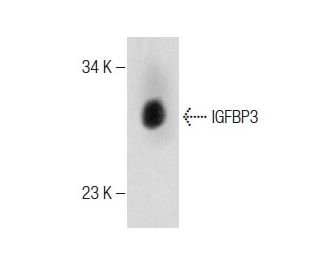
IGFBP3 (C-19): sc-6003. Western blot analysis of human recombinant IGFBP3.
Download
