
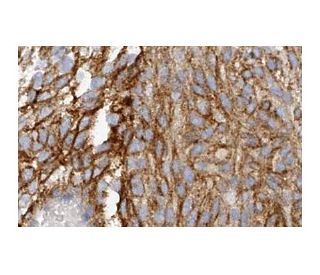

FAT2 항체 (8C5): sc-59985
- FAT2 항체 8C5 는 마우스 monoclonal IgG1 κ FAT2 항체, 1간행물에 인용, 이며 200 µg/ml으로 제공합니다.
- human 기원의 재조합 FAT2 NBF 2 도메인에 대해 제기됨, 아미노산 에 대한 에피토프 매핑
- FAT2 항체 (8C5)는 WB, IP, IF and IHC(P)으로 human유래의 FAT2 를 감지하는 데에 추천한다 .
- 항-FAT2 항체(8C5)는 IP용 agarose와 결합되어 이용 가능하며, WB, IHC(P), ELISA용 HRP와 결합되어 이용 가능하며, IF, IHC(P), FCM용 phycoerythrin 또는 FITC와 결합되어 이용 가능합니다.
- WB (RGB), IF, IHC(P) 와FCM, RGB fluorescent imaging systems, such as iBright™ FL1000, FluorChem™, Typhoon, Azure and other comparable systems에 사용가능한 Alexa Fluor® 488, Alexa Fluor® 546, Alexa Fluor® 594 or Alexa Fluor® 647결합제품도 있습니다.
- WB (NIR), IF와FCM,Near-Infrared (NIR) detection systems, such as LI-COR®Odyssey®, iBright™ FL1000, FluorChem™, Typhoon, Azure and other comparable systems에 사용가능한 Alexa Fluor® 680 or Alexa Fluor® 790 결합제품도 있습니다.
- m-IgG Fc BP-HRP 및 m-IgG1 BP-HRP 는 FAT2 항체 (8C5) for WB and IHC(P) applications. 이 시약은 이제 FAT2 항체 (8C5)와 함께 번들로 제공됩니다(아래 주문 정보 참조).

FAT2 항체(8C5)는 인간 유래의 FAT2 단백질을 웨스턴 블롯팅(WB), 면역 침전(IP), 면역 형광(IF) 및 파라핀 내장 섹션을 이용한 면역 조직 화학(IHCP)으로 검출하는 마우스 단일 클론 IgG1 카파 경쇄 항체입니다. FAT2(8C5) 항체는 비접합 형태와 아가로스, 홀세라디시 퍼옥시다제(HRP), 피코에리스린(PE), 플루오레세인 이소티오시안산염(FITC) 및 다중 Alexa Fluor® 접합체를 포함한 다양한 접합 형태 모두에서 사용할 수 있습니다. CDHF8, HFAT2 또는 MEGF1(다중 표피 성장 인자 유사 도메인 1)으로도 알려진 FAT2 단백질은 세포 부착 및 신호 전달에 중요한 역할을 하는 단일 통과 유형 I 막 단백질입니다. FAT2는 조직 구조를 유지하고 세포 간 통신을 촉진하는 데 필수적인 카데헤린의 프로토카데헤린 아과에 속합니다. FAT2는 라미닌 G 유사 도메인 1개, EGF 유사 도메인 2개, 카데린 도메인 32개로 구성된 독특한 구조로 다른 세포와 결합할 때 접착 특성과 특이성에 기여합니다. β-카테닌과 같은 세포질 단백질과 FAT2의 상호작용은 기능을 조절하고 발달 및 조직 유지 과정에서 적절한 세포 반응을 보장하는 데 필수적입니다. FAT2의 조절 장애는 암을 비롯한 다양한 질병과 관련이 있으며, 세포 접착의 변화는 전이를 증가시킬 수 있기 때문에 세포 접착에서 FAT2의 역할을 이해하는 것은 중요합니다.
Alexa Fluor®는 미국 오리건주 Molecular Probes Inc.의 상표입니다.
LI-COR®와 Odyssey®는 LI-COR Biosciences의 등록 상표입니다.
FAT2 항체 (8C5) 참고문헌:
- 인간 신경 카데린 유사 세포 부착 유전자의 대규모 계열의 놀라운 조직. | Wu, Q. and Maniatis, T. 1999. Cell. 97: 779-90. PMID: 10380929
- 프로토카데린 연구의 최근 진전. | Suzuki, ST. 2000. Exp Cell Res. 261: 13-8. PMID: 11082270
- 초파리 및 초파리 멜라노가스터의 카데린 수퍼패밀리 단백질. | Hill, E., et al. 2001. J Mol Biol. 305: 1011-24. PMID: 11162110
- 프로토카데린의 새로운 하위 클래스의 세 가지 구성원의 동정 및 특성화. | Wolverton, T. and Lalande, M. 2001. Genomics. 76: 66-72. PMID: 11549318
- 유전자 전환과 프로토카데린 유전자 클러스터 다양성의 진화. | Noonan, JP., et al. 2004. Genome Res. 14: 354-66. PMID: 14993203
- 호모 사피엔스 특이 유전자이자 정신 질환에 대한 감수성 후보인 PCDH11Y의 발현 및 유전적 변이성. | Durand, CM., et al. 2006. Am J Med Genet B Neuropsychiatr Genet. 141B: 67-70. PMID: 16331680
- 프로토카데린-알파의 세포질 도메인은 상동성 상호작용을 강화하고 세포 골격 요소를 인식합니다. | Triana-Baltzer, GB. and Blank, M. 2006. J Neurobiol. 66: 393-407. PMID: 16408303
- CNS에서 프로토카데린-알파 클러스터의 역할과 발현. | Hirayama, T. and Yagi, T. 2006. Curr Opin Neurobiol. 16: 336-42. PMID: 16697637
- Fat2는 WAVE 복합체를 편광시켜 세포 돌출부를 정렬하여 집단 이동을 유도합니다. | Williams, AM., et al. 2022. Elife. 11: PMID: 36154691
- FAT2 돌연변이는 자궁체부 자궁내막암의 더 나은 예후 및 면역 요법에 대한 반응과 관련이 있습니다. | Wang, Z., et al. 2023. Cancer Med. 12: 3797-3811. PMID: 36812126
- Fat2는 Lar과 Sema5c를 분극화하여 집단적으로 이동하는 상피 세포의 운동성을 조정합니다. | Williams, AM. and Horne-Badovinac, S. 2024. J Cell Sci. 137: PMID: 37593878
- 프로토카데린: 중추 신경계에 있는 카데린 관련 분자의 큰 계열. | Sano, K., et al. 1993. EMBO J. 12: 2249-56. PMID: 8508762
주문정보
| 제품명 | 카탈로그 번호 | 단위 | 가격 | 수량 | 관심품목 | |
FAT2 항체 (8C5) | sc-59985 | 200 µg/ml | $322.00 | |||
FAT2 (8C5): m-IgG Fc BP-HRP 번들 | sc-526949 | 200 µg Ab; 10 µg BP | $361.00 | |||
FAT2 (8C5): m-IgG1 BP-HRP 번들 | sc-532322 | 200 µg Ab; 20 µg BP | $361.00 | |||
FAT2 항체 (8C5) AC | sc-59985 AC | 500 µg/ml, 25% agarose | $424.00 | |||
FAT2 항체 (8C5) HRP | sc-59985 HRP | 200 µg/ml | $322.00 | |||
FAT2 항체 (8C5) FITC | sc-59985 FITC | 200 µg/ml | $336.00 | |||
FAT2 항체 (8C5) PE | sc-59985 PE | 200 µg/ml | $349.00 | |||
FAT2 항체 (8C5) Alexa Fluor® 488 | sc-59985 AF488 | 200 µg/ml | $364.00 | |||
FAT2 항체 (8C5) Alexa Fluor® 546 | sc-59985 AF546 | 200 µg/ml | $364.00 | |||
FAT2 항체 (8C5) Alexa Fluor® 594 | sc-59985 AF594 | 200 µg/ml | $364.00 | |||
FAT2 항체 (8C5) Alexa Fluor® 647 | sc-59985 AF647 | 200 µg/ml | $364.00 | |||
FAT2 항체 (8C5) Alexa Fluor® 680 | sc-59985 AF680 | 200 µg/ml | $364.00 | |||
FAT2 항체 (8C5) Alexa Fluor® 790 | sc-59985 AF790 | 200 µg/ml | $364.00 |