
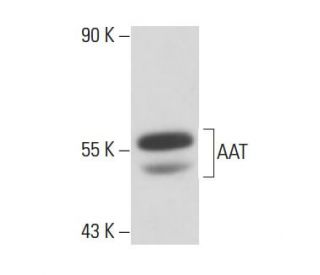


AAT Antibody (B9): sc-59438
- AAT Antibody (B9) is a mouse monoclonal IgG1, cited in 24 publications, provided at 100 µg/ml
- raised against full length AAT of human origin
- recommended for detection of AAT of human origin by WB, IP, IF, IHC(P) and ELISA
- m-IgG Fc BP-HRP and m-IgG1 BP-HRP are the preferred secondary detection reagents for AAT Antibody (B9) for WB and IHC(P) applications. These reagents are now offered in bundles with AAT Antibody (B9) (see ordering information below).

QUICK LINKS
SEE ALSO...
AAT Antibody (B9) is a mouse monoclonal IgG1 antibody that detects α1-antitrypsin (AAT) of human origin by western blotting (WB), immunoprecipitation (IP), immunofluorescence (IF), immunohistochemistry with paraffin-embedded sections (IHCP), and enzyme-linked immunosorbent assay (ELISA). Anti-AAT antibody (B9) is available in a non-conjugated form, providing flexibility for various experimental needs. AAT plays a crucial role in protecting lung tissue from damage caused by Neutrophil Elastase, an enzyme that can lead to pulmonary emphysema, a serious and irreversible lung condition characterized by the loss of elasticity in lung tissue. This 394 amino acid hepatic acute phase protein is primarily synthesized in the liver and is also found in lower concentrations in macrophages. AAT′s structure is particularly important as a highly polymorphic glycosylated serum protein, exhibiting distinct isoelectric-focusing patterns for various genetic variants. The gene encoding AAT is located on human chromosome 14, adjacent to a related serine protease inhibitor gene that encodes corticosteroid-binding globulin. Notably, post-translational modifications, such as the oxidation of the methionine 358 residue in AAT′s active site, can significantly impair elastase inhibition, highlighting the importance of maintaining structural integrity for protective function. AAT deficiency is linked to a 20-30 fold increased risk of developing early-onset pulmonary emphysema, underscoring AAT′s vital role in lung health.
Alexa Fluor® is a trademark of Molecular Probes Inc., OR., USA
LI-COR® and Odyssey® are registered trademarks of LI-COR Biosciences
AAT Antibody (B9) References:
- Differential regulation of gene activity and chromatin structure within the human serpin gene cluster at 14q32.1 in macrophage microcell hybrids. | Rollini, P. and Fournier, RE. 2000. Nucleic Acids Res. 28: 1767-77. PMID: 10734196
- A novel binding site for the native hepatic acute-phase protein alpha1-antitrypsin expressed on the human hepatoma cell line HepG 2 and intestinal cell line Caco 2. | Graziadei, I., et al. 2000. Liver. 20: 240-6. PMID: 10902975
- Alpha1-antitrypsin precursor in gastric juice is a novel biomarker for gastric cancer and ulcer. | Hsu, PI., et al. 2007. Clin Cancer Res. 13: 876-83. PMID: 17289880
- Alpha1-antitrypsin protects beta-cells from apoptosis. | Zhang, B., et al. 2007. Diabetes. 56: 1316-23. PMID: 17360983
- Alpha1-antitrypsin suppresses TNF-alpha and MMP-12 production by cigarette smoke-stimulated macrophages. | Churg, A., et al. 2007. Am J Respir Cell Mol Biol. 37: 144-51. PMID: 17395890
- Alpha-1-antitrypsin (AAT) anomalies are associated with lung disease due to rapidly growing mycobacteria and AAT inhibits Mycobacterium abscessus infection of macrophages. | Chan, ED., et al. 2007. Scand J Infect Dis. 39: 690-6. PMID: 17654345
- Siiyama (serine 53 (TCC) to phenylalanine 53 (TTC)). A new alpha 1-antitrypsin-deficient variant with mutation on a predicted conserved residue of the serpin backbone. | Seyama, K., et al. 1991. J Biol Chem. 266: 12627-32. PMID: 1905728
- Characterization of the molecular basis of the alpha 1-antitrypsin F allele. | Okayama, H., et al. 1991. Am J Hum Genet. 48: 1154-8. PMID: 2035534
- The Multifaceted Effects of Alpha1-Antitrypsin on Neutrophil Functions. | Janciauskiene, S., et al. 2018. Front Pharmacol. 9: 341. PMID: 29719508
- Alpha1-antitrypsin deficiency and asthma. | Pini, L., et al. 2021. Curr Opin Allergy Clin Immunol. 21: 46-51. PMID: 33284159
- Pulmonary transplantation of alpha-1 antitrypsin (AAT)-transgenic macrophages provides a source of functional human AAT in vivo. | Janosz, E., et al. 2021. Gene Ther. 28: 477-493. PMID: 34276045
- Synthesis in yeast of a functional oxidation-resistant mutant of human alpha-antitrypsin. | Rosenberg, S., et al. Nature. 312: 77-80. PMID: 6387509
Ordering Information
| Product Name | Catalog # | UNIT | Price | Qty | FAVORITES | |
AAT Antibody (B9) | sc-59438 | 100 µg/ml | $322.00 | |||
AAT Antibody (B9): m-IgG Fc BP-HRP Bundle | sc-539134 | 100 µg Ab; 10 µg BP | $361.00 | |||
AAT Antibody (B9): m-IgG1 BP-HRP Bundle | sc-541284 | 100 µg Ab; 20 µg BP | $361.00 |