
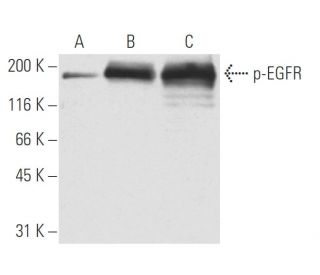

p-EGFR Anticuerpo (9H2): sc-57545
- p-EGFR Anticuerpo 9H2 es un monoclonal de ratón IgG1, ver las 12 publicaciones, proporcionado como 50 µg/0.5 ml
- criados contra un fosfopéptido del EFGR de origen human.
- recomendado para detectarTyr 1173 phosphorylated EGFR de mouse, rat, human y canine origen, mediante WB, IP y IF; no reactivo cruzado con el non-phosphorylated EGFR nor with unrelated Tyrosine-phosphorylated proteins
- Ver EGFR (A-10): sc-373746 para p-EGFR anticuerpos conjugados, incluyendo AC, HRP, FITC, PE, Alexa Fluor® 488, 594, 647, 680 y 790.
- m-IgG Fc BP-HRP y m-IgG1 BP-HRP son los reactivos de detección secundarios preferidos para p-EGFR Anticuerpo (9H2) for WB applications. Estos reactivos se ofrecen ahora en paquetes con p-EGFR Anticuerpo (9H2)(véase la información de pedido más abajo).

ENLACES RÁPIDOS
VER TAMBIÉN ....
El anticuerpo p-EGFR (9H2) es un anticuerpo monoclonal IgG1 de ratón que detecta el EGFR fosforilado Tyr 1173 en muestras de ratón, rata, humanos y caninos a través de aplicaciones como western blotting (WB), inmunoprecipitación (IP) e inmunofluorescencia (IF). El anticuerpo monoclonal p-EGFR (9H2) está disponible en forma no conjugada, lo que permite configuraciones experimentales versátiles. El receptor del factor de crecimiento epidérmico (EGFR) desempeña un papel crucial en la señalización celular, mediando las respuestas celulares a los factores de crecimiento que son vitales para procesos como la proliferación, la diferenciación y la supervivencia celular. Situado principalmente en la superficie celular, el EGFR se activa al unirse a ligandos como el EGF o el TGFα, lo que desencadena una cascada de vías de señalización intracelular esenciales para la función y el desarrollo celular normales. La fosforilación de residuos específicos de tirosina, en particular Tyr 1173, es crítica para la activación del EGFR y la señalización subsiguiente, ya que la fosforilación facilita el reclutamiento de proteínas de señalización corriente abajo, incluido el dominio de unión a fosfotirosina de GRB2. Esta interacción es fundamental para la activación de la vía de señalización Ras, que es integral para el crecimiento y la división celular. La desregulación de la señalización del EGFR suele estar implicada en varios tipos de cáncer, lo que convierte al anticuerpo p-EGFR (9H2) en una valiosa herramienta para la investigación de la biología del cáncer y las intervenciones terapéuticas.
Información sobre pedidos
| Nombre del producto | Número de catálogo | UNIDAD | Precio | CANTIDAD | Favoritos | |
p-EGFR Anticuerpo (9H2) | sc-57545 | 50 µg/0.5 ml | $322.00 | |||
Paquete de p-EGFR (9H2): m-IgG Fc BP-HRP | sc-539060 | 50 µg Ab; 10 µg BP | $361.00 | |||
Paquete de p-EGFR (9H2): m-IgG1 BP-HRP | sc-541235 | 50 µg Ab; 20 µg BP | $361.00 |