
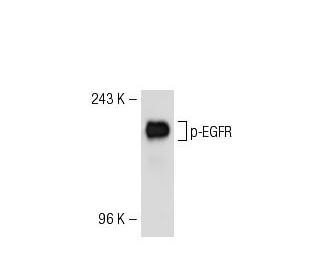


p-EGFR Antibody (1H9): sc-57543
- p-EGFR Antibody (1H9) is a mouse monoclonal IgG1, cited in 2 publications, provided at 50 µg/0.5 ml
- raised against synthetic phosphopeptide corresponding to amino acid residues surrounding serine 1047 of EGFR of human origin
- recommended for detection of Ser 1047 phosphorylated EGFR of mouse, rat, human and canine origin by WB, IP and IF
- See EGFR (A-10): sc-373746 for p-EGFR antibody conjugates, including AC, HRP, FITC, PE, Alexa Fluor® 488, 594, 647, 680 and 790.
- At present, we have not yet completed the identification of the preferred secondary detection reagent(s) for p-EGFR Antibody (1H9). This work is in progress.

QUICK LINKS
SEE ALSO...
p-EGFR Antibody (1H9) is a mouse monoclonal IgG1 antibody raised against synthetic phosphopeptide corresponding to amino acid residues surrounding Serine 1047 of EGFR of human origin. p-EGFR monoclonal antibody (1H9) detects p-EGFR in mouse, rat, human, and canine samples through applications such as western blotting (WB), immunoprecipitation (IP), and immunofluorescence (IF). Anti-p-EGFR antibody (1H9) recognizes phosphorylated forms of EGFR, which is crucial for understanding its role in cell signaling and growth regulation. EGFR is primarily located on the cell surface, where EGFR functions as a receptor for epidermal growth factors, mediating various cellular processes including proliferation, differentiation, and survival. EGFR′s location enables initiation of signaling cascades upon ligand binding, leading to autophosphorylation at specific tyrosine residues, such as Tyr 1092 and Tyr 1173. These phosphorylation events are essential for recruiting downstream signaling proteins, such as GRB2, and activating pathways like Ras, which are pivotal in cancer progression and other diseases. p-EGFR monoclonal antibody (1H9) enables researchers to gain insights into the activation status of EGFR and implications in various biological contexts, making p-EGFR (1H9) antibody a valuable tool for studies in cancer research and therapeutic development.
Ordering Information
| Product Name | Catalog # | UNIT | Price | Qty | FAVORITES | |
p-EGFR Antibody (1H9) | sc-57543 | 50 µg/0.5 ml | $322.00 |