
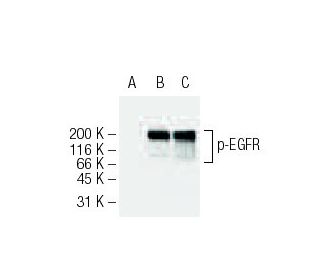


p-EGFR Antibody (12A3): sc-57542
- p-EGFR Antibody (12A3) is a mouse monoclonal IgG1, cited in 19 publications, provided at 50 µg/0.5 ml
- raised against an EGFR phosphopeptide of human origin
- recommended for detection of Tyr 845 phosphorylated EGFR of mouse, rat and human origin by WB and IP; non cross-reactive with the non-phosphorylated EGFR nor with unrelated tyrosine-phosphorylated proteins
- See EGFR (A-10): sc-373746 for p-EGFR antibody conjugates, including AC, HRP, FITC, PE, Alexa Fluor® 488, 594, 647, 680 and 790.
- m-IgG Fc BP-HRP and m-IgG1 BP-HRP are the preferred secondary detection reagents for p-EGFR Antibody (12A3) for WB applications. These reagents are now offered in bundles with p-EGFR Antibody (12A3) (see ordering information below).

QUICK LINKS
SEE ALSO...
p-EGFR Antibody (12A3) is a mouse monoclonal IgG1 antibody that detects Tyr 845 phosphorylated EGFR in mouse, rat, and human samples through western blotting (WB) and immunoprecipitation (IP). p-EGFR monoclonal antibody (12A3) is available in a non-conjugated form, providing researchers with a versatile tool for studying the epidermal growth factor receptor (EGFR), a critical player in cell signaling pathways that regulate cell growth, differentiation, and survival. EGFR functions as a receptor for epidermal growth factors, which, upon binding, activate intrinsic tyrosine kinase activity, leading to autophosphorylation at key tyrosine residues such as Tyr 1092 and Tyr 1173. These phosphorylation events are crucial for recruiting signaling proteins, including the phosphotyrosine binding domain of GRB2, which facilitates downstream signaling through the Ras pathway. Additionally, phosphorylation of these residues induces conformational changes in the C-terminal tail of EGFR, further enhancing signaling capabilities. Understanding EGFR phosphorylation dynamics is vital for elucidating involvement in various cancers and developing targeted therapies. p-EGFR (12A3) antibody serves as an essential resource for investigating EGFR phosphorylation dynamics and impact on cell signaling, providing valuable insights into cancer biology and therapeutic strategies.
Ordering Information
| Product Name | Catalog # | UNIT | Price | Qty | FAVORITES | |
p-EGFR Antibody (12A3) | sc-57542 | 50 µg/0.5 ml | $322.00 | |||
p-EGFR Antibody (12A3): m-IgG Fc BP-HRP Bundle | sc-539059 | 50 µg Ab; 10 µg BP | $361.00 | |||
p-EGFR Antibody (12A3): m-IgG1 BP-HRP Bundle | sc-541234 | 50 µg Ab; 20 µg BP | $361.00 |