
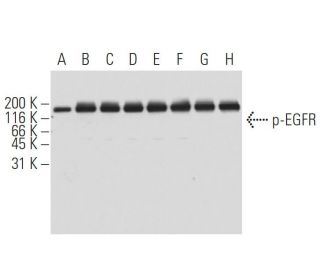

p-EGFR Antibody (11C2): sc-57541
- p-EGFR Antibody (11C2) is a mouse monoclonal IgG1 κ, cited in 7 publications, provided at 50 µg/0.5 ml
- raised against an EGFR phosphopeptide of human origin
- recommended for detection of Tyr 1045 phosphorylated EGFR of mouse, rat, human and canine origin by WB and IP
- See EGFR (A-10): sc-373746 for p-EGFR antibody conjugates, including AC, HRP, FITC, PE, Alexa Fluor® 488, 594, 647, 680 and 790.
- At present, we have not yet completed the identification of the preferred secondary detection reagent(s) for p-EGFR Antibody (11C2). This work is in progress.

QUICK LINKS
SEE ALSO...
p-EGFR Antibody (11C2) is a mouse monoclonal IgG1 antibody that detects an EGFR phosphopeptide of human origin in mouse, rat, human, and canine samples through applications such as western blotting (WB) and immunoprecipitation (IP). anti-EGFR antibody (11C2) plays a crucial role in studying the function of EGFR, which is essential for mediating cell growth and differentiation through interactions with epidermal growth factors like EGF and TGFα. Upon binding, EGFR undergoes autophosphorylation at specific tyrosine residues, including Tyr 1092 and Tyr 1173, which are pivotal for activating downstream signaling pathways, such as the Ras signaling cascade. The Ras cascade further activates a network of kinases, including Raf, MEK, and ERK, which regulate gene expression involved in cell proliferation and survival. Additionally, these pathways interact with other signaling networks, such as the PI3K/AKT pathway, to modulate cellular responses to external growth signals. This activation not only promotes cell proliferation but also influences various cellular processes, making EGFR a significant target in cancer research and therapeutic interventions. EGFR monoclonal antibody (11C2) recognition of phosphorylated forms of EGFR allows researchers to investigate the activation status of this receptor in different biological contexts, providing insights into its role in oncogenesis and potential resistance mechanisms to targeted therapies.
Ordering Information
| Product Name | Catalog # | UNIT | Price | Qty | FAVORITES | |
p-EGFR Antibody (11C2) | sc-57541 | 50 µg/0.5 ml | $322.00 |