
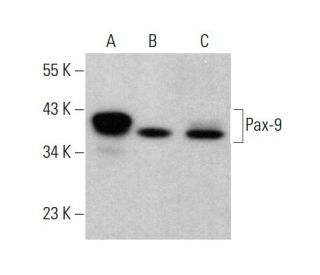
Pax-9 Anticuerpo (7C2): sc-56823
- Pax-9 Anticuerpo 7C2 es un monoclonal de rata IgG1 Pax-9 Anticuerpo, ver las 3 publicaciones, proporcionado como 200 µg/ml
- planteada frente a la proteína de fusión Pax-9 recombinante de origen mouse
- Pax-9 Anticuerpo (7C2) es recomendado para detectar Pax-9 de mouse, rat y human origen, mediante WB, IP, IF y IHC(P); no tiene reactividad cruzada con other Pax proteins
- Pax-9 Anticuerpo (7C2) es disponible conjugado a agarosa para IP; HRP para WB, IHC(P) y ELISA; y tanto a phycoerythrin como a FITC para IF, IHC(P) y FCM
- también disponible conjugado a Alexa Fluor® 488, Alexa Fluor® 546, Alexa Fluor® 594 o Alexa Fluor® 647 para WB (RGB), IF, IHC (P) y FCM
- también disponible conjugado a Alexa Fluor® 680 o Alexa Fluor® 790 para WB (NIR), IF y FCM
- Actualmente, aún no hemos completado la identificación de los reactivos de detección secundaria preferidos para Pax-9 Anticuerpo (7C2). Este trabajo está en progreso.

El anticuerpo Pax-9 (7C2) es un anticuerpo monoclonal IgG1 de rata que detecta el Pax-9 de origen humano, de rata y de ratón mediante western blotting (WB), inmunoprecipitación (IP), inmunofluorescencia (IF) e inmunohistoquímica. El anticuerpo Pax-9 (7C2) está disponible tanto en forma no conjugada como en varias formas conjugadas, incluyendo agarosa, peroxidasa de rábano picante (HRP), ficoeritrina (PE), isotiocianato de fluoresceína (FITC) y múltiples conjugados Alexa Fluor®. La Pax-9 desempeña un papel crucial en el desarrollo de diversos órganos y elementos esqueléticos, por lo que la Pax-9 es esencial para el correcto desarrollo embrionario. El Pax-9 es miembro de la familia de genes de la caja emparejada, que se caracteriza por su dominio emparejado que comparte una fuerte homología con genes de Drosophila, conocidos por su implicación en la programación temprana del desarrollo. La importancia del Pax-9 se ve subrayada por las asociaciones con varios trastornos esqueléticos hereditarios; las mutaciones en el Pax-9 pueden dar lugar a afecciones como el síndrome de Jarcho-Levin y otras formas de displasia espondilocostal, que se caracterizan por un desarrollo vertebral anormal. En particular, una mutación de desplazamiento de marco dentro del dominio emparejado de Pax-9 se ha relacionado con la oligodoncia autosómica dominante, una afección en la que los individuos tienen dientes primarios normales pero les faltan la mayoría de los molares permanentes, junto con la posible ausencia de otros dientes. El Pax-9 se localiza en el cromosoma humano 14q12-q13, lo que destaca la importancia del Pax-9 en los estudios genéticos relacionados con las anomalías dentales y esqueléticas.
Alexa Fluor® es una marca registrada de Molecular Probes Inc., OR., USA
REIVEW LI-COR® y Odyssey® son marcas registradas de LI-COR Biosciences.
Pax-9 Anticuerpo (7C2) Referencias:
- Expresión de los genes paired-box Pax-1 y Pax-9 en el desarrollo del esqueleto de las extremidades. | LeClair, EE., et al. 1999. Dev Dyn. 214: 101-15. PMID: 10030590
- La mutación de PAX9 está asociada a la oligodoncia. | Stockton, DW., et al. 2000. Nat Genet. 24: 18-9. PMID: 10615120
- Asociación entre polimorfismos del promotor de PAX-9 e hipodoncia en humanos. | Peres, RC., et al. 2005. Arch Oral Biol. 50: 861-71. PMID: 16137495
- Desarrollo de orígenes odontogénicos duales en la fase temprana del desarrollo del incisivo maxilar de rata. | Kriangkrai, R., et al. 2006. Anat Embryol (Berl). 211: 101-8. PMID: 16416307
- Nueva forma sindrómica de corea hereditaria benigna asociada a una deleción de los genes contiguos TITF-1 y PAX-9. | Devos, D., et al. 2006. Mov Disord. 21: 2237-40. PMID: 17044090
- Localización cromosómica de siete genes PAX y clonación de un nuevo miembro de la familia, PAX-9. | Stapleton, P., et al. 1993. Nat Genet. 3: 292-8. PMID: 7981748
- Un nuevo gen Pax, Pax-9, se localiza en el cromosoma 12 del ratón. | Wallin, J., et al. 1993. Mamm Genome. 4: 354-8. PMID: 8358169
- Los ratones deficientes en Pax9 carecen de derivados de la bolsa faríngea y de dientes y presentan anomalías craneofaciales y de las extremidades. | Peters, H., et al. 1998. Genes Dev. 12: 2735-47. PMID: 9732271
Información sobre pedidos
| Nombre del producto | Número de catálogo | UNIDAD | Precio | CANTIDAD | Favoritos | |
Pax-9 Anticuerpo (7C2) | sc-56823 | 200 µg/ml | $322.00 | |||
Pax-9 Anticuerpo (7C2) AC | sc-56823 AC | 500 µg/ml, 25% agarose | $424.00 | |||
Pax-9 Anticuerpo (7C2) HRP | sc-56823 HRP | 200 µg/ml | $322.00 | |||
Pax-9 Anticuerpo (7C2) FITC | sc-56823 FITC | 200 µg/ml | $336.00 | |||
Pax-9 Anticuerpo (7C2) PE | sc-56823 PE | 200 µg/ml | $349.00 | |||
Pax-9 Anticuerpo (7C2) Alexa Fluor® 488 | sc-56823 AF488 | 200 µg/ml | $364.00 | |||
Pax-9 Anticuerpo (7C2) Alexa Fluor® 546 | sc-56823 AF546 | 200 µg/ml | $364.00 | |||
Pax-9 Anticuerpo (7C2) Alexa Fluor® 594 | sc-56823 AF594 | 200 µg/ml | $364.00 | |||
Pax-9 Anticuerpo (7C2) Alexa Fluor® 647 | sc-56823 AF647 | 200 µg/ml | $364.00 | |||
Pax-9 Anticuerpo (7C2) Alexa Fluor® 680 | sc-56823 AF680 | 200 µg/ml | $364.00 | |||
Pax-9 Anticuerpo (7C2) Alexa Fluor® 790 | sc-56823 AF790 | 200 µg/ml | $364.00 |