
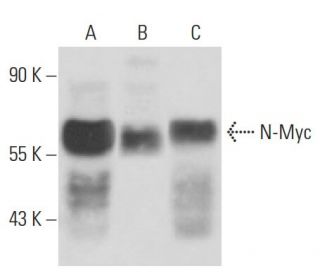


N-Myc Antibody (NCM II 100): sc-56729
- N-Myc Antibody (NCM II 100) is a mouse monoclonal IgG1 κ, cited in 34 publications, provided at 200 µg/ml
- raised against recombinant N-Myc of human origin
- Anti-N-Myc Antibody (NCM II 100) is recommended for detection of N-myc encoded proteins and their cleavage products of mouse, rat and human origin by WB, IP and IF
- Anti-N-Myc Antibody (NCM II 100) is available conjugated to agarose for IP; HRP for WB, IHC(P) and ELISA; and to either phycoerythrin or FITC for IF, IHC(P) and FCM
- also available conjugated to Alexa Fluor® 488, Alexa Fluor® 546, Alexa Fluor® 594 or Alexa Fluor® 647 for WB (RGB), IF, IHC(P) and FCM, and for use with RGB fluorescent imaging systems, such as iBright™ FL1000, FluorChem™, Typhoon, Azure and other comparable systems
- also available conjugated to Alexa Fluor® 680 or Alexa Fluor® 790 for WB (NIR), IF and FCM; for use with Near-Infrared (NIR) detection systems, such as LI-COR®Odyssey®, iBright™ FL1000, FluorChem™, Typhoon, Azure and other comparable systems
- m-IgG Fc BP-HRP and m-IgG1 BP-HRP are the preferred secondary detection reagents for N-Myc Antibody (NCM II 100) for WB applications. These reagents are now offered in bundles with N-Myc Antibody (NCM II 100) (see ordering information below).

N-Myc Antibody (NCM II 100) is a mouse monoclonal IgG1 kappa light chain antibody that detects N-myc protein of mouse, rat, and human origin by western blotting (WB), immunoprecipitation (IP), and immunofluorescence (IF). N-Myc (NCM II 100) antibody is available in non-conjugated and various conjugated forms, including agarose, horseradish peroxidase (HRP), phycoerythrin (PE), fluorescein isothiocyanate (FITC), and multiple Alexa Fluor® conjugates. N-myc protein, a member of the Myc family of oncogenes, plays a crucial role in cell proliferation, differentiation, and apoptosis, making N-myc a significant factor in cancer biology. N-myc dysregulation, particularly through gene amplification, is commonly observed in neuroblastomas, where N-myc expression levels correlate with disease progression and prognosis. N-myc protein primarily localizes in the nucleus, functioning as a transcription factor that regulates genes involved in cell cycle progression and growth. Nuclear localization enables N-myc to interact with specific DNA sequences and other transcriptional regulators, influencing cellular processes that can lead to tumor development. Understanding N-myc function and localization remains vital for developing targeted cancer therapies aimed at inhibiting N-myc activity.
Alexa Fluor® is a trademark of Molecular Probes Inc., OR., USA
LI-COR® and Odyssey® are registered trademarks of LI-COR Biosciences
Ordering Information
| Product Name | Catalog # | UNIT | Price | Qty | FAVORITES | |
N-Myc Antibody (NCM II 100) | sc-56729 | 200 µg/ml | $322.00 | |||
N-Myc Antibody (NCM II 100): m-IgG Fc BP-HRP Bundle | sc-526887 | 200 µg Ab; 10 µg BP | $361.00 | |||
N-Myc Antibody (NCM II 100): m-IgG1 BP-HRP Bundle | sc-532260 | 200 µg Ab; 20 µg BP | $361.00 | |||
N-Myc Antibody (NCM II 100) AC | sc-56729 AC | 500 µg/ml, 25% agarose | $424.00 | |||
N-Myc Antibody (NCM II 100) HRP | sc-56729 HRP | 200 µg/ml | $322.00 | |||
N-Myc Antibody (NCM II 100) FITC | sc-56729 FITC | 200 µg/ml | $336.00 | |||
N-Myc Antibody (NCM II 100) PE | sc-56729 PE | 200 µg/ml | $349.00 | |||
N-Myc Antibody (NCM II 100) Alexa Fluor® 488 | sc-56729 AF488 | 200 µg/ml | $364.00 | |||
N-Myc Antibody (NCM II 100) Alexa Fluor® 546 | sc-56729 AF546 | 200 µg/ml | $364.00 | |||
N-Myc Antibody (NCM II 100) Alexa Fluor® 594 | sc-56729 AF594 | 200 µg/ml | $364.00 | |||
N-Myc Antibody (NCM II 100) Alexa Fluor® 647 | sc-56729 AF647 | 200 µg/ml | $364.00 | |||
N-Myc Antibody (NCM II 100) Alexa Fluor® 680 | sc-56729 AF680 | 200 µg/ml | $364.00 | |||
N-Myc Antibody (NCM II 100) Alexa Fluor® 790 | sc-56729 AF790 | 200 µg/ml | $364.00 |