
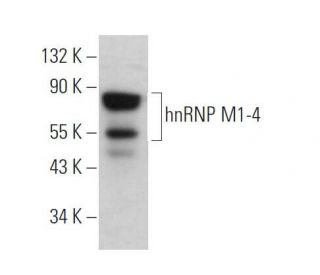
hnRNP M1-4 Anticuerpo (3C181): sc-56702
- hnRNP M1-4 Anticuerpo (3C181) es un monoclonal de ratón IgG1 κ, ver las 1 publicaciones, proporcionado como 200 µg/ml
- frente a hnRNP M1-4 nativo completo de origen human
- recomendado para detectarhnRNP M1-4 de mouse, rat, human, bovine y porcine origen, mediante WB, IP y ELISA
- Ver hnRNP M1-4 (1D8): sc-20002 para hnRNP M1-4 anticuerpos conjugados, incluyendo AC, HRP, FITC, PE, Alexa Fluor® 488, 594, 647, 680 y 790.
- m-IgG Fc BP-HRP y m-IgG1 BP-HRP son los reactivos de detección secundarios preferidos para hnRNP M1-4 Anticuerpo (3C181) for WB applications. Estos reactivos se ofrecen ahora en paquetes con hnRNP M1-4 Anticuerpo (3C181)(véase la información de pedido más abajo).

ENLACES RÁPIDOS
Las proteínas ribonucleoproteicas heterogéneas (hnRNPs) constituyen un conjunto de polipéptidos que contribuyen a la transcripción del ARNm, al procesamiento del pre-ARNm, así como al transporte del ARNm maduro al citoplasma y a la traducción. También se unen al ARN nuclear heterogéneo (hnARN), que son los transcritos producidos por la ARN polimerasa II. Hay aproximadamente 20 proteínas hnRNP conocidas y sus complejos son los principales constituyentes del esplenocito. La mayoría de las proteínas hnRNP están localizadas en el núcleo; sin embargo, algunas se desplazan entre el núcleo y el citoplasma, como hnRNP E1 y E2. hnRNP E1 puede funcionar en el citoplasma como una proteína reguladora de la traducción, mientras que hnRNP E2 estabiliza el ARNm para mejorar la traducción del ARNm poliovírico. hnRNP M está involucrada en el empalme del pre-ARNm y en el arresto transitorio del empalme inducido por el estrés.
Alexa Fluor® es una marca registrada de Molecular Probes Inc., OR., USA
REIVEW LI-COR® y Odyssey® son marcas registradas de LI-COR Biosciences.
hnRNP M1-4 Anticuerpo (3C181) Referencias:
- Los polipéptidos de 72/74 kDa del complejo de ribonucleoproteínas nucleares heterogéneas grandes 70-110 S (LH-nRNP) representan un subconjunto discreto de la familia de proteínas hnRNP M. | Kafasla, P., et al. 2000. Biochem J. 350 Pt 2: 495-503. PMID: 10947964
- Activación de un interruptor de combustible del cáncer: las proteínas hnRNP regulan el splicing alternativo del ARNm de la piruvato quinasa. | Chen, M., et al. 2010. Cancer Res. 70: 8977-80. PMID: 20978194
- Las proteínas de unión al ARN celular NS1-BP y hnRNP K regulan el empalme del ARN del virus de la gripe A. | Tsai, PL., et al. 2013. PLoS Pathog. 9: e1003460. PMID: 23825951
- Interacciones selectivas de isoformas de hnRNP M con las proteínas TET TAF15 y TLS/FUS. | Marko, M., et al. 2014. Mol Biol Rep. 41: 2687-95. PMID: 24474660
- Regulación Colinérgica de la Traducción de hnRNPA2/B1 por Receptores Muscarínicos M1. | Kolisnyk, B., et al. 2016. J Neurosci. 36: 6287-96. PMID: 27277805
- ESCO2 promueve la progresión del adenocarcinoma de pulmón regulando la acetilación de hnRNPA1. | Zhu, HE., et al. 2021. J Exp Clin Cancer Res. 40: 64. PMID: 33573689
- La expresión de PKM2 impulsada por las oncoproteínas del VPH18 reprograma el metabolismo de las células HeLa para mantener la glucólisis aeróbica y la viabilidad. | Prakasam, G., et al. 2022. Virusdisease. 33: 223-235. PMID: 36277414
- Los dos dominios de unión al ARN de la ribonucleoproteína nuclear heterogénea A1 contribuyen a la unión al ARN monocatenario. | Shamoo, Y., et al. 1994. Biochemistry. 33: 8272-81. PMID: 7518244
- Las proteínas hnRNP M humanas: identificación de un motivo de repetición rico en metionina/arginina en ribonucleoproteínas. | Datar, KV., et al. 1993. Nucleic Acids Res. 21: 439-46. PMID: 8441656
- Las proteínas C1 y C2 de los complejos ribonucleoproteicos nucleares heterogéneos se unen al ARN de forma altamente cooperativa: apoyo a su depósito contiguo en el ARNpre-m durante la transcripción. | McAfee, JG., et al. 1996. Biochemistry. 35: 1212-22. PMID: 8573576
Información sobre pedidos
| Nombre del producto | Número de catálogo | UNIDAD | Precio | CANTIDAD | Favoritos | |
hnRNP M1-4 Anticuerpo (3C181) | sc-56702 | 200 µg/ml | $322.00 | |||
Paquete de hnRNP M1-4 (3C181): m-IgG Fc BP-HRP | sc-539037 | 200 µg Ab; 10 µg BP | $361.00 | |||
Paquete de hnRNP M1-4 (3C181): m-IgG1 BP-HRP | sc-541220 | 200 µg Ab; 20 µg BP | $361.00 |