
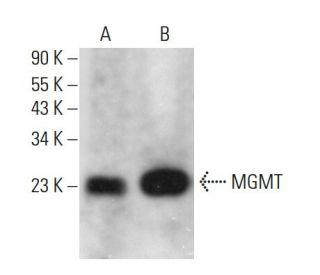
MGMT Antibody (SPM287): sc-56432
- MGMT Antibody (SPM287) is a mouse monoclonal IgG1 κ, cited in 14 publications, provided at 200 µg/ml
- raised against purified recombinant MGMT protein of human origin
- recommended for detection of MGMT of mouse, rat and human origin by WB, IP, IF, IHC(P) and FCM
- m-IgG1 BP-HRP is the preferred secondary detection reagent for MGMT Antibody (SPM287) for WB and IHC(P) applications. This reagent is now offered in a bundle with MGMT Antibody (SPM287) (see ordering information below).

QUICK LINKS
SEE ALSO...
MGMT Antibody (SPM287) is a mouse monoclonal IgG1 kappa light chain antibody raised against purified recombinant MGMT protein of human origin, capable of detecting MGMT from mouse, rat, and human samples by western blotting (WB), immunoprecipitation (IP), immunofluorescence (IF), immunohistochemistry with paraffin-embedded sections (IHCP), and flow cytometry (FCM). MGMT, also known as O6-methylguanine-DNA methyltransferase or O-6-alkylguanine DNA alkyltransferase (AGT), is a critical DNA repair enzyme that maintains genomic stability by removing mutagenic and cytotoxic alkyl groups from the O6 position of guanine, thus preventing mispairing during DNA replication. Structurally, MGMT is a single-domain protein consisting of approximately 207 amino acids, featuring a highly conserved active site with a cysteine residue (Cys145 in humans) that directly accepts the alkyl group from damaged DNA. The importance of MGMT′s structure lies in its unique mechanism of action, which has significant implications for cancer therapeutics, as inhibiting MGMT can enhance the efficacy of alkylating chemotherapeutic agents by preventing the repair of induced DNA damage in cancer cells. MGMT expression is transcriptionally activated in response to DNA damage, however, this induction does not occur in p53-deficient mice, suggesting that functional p53 is necessary for MGMT regulation. Studies have shown that MGMT mRNA and protein levels increase upon exposure to ionizing radiation only in cell lines expressing wild-type p53, indicating a regulatory relationship between MGMT and p53. Conversely, high MGMT activity has been associated with the presence of mutant p53 in certain cancer cell lines, such as those derived from oral cancers, while lower MGMT activity is observed in ovarian tumors with wild-type p53 compared to those with mutant p53, supporting the notion that wild-type p53 may down-regulate basal MGMT promoter activity. Understanding the structure and function of MGMT is essential in cancer research and therapeutic development, making anti-MGMT antibody (SPM287) a valuable tool for researchers investigating DNA repair mechanisms, protein structure-function relationships, and p53-related regulatory pathways.
Alexa Fluor® is a trademark of Molecular Probes Inc., OR., USA
LI-COR® and Odyssey® are registered trademarks of LI-COR Biosciences
Ordering Information
| Product Name | Catalog # | UNIT | Price | Qty | FAVORITES | |
MGMT Antibody (SPM287) | sc-56432 | 200 µg/ml | $322.00 | |||
MGMT Antibody (SPM287): m-IgG1 BP-HRP Bundle | sc-531647 | 200 µg Ab; 20 µg BP | $361.00 |