
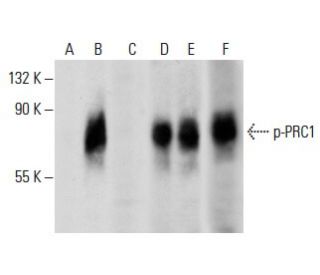

PRC1 Anticuerpo (6G2): sc-56345
- PRC1 Anticuerpo 6G2 es un monoclonal de ratón IgG2b, ver las 4 publicaciones, proporcionado como 50 µg/0.5 ml
- producido contra los amino ácidos 1-150 de PRC1 de origen human
- recomendado para detectar PRC1 de human origen, mediante WB y IP
- Actualmente, aún no hemos completado la identificación de los reactivos de detección secundaria preferidos para PRC1 Anticuerpo (6G2). Este trabajo está en progreso.

ENLACES RÁPIDOS
VER TAMBIÉN ....
La activación secuencial e inactivación de complejos Cdk/ciclina regula el ciclo celular. PRC1 (proteína reguladora de la citocinesis 1) ha sido identificada como sustrato de varios Cdks, incluyendo Cdc2 y Cdk2. PRC1 se une a la zona media de los husos mitóticos durante la anafase y se localiza en el cuerpo medio celular durante la citocinesis. La depleción de PRC1 ha demostrado prevenir la división celular, pero no tiene efecto en la división nuclear, lo que demuestra la importancia de PRC1 en la mitosis. El homólogo de levadura de PRC1, Ase1, es esencial para el ensamblaje, elongación y desensamblaje de los husos durante la mitosis. Se ha demostrado que Ase1 sufre degradación mediada por el APC (complejo promotor de la anafase) al entrar en la fase G1.
Alexa Fluor® es una marca registrada de Molecular Probes Inc., OR., USA
REIVEW LI-COR® y Odyssey® son marcas registradas de LI-COR Biosciences.
PRC1 Anticuerpo (6G2) Referencias:
- PRC1 impulsa la represión génica mediada por Polycomb controlando la iniciación de la transcripción y la frecuencia de estallido. | Dobrinić, P., et al. 2021. Nat Struct Mol Biol. 28: 811-824. PMID: 34608337
- CDK16 promueve la progresión y metástasis del cáncer de mama triple negativo fosforilando PRC1. | Li, X., et al. 2022. J Exp Clin Cancer Res. 41: 149. PMID: 35449080
- PCGF1-PRC1 vincula la represión de la cromatina con la replicación del ADN durante el compromiso de linaje de las células hematopoyéticas. | Takano, J., et al. 2022. Nat Commun. 13: 7159. PMID: 36443290
- Las proteínas accesorias específicas de PRC2.1- y PRC2.2 impulsan el reclutamiento de diferentes formas de PRC1 canónica. | Glancy, E., et al. 2023. Mol Cell. 83: 1393-1411.e7. PMID: 37030288
- Disección funcional de las subunidades RYBP y YAF2 de PRC1 durante la diferenciación neural de células madre embrionarias. | Liu, Y., et al. 2023. Nat Commun. 14: 7164. PMID: 37935677
- La dispersión de H3K27me3 organiza la arquitectura canónica de la cromatina PRC1 para regular los programas de desarrollo. | Krug, B., et al. 2023. bioRxiv.. PMID: 38116029
- PRC1 dirige la deposición de PRC2-H3K27me3 para proteger a las células madre espermatogonias adultas de la diferenciación. | Hu, M., et al. 2024. Nucleic Acids Res. 52: 2306-2322. PMID: 38142439
- La transcripción de HSATII inducida por DUX4 causa focos nucleares de KDM2A/B-PRC1 y deteriora la respuesta al daño del ADN. | Arends, T., et al. 2024. J Cell Biol. 223: PMID: 38451221
- H2AK119ub1 ajusta diferencialmente la expresión génica modulando la compactación canónica de la cromatina dependiente de PRC1 y H1. | Zhao, J., et al. 2024. Mol Cell. 84: 1191-1205.e7. PMID: 38458202
- La modularidad de la composición de PRC1 y la interacción de la cromatina definen las propiedades del condensado. | Niekamp, S., et al. 2024. Mol Cell. 84: 1651-1666.e12. PMID: 38521066
Información sobre pedidos
| Nombre del producto | Número de catálogo | UNIDAD | Precio | CANTIDAD | Favoritos | |
PRC1 Anticuerpo (6G2) | sc-56345 | 50 µg/0.5 ml | $322.00 |