
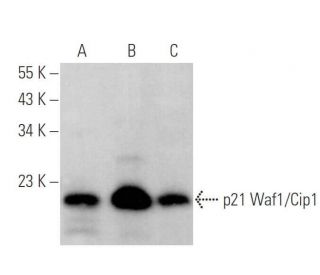
Waf1/Cip1/CDKN1A p21 Antibody (DCS-60): sc-56335
- Waf1/Cip1/CDKN1A p21 Antibody (DCS-60) is a mouse monoclonal IgG2a κ, cited in 29 publications, provided at 200 µg/ml
- raised against full length p21 Waf1/Cip1 of human origin
- recommended for detection of p21 Waf1/Cip1 of human origin by WB, IP, IF, IHC(P) and ELISA; non cross-reactive with other mitotic inhibitors
- See Waf1/Cip1/CDKN1A p21 (F-5): sc-6246 for Waf1/Cip1/CDKN1A p21 antibody conjugates, including AC, HRP, FITC, PE, Alexa Fluor® 488, 594, 647, 680 and 790.
- m-IgG Fc BP-HRP is the preferred secondary detection reagent for Waf1/Cip1/CDKN1A p21 Antibody (DCS-60) for WB and IHC(P) applications. This reagent is now offered in a bundle with Waf1/Cip1/CDKN1A p21 Antibody (DCS-60) (see ordering information below).

QUICK LINKS
SEE ALSO...
p21 Waf1/Cip1 Antibody (DCS-60) is a mouse monoclonal IgG2a antibody designed to detect the full length p21 Waf1/Cip1 of human origin, also known as CDK-interacting protein 1 (CDKN1A) or WAF1, in human samples through applications such as western blotting (WB), immunoprecipitation (IP), immunofluorescence (IF), immunohistochemistry, and enzyme-linked immunosorbent assay (ELISA). p21 Waf1/Cip1 is a critical regulator of the cell cycle, functioning as an inhibitor of cyclin-dependent kinases (Cdks) to block the phosphorylation of retinoblastoma protein (Rb) and halt cell cycle progression from the G1 to the S phase. This function is vital for maintaining cellular integrity by allowing time for DNA repair or initiating cell cycle arrest in response to stress signals. p21 Waf1/Cip1 is predominantly localized in the nucleus, where p21 Waf1/Cip1 interacts with key regulatory proteins to influence cell cycle dynamics, DNA replication, and repair processes. Nuclear localization is crucial for suppressing tumorigenesis, as dysregulation of p21 Waf1/Cip1 expression or function can result in unchecked cell proliferation. Expression of p21 Waf1/Cip1 is primarily controlled by the tumor suppressor p53, which induces upregulation following DNA damage, linking p21 Waf1/Cip1 to stress response pathways essential for genomic stability. Conservation of p21 Waf1/Cip1 across species, with the mouse homolog known as CAP20, emphasizes a fundamental role in cell cycle control and stress response mechanisms. p21 Waf1/Cip1 (DCS-60) antibody is an indispensable resource for studying these intricate regulatory pathways and their implications in cancer biology.
Ordering Information
| Product Name | Catalog # | UNIT | Price | Qty | FAVORITES | |
Waf1/Cip1/CDKN1A p21 Antibody (DCS-60) | sc-56335 | 200 µg/ml | $322.00 | |||
Waf1/Cip1/CDKN1A p21 Antibody (DCS-60): m-IgG Fc BP-HRP Bundle | sc-551942 | 200 µg Ab; 10 µg BP | $361.00 |