
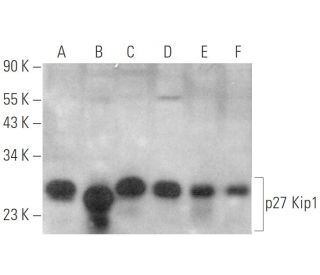
CDKN1B/Kip1 p27 Antibody (SX53G8.5): sc-53871
- CDKN1B/Kip1 p27 Antibody (SX53G8.5) is a mouse monoclonal IgG1 κ, cited in 16 publications, provided at 200 µg/ml
- raised against purified GST-p27 Kip1 fusion protein of human origin
- recommended for detection of p27 Kip1 of mouse, rat and human origin by WB, IP, IF and IHC(P)
- See CDKN1B/Kip1 p27 (F-8): sc-1641 for CDKN1B/Kip1 p27 antibody conjugates, including AC, HRP, FITC, PE, Alexa Fluor® 488, 594, 647, 680 and 790.
- m-IgG Fc BP-HRP, m-IgG1 BP-HRP and m-IgGκ BP-HRP are the preferred secondary detection reagents for CDKN1B/Kip1 p27 Antibody (SX53G8.5) for WB and IHC(P) applications. These reagents are now offered in bundles with CDKN1B/Kip1 p27 Antibody (SX53G8.5) (see ordering information below).

QUICK LINKS
SEE ALSO...
p27 Kip1 Antibody (SX53G8.5) is a mouse monoclonal IgG1 antibody that detects p27 Kip1 in mouse, rat, and human samples through various applications including western blotting (WB), immunoprecipitation (IP), immunofluorescence (IF), and immunohistochemistry. p27 Kip1 plays a crucial role as a negative regulator of cell cycle progression, particularly during the G1 phase, where p27 Kip1 inhibits the activity of cyclin-dependent kinases (Cdks) by binding to D-type cyclins and Cdk4, thereby preventing the transition to the S phase. This regulation is vital for maintaining proper cell growth and division, especially in response to external signals such as transforming growth factor-beta (TGFβ), which can induce G1 arrest. The ability of p27 Kip1 to modulate cell cycle progression highlights its importance in tumor suppression, as dysregulation of p27 Kip1 can lead to uncontrolled cell proliferation and cancer development. Anti-p27 Kip1 antibody (SX53G8.5) serves as an essential tool for researchers studying cell cycle dynamics and the molecular mechanisms underlying various diseases.
Ordering Information
| Product Name | Catalog # | UNIT | Price | Qty | FAVORITES | |
CDKN1B/Kip1 p27 Antibody (SX53G8.5) | sc-53871 | 200 µg/ml | $322.00 | |||
CDKN1B/Kip1 p27 Antibody (SX53G8.5): m-IgG Fc BP-HRP Bundle | sc-537006 | 200 µg Ab; 10 µg BP | $361.00 | |||
CDKN1B/Kip1 p27 Antibody (SX53G8.5): m-IgGκ BP-HRP Bundle | sc-534186 | 200 µg Ab; 40 µg BP | $361.00 | |||
CDKN1B/Kip1 p27 Antibody (SX53G8.5): m-IgG1 BP-HRP Bundle | sc-544951 | 200 µg Ab; 20 µg BP | $361.00 |