
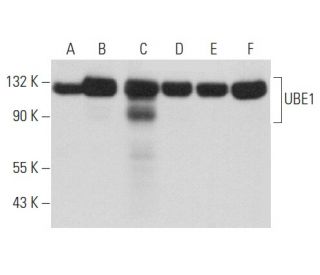
UBE1 Antibody (2G2): sc-53555
- UBE1 Antibody (2G2) is a mouse monoclonal IgG1 κ UBE1 antibody, cited in 8 publications, provided at 200 µg/ml
- raised against ubiquitin activating enzyme E1
- UBE1 Antibody (2G2) is recommended for detection of UBE1 of mouse, rat and human origin by WB, IP, IF and IHC(P)
- Anti-UBE1 Antibody (2G2) is available conjugated to agarose for IP; HRP for WB, IHC(P) and ELISA; and to either phycoerythrin or FITC for IF, IHC(P) and FCM
- also available conjugated to Alexa Fluor® 488, Alexa Fluor® 546, Alexa Fluor® 594 or Alexa Fluor® 647 for WB (RGB), IF, IHC(P) and FCM, and for use with RGB fluorescent imaging systems, such as iBright™ FL1000, FluorChem™, Typhoon, Azure and other comparable systems
- also available conjugated to Alexa Fluor® 680 or Alexa Fluor® 790 for WB (NIR), IF and FCM; for use with Near-Infrared (NIR) detection systems, such as LI-COR®Odyssey®, iBright™ FL1000, FluorChem™, Typhoon, Azure and other comparable systems
- m-IgG Fc BP-HRP, m-IgG1 BP-HRP and m-IgGκ BP-HRP are the preferred secondary detection reagents for UBE1 Antibody (2G2) for WB and IHC(P) applications. These reagents are now offered in bundles with UBE1 Antibody (2G2) (see ordering information below).

UBE1 Antibody (2G2) is a mouse monoclonal IgG1 kappa light chain antibody that detects the UBE1 protein of mouse, rat, and human origin by western blotting (WB), immunoprecipitation (IP), immunofluorescence (IF), and immunohistochemistry. Anti-UBE1 antibody (2G2) is available in both non-conjugated and various conjugated forms, including agarose, horseradish peroxidase (HRP), phycoerythrin (PE), fluorescein isothiocyanate (FITC), and multiple Alexa Fluor® conjugates. The ubiquitin activating enzyme E1 (UBE1) plays a crucial role in the ubiquitin-proteasome pathway, which is essential for regulating protein degradation and maintaining cellular homeostasis. UBE1 catalyzes the initial step of ubiquitin conjugation by adenylating the C-terminal glycine residue of ubiquitin in an ATP-dependent manner, forming a thiolester bond with a cysteine residue on UBE1. This activated ubiquitin is subsequently transferred to a ubiquitin-conjugating enzyme, which then donates the ubiquitin moiety to target substrates, marking them for degradation. Proper functioning of UBE1 is vital, as dysregulation of this pathway can lead to various diseases, including cancer and neurodegenerative disorders. Notably, the UBE1 gene is an example of an X-Y homologous gene, being X-linked with a distinct Y-linked counterpart in many mammals, although no UBE1 homolog is found on the human Y chromosome. UBE1 is believed to escape X inactivation in humans, which may have implications for gene dosage and expression in females.
Alexa Fluor® is a trademark of Molecular Probes Inc., OR., USA
LI-COR® and Odyssey® are registered trademarks of LI-COR Biosciences
UBE1 Antibody (2G2) References:
- Mapping and expression of the ubiquitin-activating enzyme E1 (Ube1) gene in the mouse. | Disteche, CM., et al. 1992. Mamm Genome. 3: 156-61. PMID: 1617221
- Molecular cloning, sequence, and tissue distribution of the human ubiquitin-activating enzyme E1. | Handley, PM., et al. 1991. Proc Natl Acad Sci U S A. 88: 258-62. PMID: 1986373
- The ubiquitin E1 enzyme Ube1 mediates NEDD8 activation under diverse stress conditions. | Leidecker, O., et al. 2012. Cell Cycle. 11: 1142-50. PMID: 22370482
- Conjugation of the ubiquitin activating enzyme UBE1 with the ubiquitin-like modifier FAT10 targets it for proteasomal degradation. | Bialas, J., et al. 2015. PLoS One. 10: e0120329. PMID: 25768649
- The ubiquitin-activating enzyme E1 as a novel therapeutic target for the treatment of restenosis. | Qin, Z., et al. 2016. Atherosclerosis. 247: 142-53. PMID: 26919560
- Ubiquitin-activating enzyme E1 inhibitor PYR-41 retards sperm enlargement after fusion to the egg. | Yoshida, K., et al. 2018. Reprod Toxicol. 76: 71-77. PMID: 29355596
- The pivotal role of ubiquitin-activating enzyme E1 (UBA1) in neuronal health and neurodegeneration. | Lambert-Smith, IA., et al. 2020. Int J Biochem Cell Biol. 123: 105746. PMID: 32315770
- Curcumin partly prevents ISG15 activation via ubiquitin-activating enzyme E1-like protein and decreases ISGylation. | Oki, N., et al. 2022. Biochem Biophys Res Commun. 625: 94-101. PMID: 35952613
- A novel gene, DXS8237E, lies within 20 kb upstream of UBE1 in Xp11.23 and has a different X inactivation status. | Coleman, MP., et al. 1996. Genomics. 31: 135-8. PMID: 8808293
- The origin and loss of the ubiquitin activating enzyme gene on the mammalian Y chromosome. | Mitchell, MJ., et al. 1998. Hum Mol Genet. 7: 429-34. PMID: 9467000
- X inactivation analysis and DNA methylation studies of the ubiquitin activating enzyme E1 and PCTAIRE-1 genes in human and mouse. | Carrel, L., et al. 1996. Hum Mol Genet. 5: 391-401. PMID: 8852665
- Transcriptional analysis of the candidate spermatogenesis gene Ube1y and of the closely related Ube1x shows that they are coexpressed in spermatogonia and spermatids but are repressed in pachytene spermatocytes. | Odorisio, T., et al. 1996. Dev Biol. 180: 336-43. PMID: 8948595
Ordering Information
| Product Name | Catalog # | UNIT | Price | Qty | FAVORITES | |
UBE1 Antibody (2G2) | sc-53555 | 200 µg/ml | $322.00 | |||
UBE1 Antibody (2G2): m-IgG Fc BP-HRP Bundle | sc-528573 | 200 µg Ab; 10 µg BP | $361.00 | |||
UBE1 Antibody (2G2): m-IgGκ BP-HRP Bundle | sc-520984 | 200 µg Ab, 40 µg BP | $361.00 | |||
UBE1 Antibody (2G2): m-IgG1 BP-HRP Bundle | sc-543004 | 200 µg Ab; 20 µg BP | $361.00 | |||
UBE1 Antibody (2G2) AC | sc-53555 AC | 500 µg/ml, 25% agarose | $424.00 | |||
UBE1 Antibody (2G2) HRP | sc-53555 HRP | 200 µg/ml | $322.00 | |||
UBE1 Antibody (2G2) FITC | sc-53555 FITC | 200 µg/ml | $336.00 | |||
UBE1 Antibody (2G2) PE | sc-53555 PE | 200 µg/ml | $349.00 | |||
UBE1 Antibody (2G2) Alexa Fluor® 488 | sc-53555 AF488 | 200 µg/ml | $364.00 | |||
UBE1 Antibody (2G2) Alexa Fluor® 546 | sc-53555 AF546 | 200 µg/ml | $364.00 | |||
UBE1 Antibody (2G2) Alexa Fluor® 594 | sc-53555 AF594 | 200 µg/ml | $364.00 | |||
UBE1 Antibody (2G2) Alexa Fluor® 647 | sc-53555 AF647 | 200 µg/ml | $364.00 | |||
UBE1 Antibody (2G2) Alexa Fluor® 680 | sc-53555 AF680 | 200 µg/ml | $364.00 | |||
UBE1 Antibody (2G2) Alexa Fluor® 790 | sc-53555 AF790 | 200 µg/ml | $364.00 |