
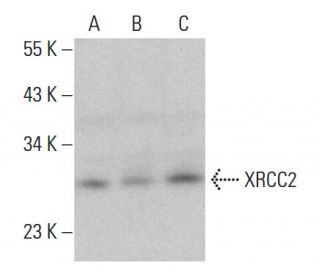

XRCC2 Antibody (1G4/1): sc-53469
- XRCC2 Antibody (1G4/1) is a mouse monoclonal IgG1 κ provided at 200 µg/ml
- raised against recombinant human denatured XRCC2 protein
- recommended for detection of XRCC2 of human and hamster origin by WBIP
- m-IgG Fc BP-HRP, m-IgG1 BP-HRP and m-IgGκ BP-HRP are the preferred secondary detection reagents for XRCC2 Antibody (1G4/1) for WB applications. These reagents are now offered in bundles with XRCC2 Antibody (1G4/1) (see ordering information below).

QUICK LINKS
XRCC2 Antibody (1G4/1) is a mouse monoclonal IgG1 kappa light chain antibody that detects XRCC2 protein of human and hamster origin by western blotting (WB) and immunoprecipitation (IP). Anti-XRCC2 antibody (1G4/1) plays a crucial role in the maintenance of genomic stability, particularly in the repair of DNA double-strand breaks through homologous recombination. XRCC2 (1G4/1) monoclonal antibody is primarily located in the nucleus, where XRCC2 is essential for repair processes that safeguard genome integrity during cell division. XRCC2 protein interacts with other key players in the DNA repair pathway, including Rad51, which is vital for homologous recombination repair mechanism. The interaction between XRCC2 and Rad51 facilitates the search for homologous sequences and subsequent strand invasion necessary for accurate DNA repair. Deficiencies in XRCC2 can lead to increased susceptibility to genomic instability and cancer, highlighting XRCC2′s importance in cellular responses to DNA damage. XRCC2 (1G4/1) antibody serves as an invaluable tool for researchers studying DNA repair mechanisms and their implications in disease.
Alexa Fluor® is a trademark of Molecular Probes Inc., OR., USA
LI-COR® and Odyssey® are registered trademarks of LI-COR Biosciences
XRCC2 Antibody (1G4/1) References:
- Associations between XRCC2 rs3218536 and ERCC2 rs13181 polymorphisms and ovarian cancer. | Zhang, W. and Zhang, Z. 2016. Oncotarget. 7: 86621-86629. PMID: 27863412
- Rare, protein-truncating variants in ATM, CHEK2 and PALB2, but not XRCC2, are associated with increased breast cancer risks. | Decker, B., et al. 2017. J Med Genet. 54: 732-741. PMID: 28779002
- XRCC2-Deficient Cells are Highly Sensitive to 5-Fluorouracil in Colorectal Cancer. | Zhang, YZ., et al. 2017. Cell Physiol Biochem. 43: 1207-1219. PMID: 28977800
- Use of the XRCC2 promoter for in vivo cancer diagnosis and therapy. | Chen, Y., et al. 2018. Cell Death Dis. 9: 420. PMID: 29549248
- XRCC2 repairs mitochondrial DNA damage and fuels malignant behavior in hepatocellular carcinoma. | Zhao, Z., et al. 2021. Cancer Lett. 512: 1-14. PMID: 33964350
- Overexpressed XRCC2 as an independent risk factor for poor prognosis in glioma patients. | Liu, Z., et al. 2021. Mol Med. 27: 52. PMID: 34051735
- XRCC2 reduced the sensitivity of NSCLC to radio-chemotherapy by arresting the cell cycle. | Shan, J., et al. 2022. Am J Transl Res. 14: 3783-3795. PMID: 35836870
- Structure and function of the RAD51B-RAD51C-RAD51D-XRCC2 tumour suppressor. | Greenhough, LA., et al. 2023. Nature. 619: 650-657. PMID: 37344587
- XRCC2 driven homologous recombination subtypes and therapeutic targeting in lung adenocarcinoma metastasis. | Gong, H., et al. 2024. NPJ Precis Oncol. 8: 169. PMID: 39090304
- c-Myc-XRCC2-FOS axis promotes the proliferation and the resistance to Doxorubicin of NSCLC. | Zhang, P., et al. 2024. Biomed Pharmacother. 179: 117315. PMID: 39153434
Ordering Information
| Product Name | Catalog # | UNIT | Price | Qty | FAVORITES | |
XRCC2 Antibody (1G4/1) | sc-53469 | 200 µg/ml | $322.00 | |||
XRCC2 Antibody (1G4/1): m-IgG Fc BP-HRP Bundle | sc-536970 | 200 µg Ab; 10 µg BP | $361.00 | |||
XRCC2 Antibody (1G4/1): m-IgGκ BP-HRP Bundle | sc-534147 | 200 µg Ab; 40 µg BP | $361.00 | |||
XRCC2 Antibody (1G4/1): m-IgG1 BP-HRP Bundle | sc-544930 | 200 µg Ab; 20 µg BP | $361.00 |