
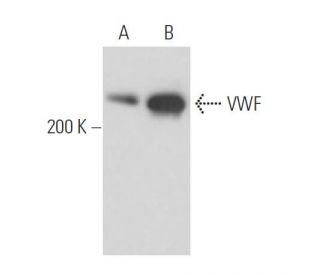


Anticorps von Willebrand Factor/VWF (F8/86): sc-53466
- L'anticorps von Willebrand Factor/VWF F8/86 est un monoclonal IgG1 κ L'Anticorps von Willebrand Factor/VWF, cité dans 31 publications, fourni en 200 µg/ml
- élevé contre le facteur Von Willebrand isolé du plasma human.
- L'Anticorps von Willebrand Factor/VWF (F8/86) est recommandé pour la détection de VWF d'origine human par WB, IP, IF et IHC(P)
- Anti-L'Anticorps von Willebrand Factor/VWF (F8/86) est disponible conjugué à l'agarose pour IP; à l'HRP pour WB, IHC(P) et ELISA; et soit à la phycoerythrin ou FITC pour IF, IHC(P) et FCM
- aussi disponible conjugué à l'Alexa Fluor® 488, Alexa Fluor® 546, Alexa Fluor® 594 ou Alexa Fluor® 647 pour WB (RGB), IF, IHC(P) et FCM
- aussi disponible conjugué à l'Alexa Fluor® 680 ou Alexa Fluor® 790 pour WB (NIR), IF et FCM
- m-IgG Fc BP-HRP, 1 BP-HRP">m-IgG1 BP-HRP et m-IgGκ BP-HRP sont les réactifs de détection secondaire préférés pour l'anticorps von Willebrand Factor/VWF (F8/86) pour les applications WB et IHC(P). Ces réactifs sont désormais proposés en lots avec l'anticorps von Willebrand Factor/VWF (F8/86)(voir les informations de commande ci-dessous).

ACCÈS RAPIDE AUX LIENS
VOIR ÉGALEMENT...
L'anticorps anti-FVW (F8/86) est un anticorps monoclonal de souris IgG1 à chaîne légère kappa conçu pour détecter la protéine du facteur von Willebrand (FVW) avec une précision exceptionnelle dans diverses applications, notamment le western blotting (WB), l'immunoprécipitation (IP), l'immunofluorescence (IF) et l'immunohistochimie sur coupes incluses en paraffine (IHCP). Le VWF est une glycoprotéine multimérique complexe composée de multiples unités répétitives, chacune contenant des domaines distincts tels que D'D3, A1, A2, A3, et les régions C-terminales, qui sont essentiels pour son rôle dans l'hémostase. Cette structure complexe permet au FVW de médier efficacement l'adhésion et l'agrégation plaquettaire sur les sites de lésions vasculaires en interagissant avec les récepteurs de la glycoprotéine Ib (GPIb) sur les plaquettes et en se liant au collagène dans la matrice sous-endothéliale. En outre, la nature multimérique du FVW renforce sa capacité à servir de transporteur pour le facteur VIII, un cofacteur vital dans la cascade de la coagulation, assurant ainsi la stabilité et la disponibilité du facteur VIII pendant la formation du caillot. L'intégrité structurelle du FVW, maintenue par des modifications post-traductionnelles telles que le clivage des propeptides et la formation de liaisons disulfures intersubunitaires, est essentielle à sa fonctionnalité et à sa capacité à prévenir les saignements excessifs, car les défauts dans la structure du FVW sont la cause sous-jacente de la maladie de von Willebrand, le trouble de la coagulation héréditaire le plus courant. L'anticorps anti-FVW (F8/86) est dirigé contre le FVW isolé du plasma humain et est disponible sous forme non conjuguée et sous diverses formes conjuguées, notamment l'agarose, la peroxydase de raifort (HRP), la phycoérythrine (PE), l'isothiocyanate de fluorescéine (FITC) et de multiples variantes Alexa Fluor®, afin de répondre à divers besoins expérimentaux. En permettant la détection et l'analyse précises des domaines structurels et des formes multimériques du VWF, l'anticorps monoclonal VWF (F8/86) facilite les études approfondies des mécanismes moléculaires de la coagulation sanguine, de la régulation de l'équilibre hémostatique et de la physiopathologie des troubles de la coagulation. Qu'il soit utilisé en recherche fondamentale pour explorer la dynamique structurelle du VWF ou en diagnostic clinique pour évaluer les niveaux et la fonctionnalité du VWF dans les échantillons de patients, l'anticorps VWF (F8/86) est un outil utile pour l'étude de la biologie vasculaire et le développement de stratégies thérapeutiques pour la prise en charge des pathologies liées à la coagulation.
Alexa Fluor® est une marque déposée de Molecular Probes Inc., OR., USA
LI-COR® et Odyssey® sont marques déposées de LI-COR Biosciences
Anticorps von Willebrand Factor/VWF (F8/86) Références:
- Le rôle des multimères du facteur von Willebrand et du clivage des propeptides dans la liaison et la stabilisation du facteur VIII. | Wise, RJ., et al. 1991. J Biol Chem. 266: 21948-55. PMID: 1939217
- L'intérêt du criblage immunohistologique dans la production d'anticorps monoclonaux. | Naiem, M., et al. 1982. J Immunol Methods. 50: 145-60. PMID: 6806388
- Effet de la multimérisation du facteur von Willebrand humain et recombinant sur l'agrégation plaquettaire, la liaison au collagène et la liaison du facteur VIII de coagulation. | Fischer, BE., et al. 1996. Thromb Res. 84: 55-66. PMID: 8885147
- Liaison du domaine A1 du facteur von Willebrand à l'histone. | Ward, CM., et al. 1997. Thromb Res. 86: 469-77. PMID: 9219327
- Modélisation moléculaire des ligands et des sites de mutation des domaines de type A du facteur de von Willebrand humain et leur pertinence pour la maladie de von Willebrand. | Jenkins, PV., et al. 1998. Blood. 91: 2032-44. PMID: 9490688
- Génétique moléculaire de la maladie de von Willebrand. | Mazurier, C., et al. 1998. Ann Genet. 41: 34-43. PMID: 9599650
- La liaison du facteur VIII au facteur von Willebrand est rendue possible par le clivage du propeptide du facteur von Willebrand et renforcée par la formation de multimères liés au disulfure. | Bendetowicz, AV., et al. 1998. Blood. 92: 529-38. PMID: 9657753
Informations pour la commande
| Nom du produit | Ref. Catalogue | COND. | Prix HT | QTÉ | Favoris | |
Anticorps von Willebrand Factor/VWF (F8/86) | sc-53466 | 200 µg/ml | $322.00 | |||
von Willebrand Factor/VWF (F8/86): m-IgG Fc BP-HRP Kit | sc-528569 | 200 µg Ab; 10 µg BP | $361.00 | |||
von Willebrand Factor/VWF (F8/86): m-IgGκ BP-HRP Kit | sc-520980 | 200 µg Ab, 40 µg BP | $361.00 | |||
von Willebrand Factor/VWF (F8/86): m-IgG1 BP-HRP Kit | sc-543001 | 200 µg Ab; 20 µg BP | $361.00 | |||
Anticorps von Willebrand Factor/VWF (F8/86) AC | sc-53466 AC | 500 µg/ml, 25% agarose | $424.00 | |||
Anticorps von Willebrand Factor/VWF (F8/86) HRP | sc-53466 HRP | 200 µg/ml | $322.00 | |||
Anticorps von Willebrand Factor/VWF (F8/86) FITC | sc-53466 FITC | 200 µg/ml | $336.00 | |||
Anticorps von Willebrand Factor/VWF (F8/86) PE | sc-53466 PE | 200 µg/ml | $349.00 | |||
Anticorps von Willebrand Factor/VWF (F8/86) Alexa Fluor® 488 | sc-53466 AF488 | 200 µg/ml | $364.00 | |||
Anticorps von Willebrand Factor/VWF (F8/86) Alexa Fluor® 546 | sc-53466 AF546 | 200 µg/ml | $364.00 | |||
Anticorps von Willebrand Factor/VWF (F8/86) Alexa Fluor® 594 | sc-53466 AF594 | 200 µg/ml | $364.00 | |||
Anticorps von Willebrand Factor/VWF (F8/86) Alexa Fluor® 647 | sc-53466 AF647 | 200 µg/ml | $364.00 | |||
Anticorps von Willebrand Factor/VWF (F8/86) Alexa Fluor® 680 | sc-53466 AF680 | 200 µg/ml | $364.00 | |||
Anticorps von Willebrand Factor/VWF (F8/86) Alexa Fluor® 790 | sc-53466 AF790 | 200 µg/ml | $364.00 |