
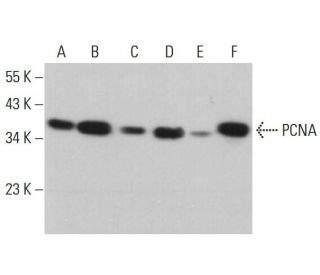
PCNA Antibody (PC5): sc-53408
- PCNA Antibody (PC5) is a mouse monoclonal IgG1 κ provided at 200 µg/ml
- raised against protein A-rat A-PCNA fusion obtained from pC2T of rat origin
- recommended for detection of PCNA of mouse, rat, human and yeast origin by WB, IP, IF and IHC(P)
- See PCNA (PC10): sc-56 for PCNA antibody conjugates, including AC, HRP, FITC, PE, Alexa Fluor® 488, 594, 647, 680 and 790.
- m-IgG Fc BP-HRP, m-IgG1 BP-HRP and m-IgGκ BP-HRP are the preferred secondary detection reagents for PCNA Antibody (PC5) for WB and IHC(P) applications. These reagents are now offered in bundles with PCNA Antibody (PC5) (see ordering information below).

QUICK LINKS
SEE ALSO...
PCNA Antibody (PC5) is a mouse monoclonal IgG1 kappa light chain antibody, raised against a protein A-rat A-PCNA fusion protein derived from the pC2T vector of rat origin. Anti-PCNA antibody (PC5) is highly recommended for detecting PCNA in samples from mouse, rat, human, and yeast. Validated for use in western blotting (WB), immunoprecipitation (IP), immunofluorescence (IF), and immunohistochemistry with paraffin-embedded sections (IHCP), PCNA (PC5) antibody can be used for studying PCNA′s involvement in cell proliferation, DNA replication, and repair across multiple species. Proliferating Cell Nuclear Antigen (PCNA) is a protein synthesized during the early G1 and S phases of the cell cycle, playing a critical role in cell cycle progression, DNA replication, and DNA repair. During the early S phase, PCNA is distributed in granular form throughout the nucleus, excluding the nucleoli, but in the later stages of S phase, PCNA relocates to the nucleoli. PCNA exists in two distinct forms: one that is actively involved in DNA replication within the nucleus, and a second, soluble form that is not associated with continuous synthesis. The soluble form of PCNA degrades in the presence of organic solvents, rendering PCNA undetectable in tissues treated with organic fixatives. This characteristic allows researchers to specifically visualize the synthesizing form of PCNA, which is actively involved in DNA replication.
Ordering Information
| Product Name | Catalog # | UNIT | Price | Qty | FAVORITES | |
PCNA Antibody (PC5) | sc-53408 | 200 µg/ml | $322.00 | |||
PCNA Antibody (PC5): m-IgG Fc BP-HRP Bundle | sc-536959 | 200 µg Ab; 10 µg BP | $361.00 | |||
PCNA Antibody (PC5): m-IgGκ BP-HRP Bundle | sc-534136 | 200 µg Ab; 40 µg BP | $361.00 | |||
PCNA Antibody (PC5): m-IgG1 BP-HRP Bundle | sc-544923 | 200 µg Ab; 20 µg BP | $361.00 |