
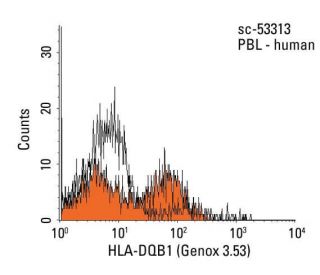

HLA-DQB1 Antibody (Genox 3.53): sc-53313
- HLA-DQB1 Antibody (Genox 3.53) is a mouse monoclonal IgG1 κ HLA-DQB1 antibody provided at 200 µg/ml
- raised against Bristol cell line of human origin
- recommended for detection of HLA-DQB1 allele DQw1 of human origin by WB, IP, IF and FCM
- available conjugated to either phycoerythrin or FITC for IF, IHC(P) and FCM
- m-IgG Fc BP-HRP, m-IgG1 BP-HRP and m-IgGκ BP-HRP are the preferred secondary detection reagents for HLA-DQB1 Antibody (Genox 3.53) for WB applications. These reagents are now offered in bundles with HLA-DQB1 Antibody (Genox 3.53) (see ordering information below).

HLA-DQB1 Antibody (Genox 3.53) is a mouse monoclonal IgG1 kappa light chain antibody that detects HLA-DQB1 protein of human origin by western blotting (WB), immunoprecipitation (IP), immunofluorescence (IF), and flow cytometry (FCM). Anti-HLA-DQB1 antibody (Genox 3.53) is available in both non-conjugated and various conjugated forms, including phycoerythrin (PE) and fluorescein isothiocyanate (FITC), providing flexibility for different experimental needs. HLA-DQB1 protein plays a crucial role in the immune system as a component of the major histocompatibility complex (MHC) class II molecules, which are essential for presenting peptide antigens to CD4+ T lymphocytes. This interaction is vital for initiating adaptive immune responses, as it allows T cells to recognize and respond to pathogens. The structure of HLA-DQB1, which consists of an α and β chain forming a heterodimer, is critical for its function; the specific conformation of this complex influences its ability to bind various peptides and present them effectively to T cells. Additionally, HLA-DQB1 expression is regulated by genetic factors, and polymorphisms in the HLA-DQB1 gene have been associated with susceptibility to autoimmune diseases, highlighting the importance of this protein in both health and disease.
Alexa Fluor® is a trademark of Molecular Probes Inc., OR., USA
LI-COR® and Odyssey® are registered trademarks of LI-COR Biosciences
HLA-DQB1 Antibody (Genox 3.53) References:
- HLA-DMA and HLA-DMB alleles in German patients with type 1 diabetes mellitus. | Siegmund, T., et al. 1999. Tissue Antigens. 54: 291-4. PMID: 10519369
- The association of HLA-DM genes with rheumatoid arthritis in Eastern France. | Toussirot, E., et al. 2000. Hum Immunol. 61: 303-8. PMID: 10689120
- Functional characterization of a lysosomal sorting motif in the cytoplasmic tail of HLA-DObeta. | Brunet, A., et al. 2000. J Biol Chem. 275: 37062-71. PMID: 10964920
- Characterization of seven new monoclonal antibodies against human DR, DR + DP and DQ1 + DQ3 antigens. | Horejsí, V., et al. 1986. Tissue Antigens. 28: 288-97. PMID: 2435017
- B-cell lymphomas of high-grade malignancy frequently lack HLA-DR, -DP and -DQ antigens and associated invariant chain. | Momburg, F., et al. 1987. Int J Cancer. 40: 598-603. PMID: 3316049
- Monoclonal antibodies to HLA--DRw determinants. | Brodsky, FM., et al. 1980. Tissue Antigens. 16: 30-48. PMID: 6162228
- Human Ia molecules carrying DC1 determinants differ in both alpha- and beta-subunits from Ia molecules carrying DR determinants. | Corte, G., et al. 1981. Nature. 292: 357-60. PMID: 6166865
- Monoclonal antibodies to HLA determinants. | Bodmer, JG. and Bodmer, WF. 1984. Br Med Bull. 40: 267-75. PMID: 6205714
- A role for HLA-DO as a co-chaperone of HLA-DM in peptide loading of MHC class II molecules. | Kropshofer, H., et al. 1998. EMBO J. 17: 2971-81. PMID: 9606180
Ordering Information
| Product Name | Catalog # | UNIT | Price | Qty | FAVORITES | |
HLA-DQB1 Antibody (Genox 3.53) | sc-53313 | 200 µg/ml | $322.00 | |||
HLA-DQB1 Antibody (Genox 3.53): m-IgG Fc BP-HRP Bundle | sc-536931 | 200 µg Ab; 10 µg BP | $361.00 | |||
HLA-DQB1 Antibody (Genox 3.53): m-IgGκ BP-HRP Bundle | sc-534107 | 200 µg Ab; 40 µg BP | $361.00 | |||
HLA-DQB1 Antibody (Genox 3.53): m-IgG1 BP-HRP Bundle | sc-544905 | 200 µg Ab; 20 µg BP | $361.00 | |||
HLA-DQw1 Antibody (Genox 3.53) FITC | sc-53313 FITC | 200 µg/ml | $336.00 | |||
HLA-DQw1 Antibody (Genox 3.53) PE | sc-53313 PE | 200 µg/ml | $349.00 |