
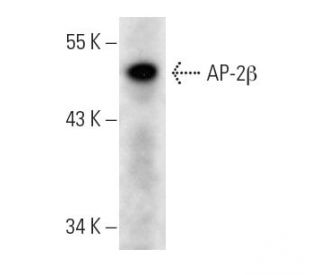


AP-2β (1G6/2): sc-53161. 在非还原条件下, 对 ZR-75-1 全细胞裂解液中 AP-2β 的表达进行 Western 印迹分析.
AP-2β 抗体 (1G6/2): sc-53161
- AP-2β抗体(1G6/2)是小鼠单克隆IgG2b (kappa轻链),规格为200 µg/ml
- 针对截短的AP-2β蛋白
- 推荐用于 mouse, rat 和 human 来源的AP-2β WB 和 IP检测
- m-IgG Fc BP-HRP、 2b BP-HRP">m-IgG2b BP-HRP和m-IgGκ BP-HRP是AP-2β Antibody (1G6/2) 适用于 WB 应用。 的首选辅助检测试剂。这些试剂现与AP-2β Antibody (1G6/2) 打包提供(请参阅下面的订购信息)。

快捷链接
相关产品
描述
基因信息
说明书与实验方案
研究信息
AP-2β抗体(1G6/2)是一种小鼠单克隆IgG2b抗体,可通过蛋白质印迹(WB)和免疫沉淀(IP)等方法检测小鼠、大鼠和人类样本中的AP-2β。AP-2β是AP-2α转录因子的剪接变体,通过与特定DNA序列结合来调节基因表达,从而影响细胞分化、增殖等多种生物学过程。AP-2β (1G6/2) 抗体已被证明可以检测抑制 AP-2α 活性的蛋白质,这种蛋白质会导致与肿瘤发生相关的基因表达改变。AP-2β是OB2-1转录因子复合物的一部分,可上调原癌基因c-ErbB-2的表达,而该基因在25-30%的乳腺癌中过度表达,这凸显了AP-2β在癌症进展中的潜在作用。AP-2β的有害突变与多种发育障碍有关,这强调了AP-2β在正常生理和疾病状态中的重要性。通过与其它转录因子的相互作用和基因表达的调节,AP-2β在理解各种生物学功能和病理的分子机制方面起着至关重要的作用。
仅限研究使用。不适用于诊断和治疗用途。
Alexa Fluor® 是Molecular Probes Inc., OR., USA的商标
LI-COR®和 Odyssey® 是LI-COR Biosciences的注册商标
AP-2β 抗体 (1G6/2) 参考文献:
- GAS41与转录因子AP-2β相互作用,并刺激AP-2β介导的转激活。 | Ding, X., et al. 2006. Nucleic Acids Res. 34: 2570-8. PMID: 16698963
- 转录因子 AP-2β 和 AP-2α 是交感神经祖细胞和分化的交感神经元存活所必需的。 | Schmidt, M., et al. 2011. Dev Biol. 355: 89-100. PMID: 21539825
- 转录因子 AP-2β 通过促进其相互作用伙伴 β-catenin 的降解来抑制宫颈癌细胞的增殖。 | Wang, F., et al. 2017. Mol Carcinog. 56: 1909-1923. PMID: 28277615
- AP-2α和AP-2β在支弓形态形成过程中合作协调同源染色体基因的表达。 | Van Otterloo, E., et al. 2018. Development. 145: PMID: 29229773
- 发育中的小鼠视网膜中 AP-2α 和 AP-2β 的条件性缺失会导致杏仁核细胞镶嵌的改变和视觉功能的破坏。 | Hicks, EA., et al. 2018. Invest Ophthalmol Vis Sci. 59: 2229-2239. PMID: 29715367
- 小鼠小梁网和 Schlemm 管的形成需要 AP-2&beta。 | Akula, M., et al. 2020. Exp Eye Res. 195: 108042. PMID: 32353428
- 转录因子 AP-2&beta 塑造了小鼠的睡眠结构。 | Nakai, A., et al. 2020. Genetics. 216: 753-764. PMID: 32878901
- 转录因子 AP-2beta (TFAP2B) 和 GATA3 在人乳腺上皮细胞中的共表达,对 CK8/18 具有强烈的尖峰免疫反应。 | Raap, M., et al. 2021. J Mol Histol. 52: 1257-1264. PMID: 34117603
- 小鼠眼周间质中 AP-2β 的条件性缺失会改变角膜上皮细胞的命运和分层。 | Walker, H., et al. 2021. Int J Mol Sci. 22: PMID: 34445433
- 从发育中的小鼠小梁网状结构区域删除转录因子 AP-2β 会导致渐进性青光眼变化。 | Taiyab, A., et al. 2022. J Neurosci Res. 100: 638-652. PMID: 34822722
订购信息
| 产品名称 | 产品编号 | 规格 | 价格 | 数量 | 收藏夹 | |
AP-2β 抗体 (1G6/2) | sc-53161 | 200 µg/ml | $322.00 | |||
AP-2β (1G6/2): m-IgG Fc BP-HRP 套装 | sc-536899 | 200 µg Ab; 10 µg BP | $361.00 | |||
AP-2β (1G6/2): m-IgGκ BP-HRP 套装 | sc-534071 | 200 µg Ab; 40 µg BP | $361.00 | |||
AP-2β (1G6/2): m-IgG2b BP-HRP 套装 | sc-549839 | 200 µg Ab; 10 µg BP | $361.00 |