
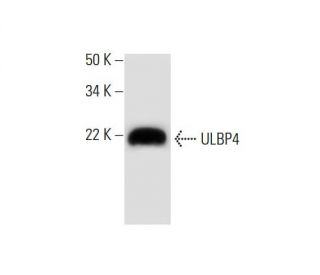
Anticorps ULBP4 (6E6): sc-53133
- L'anticorps ULBP4 6E6 est un monoclonal IgG2b κ L'Anticorps ULBP4, cité dans 11 publications, fourni en 200 µg/ml
- élevé contre des cellules human ULBP4
- L'Anticorps ULBP4 (6E6) est recommandé pour la détection de ULBP4 d'origine human par WB, IP, IF, IHC(P) et FCM
- Anti-L'Anticorps ULBP4 (6E6) est disponible conjugué à l'agarose pour IP; à l'HRP pour WB, IHC(P) et ELISA; et soit à la phycoerythrin ou FITC pour IF, IHC(P) et FCM
- aussi disponible conjugué à l'Alexa Fluor® 488, Alexa Fluor® 546, Alexa Fluor® 594 ou Alexa Fluor® 647 pour WB (RGB), IF, IHC(P) et FCM
- aussi disponible conjugué à l'Alexa Fluor® 680 ou Alexa Fluor® 790 pour WB (NIR), IF et FCM
- également fourni sans azide pour le blocage, sc-53133 L, 200 µg/0.1 ml
- m-IgG Fc BP-HRP, 2b BP-HRP">m-IgG2b BP-HRP et m-IgGκ BP-HRP sont les réactifs de détection secondaire préférés pour l'anticorps ULBP4 (6E6) pour les applications WB et IHC(P). Ces réactifs sont désormais proposés en lots avec l'anticorps ULBP4 (6E6)(voir les informations de commande ci-dessous).

L'anticorps ULBP4 (6E6) est un anticorps monoclonal IgG2b à chaîne légère kappa de souris qui détecte la protéine ULBP4 d'origine humaine par western blotting (WB), immunoprécipitation (IP), immunofluorescence (IF), immunohistochimie sur coupes incluses en paraffine (IHCP) et cytométrie de flux (FCM). L'anticorps ULBP4 (6E6) est disponible sous forme non conjuguée et sous diverses formes conjuguées, notamment agarose, peroxydase de raifort (HRP), phycoérythrine (PE), isothiocyanate de fluorescéine (FITC) et plusieurs conjugués Alexa Fluor®. ULBP4, membre de la famille des protéines de liaison UL16, joue un rôle crucial dans la réponse immunitaire en agissant comme ligand du récepteur activateur NKG2D/DAP10, qui est essentiel pour l'activation des cellules tueuses naturelles (NK) et des cellules T CD8+. L'interaction entre ULBP4 et NKG2D/DAP10 déclenche une cascade d'événements de signalisation qui conduisent à la sécrétion de cytokines, telles que l'interféron-gamma, et favorise la lyse des cellules tumorales. ULBP4 est une protéine ancrée au glycosylphosphatidylinositol (GPI), qui se localise à la surface des cellules et facilite la surveillance immunitaire. L'expression d'ULBP4 sur les cellules stressées ou transformées sert de signal pour la reconnaissance immunitaire, ce qui fait d'ULBP4 un élément essentiel de la défense de l'organisme contre les tumeurs malignes et les infections. Les formes solubles d'ULBP4 peuvent moduler les réponses immunitaires en induisant la phosphorylation de la protéine tyrosine et en activant des voies de signalisation clés, notamment Janus kinase 2, STAT5 et phosphatidylinositol 3-kinase/Akt, ce qui souligne encore l'importance d'ULBP4 dans la régulation immunitaire.
Alexa Fluor® est une marque déposée de Molecular Probes Inc., OR., USA
LI-COR® et Odyssey® sont marques déposées de LI-COR Biosciences
Anticorps ULBP4 (6E6) Références:
- Les ULBP, nouvelles molécules apparentées au CMH de classe I, se lient à la glycoprotéine UL16 du CMV et stimulent la cytotoxicité des NK par l'intermédiaire du récepteur NKG2D. | Cosman, D., et al. 2001. Immunity. 14: 123-33. PMID: 11239445
- ULBP1, 2, 3: nouvelles molécules apparentées au CMH de classe I qui se lient à la glycoprotéine UL16 du cytomégalovirus humain et activent les cellules NK. | Kubin, M., et al. 2001. Eur J Immunol. 31: 1428-37. PMID: 11465099
- Interactions du NKG2D humain avec ses ligands MICA, MICB et les homologues de la famille des protéines RAE-1 de la souris. | Steinle, A., et al. 2001. Immunogenetics. 53: 279-87. PMID: 11491531
- Les protéines de liaison UL16, de nouvelles protéines liées au CMH de classe I, se lient à NKG2D et activent de multiples voies de signalisation dans les cellules NK primaires. | Sutherland, CL., et al. 2002. J Immunol. 168: 671-9. PMID: 11777960
Informations pour la commande
| Nom du produit | Ref. Catalogue | COND. | Prix HT | QTÉ | Favoris | |
Anticorps ULBP4 (6E6) | sc-53133 | 200 µg/ml | $322.00 | |||
ULBP4 (6E6): m-IgG Fc BP-HRP Kit | sc-528552 | 200 µg Ab; 10 µg BP | $361.00 | |||
ULBP4 (6E6): m-IgGκ BP-HRP Kit | sc-520951 | 200 µg Ab, 40 µg BP | $361.00 | |||
ULBP4 (6E6): m-IgG2b BP-HRP Kit | sc-550051 | 200 µg Ab; 10 µg BP | $361.00 | |||
Anticorps ULBP4 (6E6) L | sc-53133 L | 200 µg/0.1 ml | $322.00 | |||
Anticorps ULBP4 (6E6) AC | sc-53133 AC | 500 µg/ml, 25% agarose | $424.00 | |||
Anticorps ULBP4 (6E6) HRP | sc-53133 HRP | 200 µg/ml | $322.00 | |||
Anticorps ULBP4 (6E6) FITC | sc-53133 FITC | 200 µg/ml | $336.00 | |||
Anticorps ULBP4 (6E6) PE | sc-53133 PE | 200 µg/ml | $349.00 | |||
Anticorps ULBP4 (6E6) Alexa Fluor® 488 | sc-53133 AF488 | 200 µg/ml | $364.00 | |||
Anticorps ULBP4 (6E6) Alexa Fluor® 546 | sc-53133 AF546 | 200 µg/ml | $364.00 | |||
Anticorps ULBP4 (6E6) Alexa Fluor® 594 | sc-53133 AF594 | 200 µg/ml | $364.00 | |||
Anticorps ULBP4 (6E6) Alexa Fluor® 647 | sc-53133 AF647 | 200 µg/ml | $364.00 | |||
Anticorps ULBP4 (6E6) Alexa Fluor® 680 | sc-53133 AF680 | 200 µg/ml | $364.00 | |||
Anticorps ULBP4 (6E6) Alexa Fluor® 790 | sc-53133 AF790 | 200 µg/ml | $364.00 |