
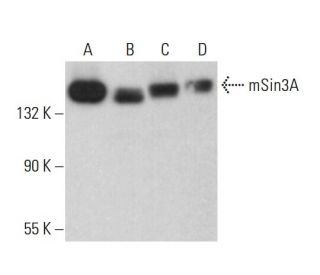
mSin3A Anticorpo (G-11): sc-5299
- mSin3A Anticorpo G-11é um anticorpo monoclonal produzido em camundongo IgG2a κ mSin3A anticorpo, citado em 27 publicações, fornecido em 200 µg/ml
- mapeamento de epítopos dentro da região PAH2 de mSin3A de origem mouse
- mSin3A Anticorpo (G-11) é recomendado para a detecção de mSin3A de mouse, rat e human origem em WB, IP, IF, IHC(P) e ELISA
- Anticorpo anti-mSin3A O anticorpo anti-mSin3A (G-11) está disponível conjugado com agarose para IP; HRP para WB, IHC(P) e ELISA; e com fioeritrina ou FITC para IF, IHC(P) e FCM
- também disponível conjugado com Alexa Fluor® 488, Alexa Fluor® 546, Alexa Fluor® 594 ou Alexa Fluor® 647 para WB (RGB), IF, IHC(P) e FCM, e para utilização com sistemas de imagiologia fluorescente RGB, tais como iBright™ FL1000, FluorChem™, Typhoon, Azure e outros sistemas comparáveis
- também disponível conjugado com Alexa Fluor® 680 ou Alexa Fluor® 790 para WB (NIR), IF e FCM; para utilização com sistemas de deteção de infravermelhos próximos (NIR), tais como LI-COR®Odyssey®, iBright™ FL1000, FluorChem™, Typhoon, Azure e outros sistemas comparáveis
- disponível como reagente TransCruz para ensaios de Gel Supershift e uso em ChIP (sc-5299 X, 200 µg/0.1 ml)
- O m-IgG Fc BP-HRP e o m-IgGκ BP-HRP são os reagentes de deteção secundários preferidos para o anticorpo mSin3A (G-11) para aplicações WB e IHC(P). Estes reagentes são agora disponibilizados em conjuntos com o anticorpo mSin3A (G-11)(ver informações de encomenda abaixo).

LINKS RÁPIDOS
O anticorpo mSin3A (G-11) é um anticorpo monoclonal de cadeia leve IgG2a kappa de ratinho que detecta mSin3A de origem de camundongo, rato e humana através de várias aplicações, incluindo western blotting (WB), imunoprecipitação (IP), imunofluorescência (IF), imunohistoquímica (IHC) e ensaio imunoenzimático (ELISA). O anticorpo mSin3A (G-11) é apresentado em formas não conjugadas e múltiplas formas conjugadas, tais como agarose, peroxidase de rábano, ficoeritrina, isotiocianato de fluoresceína e vários conjugados Alexa Fluor®. mSin3A desempenha um papel crucial na regulação da expressão genética, particularmente na proliferação e diferenciação celular, funcionando como um corepressor na regulação transcricional. mSin3A interage com a família de proteínas Mad, que são essenciais para a repressão de genes alvo quando ligadas ao heterodímero Myc-Max. Esta interação ajuda a manter o equilíbrio entre o crescimento e a diferenciação celular, evitando a proliferação descontrolada que pode levar à tumorigénese. mSin3A contém quatro domínios conservados de hélice anfipática emparelhada (PAH), que são importantes para a interação com as proteínas Mad, especificamente através do segundo domínio PAH (PAH2). Ao ligar a mSin3A ao ADN, os heterodímeros Mad-Max reprimem eficazmente a transcrição, realçando a importância da mSin3A nos processos celulares e as potenciais implicações na biologia do cancro.
Alexa Fluor® é uma marca comercial da Molecular Probes Inc., OR., EUA
LI-COR® e Odyssey® são marcas registadas da LI-COR Biosciences
Referencias do mSin3A Anticorpo (G-11):
- As proteínas Myc e Max possuem actividades transcricionais distintas. | Kretzner, L., et al. 1992. Nature. 359: 426-9. PMID: 1406956
- O complexo modificador da cromatina mSin3A é essencial para a embriogénese e o desenvolvimento das células T. | Cowley, SM., et al. 2005. Mol Cell Biol. 25: 6990-7004. PMID: 16055712
- As oncoproteínas da família Myc funcionam através de uma via comum para transformar células normais em cultura: interferência cruzada por mutantes dominantes Max e trans-acting. | Mukherjee, B., et al. 1992. Genes Dev. 6: 1480-92. PMID: 1644290
- A repressão da transcrição mediada por p53 pelo adenovírus E1B 55-kDa não requer o corepressor mSin3A e as histonas desacetilases. | Zhao, LY., et al. 2007. J Biol Chem. 282: 7001-10. PMID: 17209038
- A modificação metilglioxal de mSin3A liga a glicólise à transcrição de angiopoietina-2. | Yao, D., et al. 2007. Cell. 128: 625. PMID: 17387784
- O exercício físico e a diabetes têm efeitos opostos na montagem e na modificação O-GlcNAc do complexo mSin3A/HDAC1/2 no coração. | Cox, EJ. and Marsh, SA. 2013. Cardiovasc Diabetol. 12: 101. PMID: 23835259
- Repressão transcricional do gene Aurora-A pelo p53 de tipo selvagem através da ligação direta ao seu promotor com a histona desacetilase 1 e a mSin3a. | Yang, TY., et al. 2018. Int J Cancer. 142: 92-108. PMID: 28884479
- A repressão transcricional de Mad-Max é mediada pela formação de complexos ternários com homólogos de mamíferos do repressor de levedura Sin3. | Ayer, DE., et al. 1995. Cell. 80: 767-76. PMID: 7889570
- Um domínio amino-terminal de Mxi1 medeia a atividade oncogénica anti-Myc e interage com um homólogo do repressor transcricional de levedura SIN3. | Schreiber-Agus, N., et al. 1995. Cell. 80: 777-86. PMID: 7889571
- A proteína c-Myc induz a progressão do ciclo celular e a apoptose através da dimerização com Max. | Amati, B., et al. 1993. EMBO J. 12: 5083-7. PMID: 8262051
- Mad: um parceiro heterodimérico de Max que antagoniza a atividade transcricional de Myc. | Ayer, DE., et al. 1993. Cell. 72: 211-22. PMID: 8425218
- Mad3 e Mad4: novos repressores transcricionais que interagem com Max e que suprimem a transformação dependente de c-myc e são expressos durante a diferenciação neural e epidérmica. | Hurlin, PJ., et al. 1996. EMBO J. 15: 2030. PMID: 8617250
Informacoes sobre ordens
| Nome do Produto | Numero de Catalogo | UNID | Preco | Qde | FAVORITOS | |
mSin3A Anticorpo (G-11) | sc-5299 | 200 µg/ml | $322.00 | |||
Pacote do mSin3A (G-11): m-IgG Fc BP-HRP | sc-528154 | 200 µg Ab; 10 µg BP | $361.00 | |||
Pacote do mSin3A (G-11): m-IgGκ BP-HRP | sc-520462 | 200 µg Ab, 40 µg BP | $361.00 | |||
mSin3A Anticorpo (G-11) X | sc-5299 X | 200 µg/0.1 ml | $322.00 | |||
mSin3A Anticorpo (G-11) AC | sc-5299 AC | 500 µg/ml, 25% agarose | $424.00 | |||
mSin3A Anticorpo (G-11) HRP | sc-5299 HRP | 200 µg/ml | $322.00 | |||
mSin3A Anticorpo (G-11) FITC | sc-5299 FITC | 200 µg/ml | $336.00 | |||
mSin3A Anticorpo (G-11) PE | sc-5299 PE | 200 µg/ml | $349.00 | |||
mSin3A Anticorpo (G-11) Alexa Fluor® 488 | sc-5299 AF488 | 200 µg/ml | $364.00 | |||
mSin3A Anticorpo (G-11) Alexa Fluor® 546 | sc-5299 AF546 | 200 µg/ml | $364.00 | |||
mSin3A Anticorpo (G-11) Alexa Fluor® 594 | sc-5299 AF594 | 200 µg/ml | $364.00 | |||
mSin3A Anticorpo (G-11) Alexa Fluor® 647 | sc-5299 AF647 | 200 µg/ml | $364.00 | |||
mSin3A Anticorpo (G-11) Alexa Fluor® 680 | sc-5299 AF680 | 200 µg/ml | $364.00 | |||
mSin3A Anticorpo (G-11) Alexa Fluor® 790 | sc-5299 AF790 | 200 µg/ml | $364.00 |