
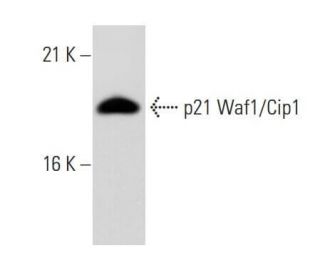


p21 Waf1/Cip1 抗体 (WA-1): sc-51689. 对 HeLa 核提取物中 p21 Waf1/Cip1 的表达进行 Western 印迹分析.
Waf1/Cip1/CDKN1A p21 抗体 (WA-1): sc-51689
- Waf1/Cip1/CDKN1A p21抗体(WA-1)是小鼠单克隆IgG1 κ, 在8篇文献中引用,规格为200 µg/ml
- 针对human来源的p21 Waf1/Cip1蛋白
- 推荐用于 mouse, rat 和 human 来源的p21 Waf1/Cip1 WB, IP, IF 和 IHC(P)检测
- 看 Waf1/Cip1/CDKN1A p21 (F-5): sc-6246,可查看有标记的 Waf1/Cip1/CDKN1A p21 抗体,包括AC, HRP, FITC, PE, Alexa Fluor® 488, 594, 647, 680 和 790
- m-IgG Fc BP-HRP是Waf1/Cip1/CDKN1A p21 Antibody (WA-1) 适用于 WB 和 IHC(P) 应用。 的首选辅助检测试剂。该试剂现与Waf1/Cip1/CDKN1A p21 Antibody (WA-1) 搭配使用(请参阅下面的订购信息)。

快捷链接
相关产品
描述
基因信息
说明书与实验方案
研究信息
関連項目
目前已确定,细胞周期蛋白通过与同源细胞周期蛋白依赖激酶(Cdks)结合并激活,在促进细胞周期转换中发挥积极作用。Cdk2与细胞周期蛋白A, D和E结合,并与哺乳动物中G1期向S期转变的控制有关。一个新的cdk相互作用蛋白,命名为p21 Waf1/Cip1, Cip1或Waf1,已在cyclin A, cyclin D1, cyclin E和Cdk2免疫沉淀中被鉴定。p21 Waf1/Cip1是一种有效的Cdks紧密结合抑制剂,可通过cyclin a - cdk2、cyclin E-Cdk2、cyclin D1-Cdk4和cyclin D2-Cdk4复合物抑制Rb的磷酸化。野生型p53可诱导p21 Waf1/Cip1的表达,而突变型p53则不能。p21 Waf1/Cip1的小鼠同源物命名为CAP20。
仅限研究使用。不适用于诊断和治疗用途。
订购信息
| 产品名称 | 产品编号 | 规格 | 价格 | 数量 | 收藏夹 | |
Waf1/Cip1/CDKN1A p21 抗体 (WA-1) | sc-51689 | 200 µg/ml | $322.00 | |||
Waf1/Cip1/CDKN1A p21 (WA-1): m-IgG Fc BP-HRP 套装 | sc-538942 | 200 µg Ab; 10 µg BP | $361.00 |