
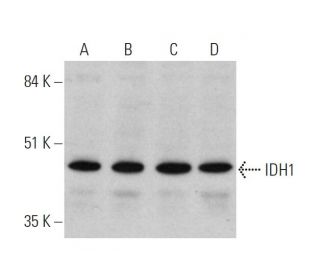
epitope mapping near the N-terminus of IDH1 of human origin
recommended for detection of IDH1 of mouse, rat and human origin by WB, IP, IF and ELISA; also reactive with additional species, including equine, canine, bovine, porcine and avian
IDHC Background Information The Isocitrate dehydrogenase (IDHC or IDH) cytoplasmic enzyme is a homodimer of 416 residues that belongs to the isocitrate and isopropylmalate dehydrogenases family. IDHC catalyzes the third step of the citric acid cycle, which involves the oxidative decarboxylation of isocitrate, forming å-ketoglutarate and CO2 in a two step reaction. The first step involves the oxidation of isocitrate to the intermediate oxalosuccinate, while the second step involves the production of å-ketoglutarate. During this process, either NADH or NADPH is produced along with CO2. Ca2+ can bind to IDHC as a complex with isocitrate, acting as a competitive inhibitor of Mg2+. The IDHC enzyme is inactivated by phosphorylation at Ser-113 and contains a clasp-like domain wherein both polypeptide chains in the dimer interlock. IDHC is expressed in a wide range of species and also in organisms that lack a complete citric acid cycle.
IDH1 (N-20) Product Citations
See how others have used IDH1 (N-20): sc-49996 antibody and or IDH1 (N-20) antibody conjugates.
3 total citations
Loading citations.
IDH1 (N-20)
Click on image to enlarge
IDH1 (N-20): sc-49996. Western blot analysis of IDH1 expression in SW480 (A), HeLa (B) and DU 145 (C) whole cell lysates.
