
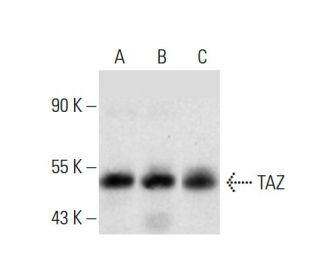

TAZ Antibody (H-70): sc-48805
- TAZ Antibody (H-70) is a rabbit polyclonal IgG; 200 µg/ml
- epitope corresponding to amino acids 161-230 mapping within an internal region of TAZ of human origin
- Discontinued polyclonal antibody

SEE ALSO...
Ordering Information
TAZ (D-8): sc-518026 [ Recommended monoclonal replacement for TAZ (H-70) ]
| Product Name | Catalog # | UNIT | Price | Qty | FAVORITES | |
TAZ Antibody (D-8) | sc-518026 | 200 µg/ml | $322.00 | |||
TAZ Antibody (D-8) AC | sc-518026 AC | 500 µg/ml, 25% agarose | $424.00 | |||
TAZ Antibody (D-8) HRP | sc-518026 HRP | 200 µg/ml | $322.00 | |||
TAZ Antibody (D-8) FITC | sc-518026 FITC | 200 µg/ml | $336.00 | |||
TAZ Antibody (D-8) PE | sc-518026 PE | 200 µg/ml | $349.00 | |||
TAZ Antibody (D-8) Alexa Fluor® 488 | sc-518026 AF488 | 200 µg/ml | $364.00 | |||
TAZ Antibody (D-8) Alexa Fluor® 546 | sc-518026 AF546 | 200 µg/ml | $364.00 | |||
TAZ Antibody (D-8) Alexa Fluor® 594 | sc-518026 AF594 | 200 µg/ml | $364.00 | |||
TAZ Antibody (D-8) Alexa Fluor® 647 | sc-518026 AF647 | 200 µg/ml | $364.00 | |||
TAZ Antibody (D-8) Alexa Fluor® 680 | sc-518026 AF680 | 200 µg/ml | $364.00 | |||
TAZ Antibody (D-8) Alexa Fluor® 790 | sc-518026 AF790 | 200 µg/ml | $364.00 |