
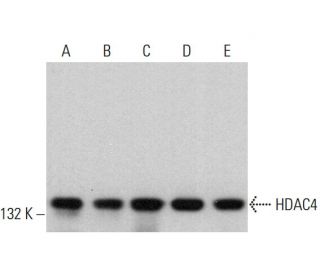
Anticorps Histone Deacetylase 4 (HDAC4) (D-1): sc-48390
- L'Anticorps Histone Deacetylase 4 (HDAC4) (D-1) est un monoclonal de souris IgG1 κ, cité dans 1 publications, fourni en 200 µg/ml
- dirigé contre les acides aminés 530-631 de HDAC4 d'origine human
- recommandé pour la détection de HDAC4 d'origine mouse, rat et human par WB, IP, IF, IHC(P) et ELISA
- Voir Histone Deacetylase 4 (A-4): sc-46672 pour d'autres anticorps conjugués Histone Deacetylase 4 (HDAC4), dont AC, HRP, FITC, PE, Alexa Fluor® 488, 594, 647, 680 et 790.
- m-IgG Fc BP-HRP, 1 BP-HRP">m-IgG1 BP-HRP et m-IgGκ BP-HRP sont les réactifs de détection secondaire préférés pour l'anticorps Histone Deacetylase 4 (HDAC4) (D-1) pour les applications WB et IHC(P). Ces réactifs sont désormais proposés en lots avec l'anticorps Histone Deacetylase 4 (HDAC4) (D-1)(voir les informations de commande ci-dessous).

In the intact cell, DNA closely associates with histones and other nuclear proteins to form chromatin. The remodeling of chromatin is believed to be a critical component of transcriptional regulation and a major source of this remodeling is brought about by the acetylation of nucleosomal histones. Acetylation of lysine residues in the amino terminal tail domain of histone results in an allosteric change in the nucleosomal conformation and an increased accessibility to transcription factors by DNA. Conversely, the deacetylation of histones is associated with transcriptional silencing. Several mammalian proteins have been identified as nuclear histone acetylases, including GCN5, p300/CBP, PCAF (p300/CBP associated factor), HAT1, and the TFIID subunit TAF II p250. Mammalian HDAC1 (also designated HD1), HDAC2 (also designated RPD3) and HDAC3-6, have been identified as histone deacetylases.
Informations pour la commande
| Nom du produit | Ref. Catalogue | COND. | Prix HT | QTÉ | Favoris | |
Anticorps Histone Deacetylase 4 (HDAC4) (D-1) | sc-48390 | 200 µg/ml | $322.00 | |||
Histone Deacetylase 4 (HDAC4) (D-1): m-IgG Fc BP-HRP Kit | sc-536824 | 200 µg Ab; 10 µg BP | $361.00 | |||
Histone Deacetylase 4 (HDAC4) (D-1): m-IgGκ BP-HRP Kit | sc-533991 | 200 µg Ab; 40 µg BP | $361.00 | |||
Histone Deacetylase 4 (HDAC4) (D-1): m-IgG1 BP-HRP Kit | sc-544842 | 200 µg Ab; 20 µg BP | $361.00 |