
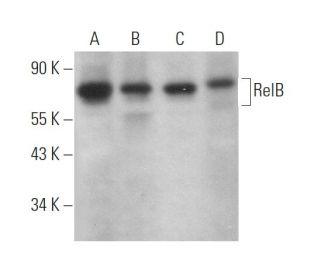
RelB Antibody (C-4): sc-48379
- RelB Antibody (C-4) is a mouse monoclonal IgG1 κ, cited in 2 publications, provided at 200 µg/ml
- raised against amino acids 380-579 of RelB of human origin
- recommended for detection of RelB of mouse, rat and human origin by WB, IP, IF, IHC(P) and ELISA
- See RelB (D-4): sc-48366 for RelB antibody conjugates, including AC, HRP, FITC, PE, Alexa Fluor® 488, 594, 647, 680 and 790.
- m-IgG Fc BP-HRP is the preferred secondary detection reagent for RelB Antibody (C-4) for WB and IHC(P) applications. This reagent is now offered in a bundle with RelB Antibody (C-4) (see ordering information below).

QUICK LINKS
SEE ALSO...
RelB Antibody (C-4) is a mouse monoclonal IgG1 antibody that detects RelB in mouse, rat, and human samples through western blotting (WB), immunoprecipitation (IP), immunofluorescence (IF), immunohistochemistry with paraffin-embedded sections (IHCP), and enzyme-linked immunosorbent assay (ELISA). RelB is a crucial member of the NFκB family of transcription factors, playing a significant role in regulating immune responses, inflammation, and cell survival. anti-RelB antibody (C-4) forms heterodimers with other NFκB subunits, such as p50, to bind to specific DNA sequences and activate transcription of target genes in the nucleus. This nuclear localization allows RelB to exert effects on gene expression in response to various stimuli, including cytokines and stress signals. Additionally, RelB undergoes post-translational modifications, such as phosphorylation, which can influence activity and stability, further underscoring importance in cellular signaling pathways. RelB (C-4) antibody serves as an essential tool for researchers studying NFκB signaling in health and disease, providing insights into function in various biological processes.
Ordering Information
| Product Name | Catalog # | UNIT | Price | Qty | FAVORITES | |
RelB Antibody (C-4) | sc-48379 | 200 µg/ml | $322.00 | |||
RelB Antibody (C-4): m-IgG Fc BP-HRP Bundle | sc-538938 | 200 µg Ab; 10 µg BP | $361.00 |