
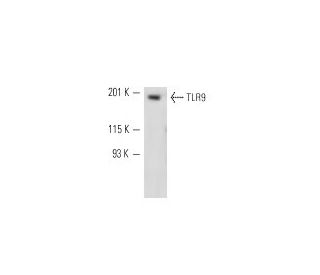

TLR9 Antibody (5G5): sc-47723
- TLR9 Antibody (5G5) is a mouse monoclonal IgG2a λ, cited in 17 publications, provided at 100 µg/ml
- raised against a fusion protein consisting of TLR9 of human TLR9 (residues 1-815)
- recommended for detection of TLR9 of mouse, rat and human origin by WB, IP, IF, IHC(P) and FCM; also reactive with additional species, including canine
- At present, we have not yet completed the identification of the preferred secondary detection reagent(s) for TLR9 Antibody (5G5). This work is in progress.

TLR9 Antibody (5G5) is a mouse monoclonal IgG antibody that detects TLR9 protein of mouse, rat, and human origin by western blotting (WB), immunoprecipitation (IP), immunofluorescence (IF), immunohistochemistry with paraffin-embedded sections (IHCP), and flow cytometry (FCM). Anti-TLR9 antibody (5G5) is available as the non-conjugated form. TLR9 protein plays a crucial role in the innate immune system by recognizing specific unmethylated CpG motifs found in bacterial and viral DNA, which is essential for initiating an immune response. This recognition triggers the activation of various signaling pathways, including the NFκB pathway, leading to the production of pro-inflammatory cytokines and the activation of adaptive immunity. TLR9 is predominantly expressed in immune-related tissues such as the spleen, lymph nodes, and bone marrow, where TLR9 helps to orchestrate the body′s defense against pathogens. TLR9′s ability to detect foreign DNA is vital for the immune system′s ability to distinguish between self and non-self, making TLR9 a key player in maintaining immune homeostasis and preventing autoimmune diseases.
Alexa Fluor® is a trademark of Molecular Probes Inc., OR., USA
LI-COR® and Odyssey® are registered trademarks of LI-COR Biosciences
TLR9 Antibody (5G5) References:
- Host defense mechanisms triggered by microbial lipoproteins through toll-like receptors. | Brightbill, HD., et al. 1999. Science. 285: 732-6. PMID: 10426995
- Three novel mammalian toll-like receptors: gene structure, expression, and evolution. | Du, X., et al. 2000. Eur Cytokine Netw. 11: 362-71. PMID: 11022119
- Cloning and characterization of a sub-family of human toll-like receptors: hTLR7, hTLR8 and hTLR9. | Chuang, TH. and Ulevitch, RJ. 2000. Eur Cytokine Netw. 11: 372-8. PMID: 11022120
- Drosophila Toll and IL-1 receptor. | Gay, NJ. and Keith, FJ. 1991. Nature. 351: 355-6. PMID: 1851964
- Revisiting TLR9 as a target for CLL therapy. | Kortylewski, M. 2021. Blood. 137: 3006-3008. PMID: 34081121
- Dual TLR9 and PD-L1 targeting unleashes dendritic cells to induce durable antitumor immunity. | Fernandez-Rodriguez, L., et al. 2023. J Immunother Cancer. 11: PMID: 37208130
- TLR9 ligand sequestration by chemokine CXCL4 negatively affects central B cell tolerance. | Çakan, E., et al. 2023. J Exp Med. 220: PMID: 37773045
- Cyclical palmitoylation regulates TLR9 signalling and systemic autoimmunity in mice. | Ni, H., et al. 2024. Nat Commun. 15: 1. PMID: 38169466
- Formation of memory assemblies through the DNA-sensing TLR9 pathway. | Jovasevic, V., et al. 2024. Nature. 628: 145-153. PMID: 38538785
- Tlr9 deficiency in B cells leads to obesity by promoting inflammation and gut dysbiosis. | Wang, P., et al. 2024. Nat Commun. 15: 4232. PMID: 38762479
- The Role of TLR7 and TLR9 in the Pathogenesis of Systemic Sclerosis. | Wang, C., et al. 2024. Int J Mol Sci. 25: PMID: 38892317
- A family of human receptors structurally related to Drosophila Toll. | Rock, FL., et al. 1998. Proc Natl Acad Sci U S A. 95: 588-93. PMID: 9435236
Ordering Information
| Product Name | Catalog # | UNIT | Price | Qty | FAVORITES | |
TLR9 Antibody (5G5) | sc-47723 | 100 µg/ml | $322.00 |