
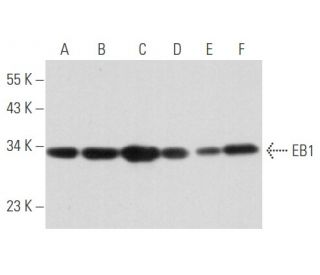
EB1 Anticuerpo (1A11/4): sc-47704
- EB1 Anticuerpo 1A11/4 es un monoclonal de ratón IgG2b κ EB1 Anticuerpo, ver las 23 publicaciones, proporcionado como 200 µg/ml
- criado contra EB1 δC1 mutante
- EB1 Anticuerpo (1A11/4) es recomendado para detectar EB1 de human, canine y monkey origen, mediante WB, IP, IF y IHC(P)
- EB1 Anticuerpo (1A11/4) es disponible conjugado a agarosa para IP; HRP para WB, IHC(P) y ELISA; y tanto a phycoerythrin como a FITC para IF, IHC(P) y FCM
- también disponible conjugado a Alexa Fluor® 488, Alexa Fluor® 546, Alexa Fluor® 594 o Alexa Fluor® 647 para WB (RGB), IF, IHC (P) y FCM
- también disponible conjugado a Alexa Fluor® 680 o Alexa Fluor® 790 para WB (NIR), IF y FCM
- m-IgG Fc BP-HRP, 2b BP-HRP">m-IgG2b BP-HRP y m-IgGκ BP-HRP son los reactivos de detección secundarios preferidos para EB1 Anticuerpo (1A11/4) para aplicaciones WB e IHC(P). Estos reactivos se ofrecen ahora en paquetes con EB1 Anticuerpo (1A11/4)(véase la información de pedido más abajo).

ENLACES RÁPIDOS
VER TAMBIÉN ....
El anticuerpo EB1 (1A11/4) es un anticuerpo monoclonal de ratón IgG2b de cadena ligera kappa que detecta la proteína EB1 de origen humano, canino y de mono mediante western blotting (WB), inmunoprecipitación (IP), inmunofluorescencia (IF) e inmunohistoquímica con secciones incluidas en parafina (IHCP). El anticuerpo EB1 (1A11/4) está disponible tanto en forma no conjugada como en varias formas conjugadas, incluyendo agarosa, peroxidasa de rábano picante (HRP), ficoeritrina (PE), isotiocianato de fluoresceína (FITC) y múltiples conjugados Alexa Fluor®. La EB1, también conocida como proteína asociada a microtúbulos RP/EB miembro 1 de la familia (MAPRE1) o proteína de unión a APC EB1, desempeña un papel crucial en la dinámica de los microtúbulos y es esencial para la correcta división celular y el transporte intracelular. La función de MAPRE1 es especialmente importante en la biología del cáncer, ya que EB1 regula la proteína supresora de tumores poliposis adenomatosa coli (APC), que previene el cáncer colorrectal. Las mutaciones en la APC pueden provocar la pérdida de sus funciones reguladoras, lo que da lugar a una proliferación celular descontrolada y a la tumorigénesis. A través de la unión a la región carboxi terminal de APC, EB1 ayuda a mediar los efectos supresores de tumores, y la desregulación de la expresión de MAPRE1 se ha implicado en varios tipos de cáncer, incluido el carcinoma esofágico de células escamosas. La influencia de EB1 en la estabilidad de los microtúbulos y las interacciones con otras proteínas en las vías de señalización subrayan aún más la importancia de MAPRE1 tanto en los procesos celulares normales como en la progresión del cáncer.
Alexa Fluor® es una marca registrada de Molecular Probes Inc., OR., USA
REIVEW LI-COR® y Odyssey® son marcas registradas de LI-COR Biosciences.
EB1 Anticuerpo (1A11/4) Referencias:
- Las proteínas EB1 regulan la dinámica de los microtúbulos, la polaridad celular y la estabilidad cromosómica. | Tirnauer, JS. and Bierer, BE. 2000. J Cell Biol. 149: 761-6. PMID: 10811817
- Análisis molecular de mutaciones APC en poliposis adenomatosa familiar y carcinomas de colon esporádicos. | Cottrell, S., et al. 1992. Lancet. 340: 626-30. PMID: 1355210
- Determinantes estructurales para el reclutamiento mediado por EB1 de APC y espectraplakinas al extremo plus del microtúbulo. | Slep, KC., et al. 2005. J Cell Biol. 168: 587-98. PMID: 15699215
- CLIP-170 rastrea los extremos crecientes de los microtúbulos mediante el reconocimiento dinámico de sitios compuestos de unión EB1/tubulina. | Bieling, P., et al. 2008. J Cell Biol. 183: 1223-33. PMID: 19103809
- El seguimiento del extremo positivo de los microtúbulos mediante CLIP-170 requiere EB1. | Dixit, R., et al. 2009. Proc Natl Acad Sci U S A. 106: 492-7. PMID: 19126680
- La proteína EB1 de unión al extremo plus de los microtúbulos es necesaria para la diferenciación, elongación y fusión de las células musculares. | Zhang, T., et al. 2009. J Cell Sci. 122: 1401-9. PMID: 19366726
- La proteína EB1 regula la migración y la protrusión de actina en células de melanoma. | Schober, JM., et al. 2009. Cancer Lett. 284: 30-6. PMID: 19427113
- EB1 regula directamente la nucleación de actina mediada por APC. | Juanes, MA., et al. 2020. Curr Biol. 30: 4763-4772.e8. PMID: 33007249
- La crotonilación dinámica de EB1 por TIP60 asegura el posicionamiento preciso del huso en mitosis. | Song, X., et al. 2021. Nat Chem Biol. 17: 1314-1323. PMID: 34608293
- La separación de fases de EB1 guía la dinámica del extremo plus de los microtúbulos. | Song, X., et al. 2023. Nat Cell Biol. 25: 79-91. PMID: 36536176
- APC se une a la nueva proteína EB1. | Su, LK., et al. 1995. Cancer Res. 55: 2972-7. PMID: 7606712
Información sobre pedidos
| Nombre del producto | Número de catálogo | UNIDAD | Precio | CANTIDAD | Favoritos | |
EB1 Anticuerpo (1A11/4) | sc-47704 | 200 µg/ml | $322.00 | |||
Paquete de EB1 (1A11/4): m-IgG Fc BP-HRP | sc-528509 | 200 µg Ab; 10 µg BP | $361.00 | |||
Paquete de EB1 (1A11/4): m-IgGκ BP-HRP | sc-520903 | 200 µg Ab, 40 µg BP | $361.00 | |||
Paquete de EB1 (1A11/4): m-IgG2b BP-HRP | sc-550048 | 200 µg Ab; 10 µg BP | $361.00 | |||
EB1 Anticuerpo (1A11/4) AC | sc-47704 AC | 500 µg/ml, 25% agarose | $424.00 | |||
EB1 Anticuerpo (1A11/4) HRP | sc-47704 HRP | 200 µg/ml | $322.00 | |||
EB1 Anticuerpo (1A11/4) FITC | sc-47704 FITC | 200 µg/ml | $336.00 | |||
EB1 Anticuerpo (1A11/4) PE | sc-47704 PE | 200 µg/ml | $349.00 | |||
EB1 Anticuerpo (1A11/4) Alexa Fluor® 488 | sc-47704 AF488 | 200 µg/ml | $364.00 | |||
EB1 Anticuerpo (1A11/4) Alexa Fluor® 546 | sc-47704 AF546 | 200 µg/ml | $364.00 | |||
EB1 Anticuerpo (1A11/4) Alexa Fluor® 594 | sc-47704 AF594 | 200 µg/ml | $364.00 | |||
EB1 Anticuerpo (1A11/4) Alexa Fluor® 647 | sc-47704 AF647 | 200 µg/ml | $364.00 | |||
EB1 Anticuerpo (1A11/4) Alexa Fluor® 680 | sc-47704 AF680 | 200 µg/ml | $364.00 | |||
EB1 Anticuerpo (1A11/4) Alexa Fluor® 790 | sc-47704 AF790 | 200 µg/ml | $364.00 |