
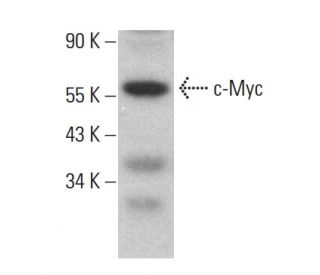
Myc Antibody (9E11): sc-47694
- Myc Antibody (9E11) is a mouse monoclonal IgG2a κ, cited in 98 publications, provided at 200 µg/ml
- raised against amino acids 408-420 within the C-terminal domain of c-Myc of human origin
- Anti-Myc Antibody (9E11) is recommended for detection of c-Myc p67 and c-Myc tagged fusion proteins of mouse, rat, human and monkey origin by WB, IP, IF and IHC(P)
- Anti-Myc Antibody (9E11) is available conjugated to agarose for IP; HRP for WB, IHC(P) and ELISA; and to either phycoerythrin or FITC for IF, IHC(P) and FCM
- also available conjugated to Alexa Fluor® 488, Alexa Fluor® 546, Alexa Fluor® 594 or Alexa Fluor® 647 for WB (RGB), IF, IHC(P) and FCM, and for use with RGB fluorescent imaging systems, such as iBright™ FL1000, FluorChem™, Typhoon, Azure and other comparable systems
- also available conjugated to Alexa Fluor® 680 or Alexa Fluor® 790 for WB (NIR), IF and FCM; for use with Near-Infrared (NIR) detection systems, such as LI-COR®Odyssey®, iBright™ FL1000, FluorChem™, Typhoon, Azure and other comparable systems
- also available conjugated to biotin for WB, IHC(P) and ELISA; and to TRITC for IF, IHC(P) and FCM
- TransCruz reagent for Gel Supershift and ChIP applications (sc-47694 X, 200 µg/0.1 ml)
- m-IgG Fc BP-HRP, m-IgG2a BP-HRP and m-IgGκ BP-HRP are the preferred secondary detection reagents for Myc Antibody (9E11) for WB and IHC(P) applications. These reagents are now offered in bundles with Myc Antibody (9E11) (see ordering information below).

QUICK LINKS
c-Myc Antibody (9E11) is a mouse monoclonal IgG2a kappa light chain antibody raised against amino acids 408-420 of human c-Myc. c-Myc mouse monoclonal antibody (9E11) recognizes an epitope within this region and detects c-Myc-tagged fusion proteins from mouse, rat, and human sources. Anti-c-Myc monoclonal antibody (9E11) demonstrates high suitability for Western blotting, immunoprecipitation, immunofluorescence, and immunohistochemistry on paraffin-embedded tissues. c-Myc (9E11) antibody is available in non-conjugated form and multiple conjugated forms including agarose, HRP, PE, FITC, and various Alexa Fluor® conjugates, offering versatility for diverse experimental needs. The c-Myc protein, encoded by the MYC proto-oncogene on chromosome 8q24, is a nuclear transcription factor that plays a crucial role in regulating cell proliferation, differentiation, and apoptosis. c-Myc contains essential structural motifs in the C-terminal region, such as the basic region, helix-loop-helix, and leucine zipper domains, which are vital for DNA binding and dimerization with Max protein. The c-Myc/Max heterodimer binds to specific E-box sequences (CACGTG) in target gene promoters, activating transcription and promoting cell cycle progression. Overexpression or amplification of the c-Myc gene is a common feature in various human cancers, including Burkitt′s lymphoma, neuroblastoma, and carcinomas of the lung, breast, and colon, leading to uncontrolled cell growth and tumor development. Max can form heterodimers with other basic helix-loop-helix leucine zipper proteins like Mad1 and Mxi1; these complexes can repress transcription by recruiting co-repressors such as mSin3, thereby counteracting c-Myc activity. Understanding the complex regulatory mechanisms involving c-Myc is essential for cancer research and the development of targeted therapies.
Alexa Fluor® is a trademark of Molecular Probes Inc., OR., USA
LI-COR® and Odyssey® are registered trademarks of LI-COR Biosciences
Ordering Information
| Product Name | Catalog # | UNIT | Price | Qty | FAVORITES | |
Myc Antibody (9E11) | sc-47694 | 200 µg/ml | $322.00 | |||
Myc Antibody (9E11): m-IgG Fc BP-HRP Bundle | sc-528507 | 200 µg Ab; 10 µg BP | $361.00 | |||
Myc Antibody (9E11): m-IgGκ BP-HRP Bundle | sc-520901 | 200 µg Ab, 40 µg BP | $361.00 | |||
Myc Antibody (9E11): m-IgG2a BP-HRP Bundle | sc-547113 | 200 µg Ab; 10 µg BP | $361.00 | |||
Myc Antibody (9E11) X | sc-47694 X | 200 µg/0.1 ml | $322.00 | |||
Myc Antibody (9E11) AC | sc-47694 AC | 500 µg/ml, 25% agarose | $424.00 | |||
Myc Antibody (9E11) HRP | sc-47694 HRP | 200 µg/ml | $322.00 | |||
Myc Antibody (9E11) FITC | sc-47694 FITC | 200 µg/ml | $336.00 | |||
Myc Antibody (9E11) PE | sc-47694 PE | 200 µg/ml | $349.00 | |||
Myc Antibody (9E11) Alexa Fluor® 488 | sc-47694 AF488 | 200 µg/ml | $364.00 | |||
Myc Antibody (9E11) Alexa Fluor® 546 | sc-47694 AF546 | 200 µg/ml | $364.00 | |||
Myc Antibody (9E11) Alexa Fluor® 594 | sc-47694 AF594 | 200 µg/ml | $364.00 | |||
Myc Antibody (9E11) Alexa Fluor® 647 | sc-47694 AF647 | 200 µg/ml | $364.00 | |||
Myc Antibody (9E11) Alexa Fluor® 680 | sc-47694 AF680 | 200 µg/ml | $364.00 | |||
Myc Antibody (9E11) Alexa Fluor® 790 | sc-47694 AF790 | 200 µg/ml | $364.00 | |||
Myc Antibody (9E11) B | sc-47694 B | 200 µg/ml | $326.00 | |||
Myc Antibody (9E11) TRITC | sc-47694 TRITC | 200 µg/ml | $326.00 |