
 |
- rabbit polyclonal IgG, 200 µg/ml
- epitope mapping at the C-terminus of CDKN3 of human origin
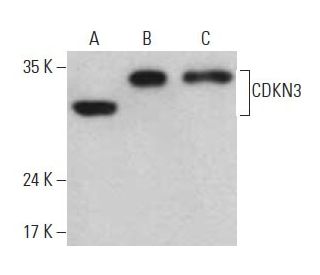
- recommended for detection of CDKN3 p34 of human origin by WB, IP, IF, IHC(P) and ELISA; also reactive with additional species, including canine
- blocking peptide, sc-475 P
|
|
| |
Ordering InformationProduct Citations
Recommended Support Products:
(click button of application of choice)
| |
| Species |
Gene Name |
Gene ID |
Chromosome Location |
Isoform (mRNA) Accession # |
Protein Accession # |
OMIM™ Number |
| Human |
CDKN3 |
1033 |
14q22.2 |
NM_005192 |
Q16667
|
123832 |
| |
CDKN3 Background Information Cyclin-dependent kinase inhibitor 3 (CDKN3), also designated Cdk2-associated dual specificity phosphatase, cyclin-dependent kinase interactor 1 (CDI1), CIP2, KAP or KAP1, belongs to the protein-tyrosine phosphatase family. CDKN3, a cyclin-dependent kinase inhibitor, interacts and dephosphorylates Cdk2 kinase, which prevents Cdk2 kinase activation. CDKN3 is important in cell cycle regulation. It is a dual specificity phosphatase that is active toward substrates which contain phosphotyrosine or phosphoserine residues. CDKN3 does not interact with Cdk4, but can interact with other cyclin-dependent kinases such as Cdc2, Cdk2 and Cdk3. The gene encoding for the CDKN3 protein maps to chromosome 14q22. This gene has been noted to be mutated, overexpressed or deleted in many cancers. Defects in the CDKN3 gene may may be implicated in hepatocellular carcinoma (HCC).
| CDKN3 (C-18) Product Citations |
See how others have used CDKN3 (C-18): sc-475 antibody and or CDKN3 (C-18) antibody conjugates.
3 total citations Loading citations.
|
| |
|
 |
|
CDKN3 (C-18)
Click on image to enlarge
|
|
CDKN3 (C-18): sc-475. Immunoperoxidase staining of formalin-fixed, paraffin-embedded human lung tumor showing cytoplasmic staining.
CDKN3 (C-18): sc-475. Western blot analysis of CDKN3 expression in HeLa whole cell lysate.
CDKN3 (C-18): sc-475. Immunoperoxidase staining of formalin fixed, paraffin-embedded human epididymus tissue showing nuclear staining of glandular cells. Kindly provided by The Swedish Human Protein Atlas (HPA) program.
|
|
Download
|
|
