
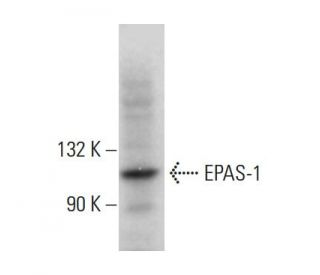


EPAS-1 抗体 (A-5): sc-46691. U-87 MG 全细胞裂解液中 EPAS-1 表达的 Western 印迹分析.
EPAS-1/HIF-2 alpha 抗体 (A-5): sc-46691
- EPAS-1/HIF-2 alpha抗体(A-5)是小鼠单克隆IgG2b κ, 在20篇文献中引用,规格为200 µg/ml
- 免疫human物种的EPAS-1的氨基酸556-865
- EPAS-1/HIF-2 alpha 抗体 (A-5) 推荐用于WB, IP, IF 和 ELISA,检测human 来源的 EPAS-1
- 抗EPAS-1/HIF-2 alpha抗体(A-5)可与琼脂糖结合用于IP;与HRP结合用于WB、IHC(P)和ELISA;与藻红蛋白或FITC结合用于IF、IHC(P)和FCM
- 还可偶联Alexa Fluor® 488, Alexa Fluor® 546, Alexa Fluor® 594 和 Alexa Fluor® 647,用于WB (RGB), IF, IHC(P) 和 FCM, 以及用于RGB荧光成像系统,例如iBright™ FL1000, FluorChem™, Typhoon, Azure和其他类似的系统
- 还可偶联Alexa Fluor® 680 和 Alexa Fluor® 790, 用于WB (NIR), IF 和 FCM; 以及用于近红外(NIR)检测系统,如LI-COR®/Odyssey®, iBright™ FL1000, FluorChem™, Typhoon, Azure和类似系统
- 可用于凝胶迁移和ChIP的TransCruz试剂(sc-46691 X, 200 µg/0.1 ml)
- 目前,我们还没有完成EPAS-1/HIF-2 alpha 抗体 (A-5)的首选二抗检测试剂的鉴定。这项工作正在进行中。

快捷链接
相关产品
描述
基因信息
蛋白序列
说明书与实验方案
研究信息
関連項目
EPAS-1抗体(A-5)是一种小鼠单克隆IgG2b kappa轻链抗体,可通过蛋白质印迹(WB)、免疫沉淀(IP)、免疫荧光(IF)和酶联免疫吸附测定(ELISA)检测人类EPAS-1。EPAS-1 (A-5) 抗体有非结合型和多种结合型,包括琼脂糖、辣根过氧化物酶 (HRP)、藻红蛋白 (PE)、异硫氰酸荧光素 (FITC) 和多种 Alexa Fluor® 结合物。EPAS-1 也称为 HIF-2α,在细胞对缺氧(一种以低氧水平为特征的状态)的反应中起着至关重要的作用。EPAS-1主要位于细胞核中,作为转录因子调节血管生成、红细胞生成和葡萄糖代谢等关键过程的基因表达。EPAS-1能够与其他缺氧诱导因子(如HIF-1β (Arnt 1))形成异二聚体,从而与目标基因启动子中的缺氧响应元件结合,促进基因转录,帮助细胞适应缺氧环境。了解EPAS-1的功能和定位至关重要,因为EPAS-1失调与多种病理状况有关,包括癌症和心血管疾病,这些疾病通常与供氧不足有关。
仅限研究使用。不适用于诊断和治疗用途。
Alexa Fluor® 是Molecular Probes Inc., OR., USA的商标
LI-COR®和 Odyssey® 是LI-COR Biosciences的注册商标
订购信息
| 产品名称 | 产品编号 | 规格 | 价格 | 数量 | 收藏夹 | |
EPAS-1/HIF-2 alpha 抗体 (A-5) | sc-46691 | 200 µg/ml | $322.00 | |||
EPAS-1/HIF-2 alpha 抗体 (A-5) X | sc-46691 X | 200 µg/0.1 ml | $322.00 | |||
EPAS-1/HIF-2 alpha 抗体 (A-5) AC | sc-46691 AC | 500 µg/ml, 25% agarose | $424.00 | |||
EPAS-1/HIF-2 alpha 抗体 (A-5) HRP | sc-46691 HRP | 200 µg/ml | $322.00 | |||
EPAS-1/HIF-2 alpha 抗体 (A-5) FITC | sc-46691 FITC | 200 µg/ml | $336.00 | |||
EPAS-1/HIF-2 alpha 抗体 (A-5) PE | sc-46691 PE | 200 µg/ml | $349.00 | |||
EPAS-1/HIF-2 alpha 抗体 (A-5) Alexa Fluor® 488 | sc-46691 AF488 | 200 µg/ml | $364.00 | |||
EPAS-1/HIF-2 alpha 抗体 (A-5) Alexa Fluor® 546 | sc-46691 AF546 | 200 µg/ml | $364.00 | |||
EPAS-1/HIF-2 alpha 抗体 (A-5) Alexa Fluor® 594 | sc-46691 AF594 | 200 µg/ml | $364.00 | |||
EPAS-1/HIF-2 alpha 抗体 (A-5) Alexa Fluor® 647 | sc-46691 AF647 | 200 µg/ml | $364.00 | |||
EPAS-1/HIF-2 alpha 抗体 (A-5) Alexa Fluor® 680 | sc-46691 AF680 | 200 µg/ml | $364.00 | |||
EPAS-1/HIF-2 alpha 抗体 (A-5) Alexa Fluor® 790 | sc-46691 AF790 | 200 µg/ml | $364.00 |