
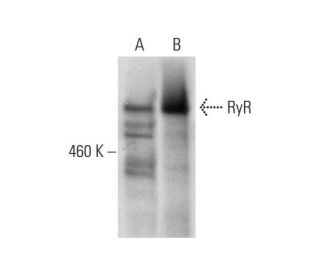


RyR Antibody (F-1): sc-376507
- RyR Antibody (F-1) is a mouse monoclonal IgG1 κ RyR antibody, cited in 11 publications, provided at 200 µg/ml
- raised against amino acids 1-300 mapping at the N-terminus of RyR of human origin
- RyR Antibody (F-1) is recommended for detection of skeletal muscle, cardiac muscle and brain ryanodine receptors of mouse, rat and human origin by WB, IP, IF and ELISA
- Anti-RyR Antibody (F-1) is available conjugated to agarose for IP; HRP for WB, IHC(P) and ELISA; and to either phycoerythrin or FITC for IF, IHC(P) and FCM
- also available conjugated to Alexa Fluor® 488, Alexa Fluor® 546, Alexa Fluor® 594 or Alexa Fluor® 647 for WB (RGB), IF, IHC(P) and FCM, and for use with RGB fluorescent imaging systems, such as iBright™ FL1000, FluorChem™, Typhoon, Azure and other comparable systems
- also available conjugated to Alexa Fluor® 680 or Alexa Fluor® 790 for WB (NIR), IF and FCM; for use with Near-Infrared (NIR) detection systems, such as LI-COR®Odyssey®, iBright™ FL1000, FluorChem™, Typhoon, Azure and other comparable systems
- At present, we have not yet completed the identification of the preferred secondary detection reagent(s) for RyR Antibody (F-1). This work is in progress.

QUICK LINKS
RyR (F-1) is a mouse monoclonal IgG1 kappa light chain antibody that detects RyR protein of mouse, rat and human origin by western blotting (WB), immunoprecipitation (IP), immunofluorescence (IF) and enzyme-linked immunosorbent assay (ELISA). Anti-RyR antibody (F-1) is available as both non-conjugated form, as well as multiple conjugated forms, including agarose, horseradish peroxidase (HRP), phycoerythrin (PE), fluorescein isothiocyanate (FITC) and multiple Alexa Fluor® conjugates. Dihydropyridine receptor (DHPR) is a surface membrane protein critical for the excitation-contraction coupling of striated muscle. DHPR and the sarcoplasmic reticulum ryanodine receptor (RyR) are two key components of the intracellular junctions, where depolarization of the surface membrane is converted into the release of Ca2+ from internal stores. The α1 subunit of DHPR contains a cytoplasmic loop involved in interactions with RyR. Phosphorylation of DHPR α1 subunit plays a role in functional interaction of DHPR and RyR. Mutation in DHPR α1 results in excitation-contraction uncoupling, leading to muscular dysgenesis, a complete inactivity in developing skeletal muscles. Cells lacking RyR expression also lack excitation-contraction coupling and show several-fold reduction in Ca2+ current density.
Alexa Fluor® is a trademark of Molecular Probes Inc., OR., USA
LI-COR® and Odyssey® are registered trademarks of LI-COR Biosciences
RyR Antibody (F-1) References:
- A genetic model for the study of abnormal nerve-muscle interactions at the level of excitation-contraction coupling: the mutation muscular dysgenesis. | Pinçon-Raymond, M., et al. 1990. J Physiol (Paris). 84: 82-7. PMID: 2193149
- Regulation of the RyR channel gating by Ca2+ and Mg2. | Laver, DR. 2018. Biophys Rev. 10: 1087-1095. PMID: 29926426
- The effect of statins on RyR and RyR-associated disease. | Haseeb, M. and Thompson, PD. 2021. J Appl Physiol (1985). 131: 661-671. PMID: 34166122
- The cardiomyocyte firestarter-RyR clusters ignite their neighbours after augmentation of Ca2+ release by β-stimulation. | Demydenko, K. and Roderick, HL. 2022. Acta Physiol (Oxf). 234: e13798. PMID: 35147280
- RyR-mediated calcium release in hippocampal health and disease. | Hidalgo, C. and Paula-Lima, A. 2024. Trends Mol Med. 30: 25-36. PMID: 37957056
- Binding sites of monoclonal antibodies and dihydropyridine receptor alpha 1 subunit cytoplasmic II-III loop on skeletal muscle triadin fusion peptides. | Fan, H., et al. 1995. Biochemistry. 34: 14893-901. PMID: 7578101
- Phosphorylation of dihydropyridine receptor II-III loop peptide regulates skeletal muscle calcium release channel function. Evidence for an essential role of the beta-OH group of Ser687. | Lu, X., et al. 1995. J Biol Chem. 270: 18459-64. PMID: 7629172
- Formation of triads without the dihydropyridine receptor alpha subunits in cell lines from dysgenic skeletal muscle. | Powell, JA., et al. 1996. J Cell Biol. 134: 375-87. PMID: 8707823
- Formation of junctions involved in excitation-contraction coupling in skeletal and cardiac muscle. | Flucher, BE. and Franzini-Armstrong, C. 1996. Proc Natl Acad Sci U S A. 93: 8101-6. PMID: 8755610
- Functional nonequality of the cardiac and skeletal ryanodine receptors. | Nakai, J., et al. 1997. Proc Natl Acad Sci U S A. 94: 1019-22. PMID: 9023375
- A carboxy-terminal peptide of the alpha 1-subunit of the dihydropyridine receptor inhibits Ca(2+)-release channels. | Slavik, KJ., et al. 1997. Am J Physiol. 272: C1475-81. PMID: 9176137
- Ryanodine receptors of striated muscles: a complex channel capable of multiple interactions. | Franzini-Armstrong, C. and Protasi, F. 1997. Physiol Rev. 77: 699-729. PMID: 9234963
Ordering Information
| Product Name | Catalog # | UNIT | Price | Qty | FAVORITES | |
RyR Antibody (F-1) | sc-376507 | 200 µg/ml | $322.00 | |||
RyR Antibody (F-1) AC | sc-376507 AC | 500 µg/ml, 25% agarose | $424.00 | |||
RyR Antibody (F-1) HRP | sc-376507 HRP | 200 µg/ml | $322.00 | |||
RyR Antibody (F-1) FITC | sc-376507 FITC | 200 µg/ml | $336.00 | |||
RyR Antibody (F-1) PE | sc-376507 PE | 200 µg/ml | $349.00 | |||
RyR Antibody (F-1) Alexa Fluor® 488 | sc-376507 AF488 | 200 µg/ml | $364.00 | |||
RyR Antibody (F-1) Alexa Fluor® 546 | sc-376507 AF546 | 200 µg/ml | $364.00 | |||
RyR Antibody (F-1) Alexa Fluor® 594 | sc-376507 AF594 | 200 µg/ml | $364.00 | |||
RyR Antibody (F-1) Alexa Fluor® 647 | sc-376507 AF647 | 200 µg/ml | $364.00 | |||
RyR Antibody (F-1) Alexa Fluor® 680 | sc-376507 AF680 | 200 µg/ml | $364.00 | |||
RyR Antibody (F-1) Alexa Fluor® 790 | sc-376507 AF790 | 200 µg/ml | $364.00 |